
Scissors and Taffeta Silk
Fabric scissors are special scissors; they are to be guarded with vigilance

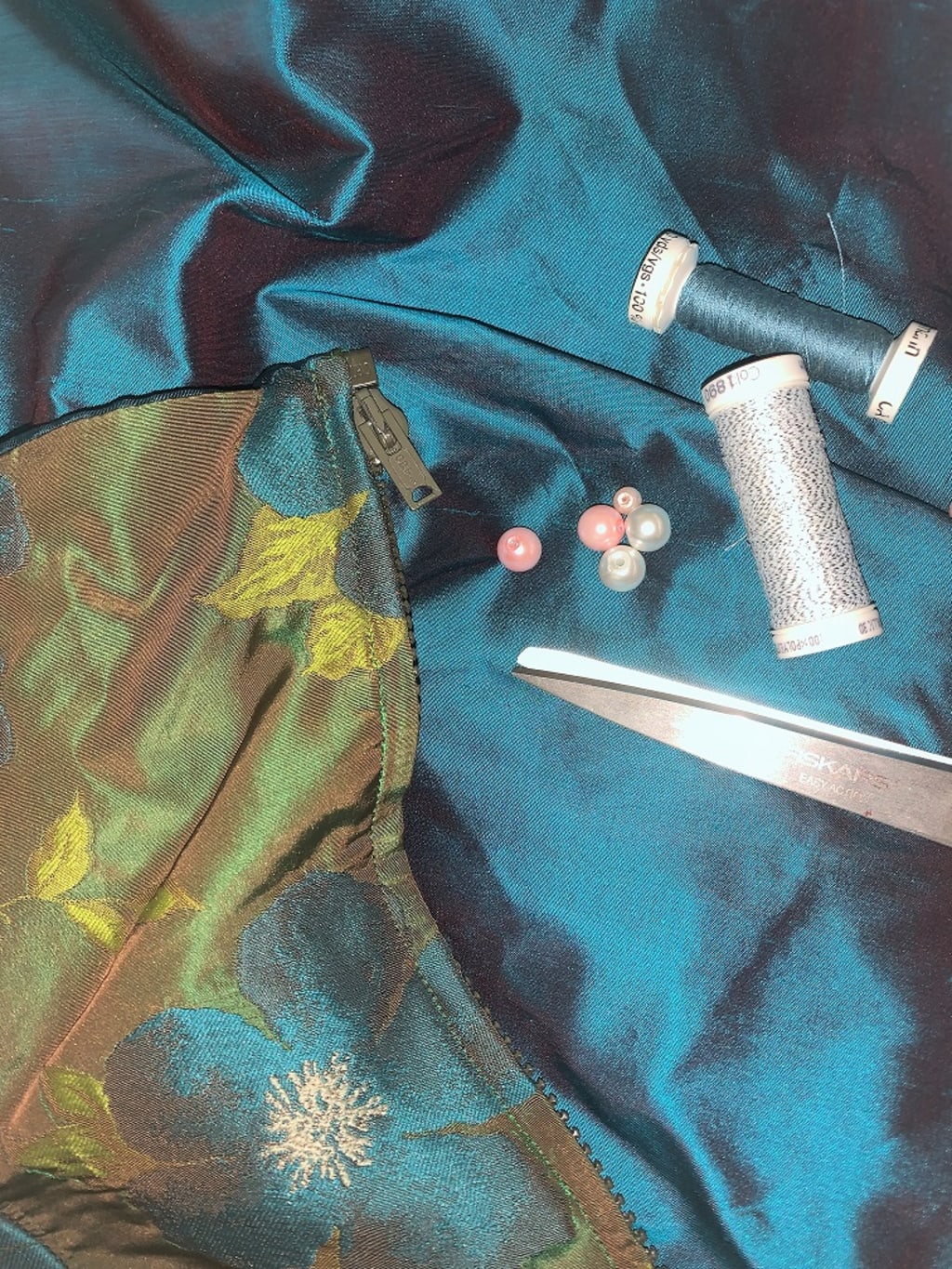
Every dressmakers’ children know that fabric scissors are sacred and holy and should not be used for anything else but fabric and not without prior permission from the proud owner. Dressmakers’ husbands, on the other hand, may “forget” that at times and accidentally commit a deadly sin by using these sacred objects for opening bags of dog food or for cutting off tags from store-bought products. If the respective dressmaker happens to witness this serious offense, a few stern words may create a rather tense moment in an otherwise calm and serene home environment owning to the fact that fabric scissors are special scissors; they are to be guarded with vigilance, so that they remain sharp as a razor allowing them to glide effortlessly through linen, chenille, velvet, and silk.
I learned this indispensable rule of dressmaking from a professional seamstress who had helped me create the most stunning ball gown for a military ball many years ago. I still have the ball gown. It is in a box on the top shelf of my closet, carefully wrapped in tissue paper. The seamstress, Ms. Rose, had these heavy-duty dressmaker’s shears with long blades made from forged steel that certainly never touched anything but the finest cloth. Ms. Rose also had them professionally sharpened every so often by someone who was still well-versed in this ancient craft. This person, this scissor-sharpener, was more of a shadow figure, but Ms. Rose often talked about him and his skills in our little sewing circle.
We met each week at the sewing circle, which was held in a room in the back of a small-town fabric store owned by a good-natured woman named Marina who loved quilts and quilting. Her store was part of her home on Main Street, so on occasion, some of her family members would drop in. To create more clients for herself and more revenue, Marina once had the splendid idea to team up with a professional seamstress, which happened to be Ms. Rose. For a small fee, Ms. Rose would offer advice and a helping hand with any chosen sewing project. Ms. Rose was also a firm believer in shapewear and provided guidance in this area as well ─ no matter if you wanted to hear it or not! Ms. Rose believed that it was just natural to resort to shapewear after a certain age to smoothen out any bumps and lumps, so that the fabric would fall right and accentuate only the good of a womanly figure. When it came to joining Marina’s and Ms. Rose’s sewing circle, there was only one rule: you had to purchase all fabrics and patterns from her store. Aside from her quilting fabrics, Marina carried a large selection of apparel fabrics, including a beautiful iridescent silk taffeta with a complementary flower-embroidered version. I fell in love with the material, and Marina was quick in finding a matching ball gown pattern.
The silk taffeta was quite exquisite and expensive. Ms. Rose helped me cut and fold the pattern so it could be used again for another project. She also taught me how to adjust the pattern to my in-between size. Not only did Ms. Rose believe in shapewear, but she also believed in brand name sewing tools and meticulous preparation before the actual sewing step. Her glass head and silk pins were always extremely sharp and of good quality. The actual step of pinning the pattern onto the fabric was somewhat complicated. I was thankful for Ms. Rose’s experience because some pattern pieces had to be on a fold. Working with the grain of the fabric was also beyond my experience level. Ms. Rose always made sewing look so easy.
When Ms. Rose had a date at night, she would make herself a new pencil skirt before noon on the same day, which she was then rocking with some black back seam tights and stilettos. It was unknown to us if the men in her life appreciated the effort. All of Ms. Rose’s clothes were well made with delicate linings, finished seams, and perfectly sewn buttonholes. This is the promise that sewing holds for many women; well-tailored, beautiful clothes that fit perfectly, a creation of art for one to live their life in, or in my case, to be a princess for a day in a ball gown that suited me. Sewing also holds the promise of community. For centuries, women discussed their personal affairs with other women in sewing circles. This has always been a cathartic outlet for all kinds of marital problems, for weight loss failures, and recipe disasters. Talking about these things helps strengthening bonds between women. The goal is not so much to find solutions but to connect with others. Ideally, you leave with a beautiful garment and recharged batteries that help you get through everyday life for a while.
It took many sessions to complete the ball gown, many sessions where the room was filled with laughter and the smell of coffee and pastries. The iron would turn on and off by itself and always made a clicking noise. At times, the bell on the store’s door rang, and Marina had to rush to the front to help a customer. Sometimes Ms. Rose became a little agitated with her adult sewing students when their limitations in perception did not allow them to imagine the completed garment. There I was in the middle of all of this madness, tables with sewing machines, chatting women, mounts of fabric, and my ball gown slowly started to become a reality. I did cut out many of the fabric pieces myself under the stern observation of Ms. Rose. I was still new to sewing back then and still needed to purchase many essential tools required for sewing, such as a seam ripper and chalk. My first fabric scissors, which I had bought at a craft store on the military base, were actually Easy Action ™ scissors made by Fiskars® that were husband-proof. I loved them because they were super sharp and easy to use.
Now years later, I realize the happiness of the moment in creating this dress, the value of a community I was part of, meeting Marina and Ms. Rose and sharing this experience with two of my closest friends who were also part of the sewing circle. My friend, Heather, always made garments, bags, and aprons using fabric in what she called “berry colors,” shades of mauve, amethyst, mulberry, and grape. She also liked fabrics with owl prints and polka dots. My friend, Erica, worked on a poncho for the longest time. The poncho was made from a red faux fur fabric that would keep her warm and cozy over the winter. Personal choices that match with personalities! To this day, Heather, Erica, and I still talk about our time at the sewing circle in the back of Marina’s store. We still talk about Ms. Rose’s colorful personality and the skills she taught us. As for the dress I had made for myself, I received many compliments for it at the military ball:
“Where did you get it?”
“Oh, I made it myself!”
*looks at me in disbelief…
About the Creator
Keep reading
More stories from writers in Humans and other communities.
Whiskey At Dusk
Guess the whiskey was more important to you in the end, wasn’t it? It was more than the well-being of your friends; more vital than showing up to the places you promised you would and could come to; more critical of a matter than fulfilling your damn responsibilities and getting the press off your back.
By Snarky Lisaa day ago in Humans
Who am I?
I’m in a crowd of people, all I hear is noise surrounding me. Words echo like rolling thunder. Facial expression are vast like waves in the ocean. Im battling to drown out the chaos. This is me, and this is what daily life looks like for me. I am a woman, daughter, sister, mother, partner, friend, confidant, and every single title a woman can carry in a world that we need to be identified in with a word. Do I know who I am? Do these words that describe me, make me who I am? Or do the opinions and perception of others and maybe one. Make me who I am?
By Deana Cabison4 days ago in Humans
The Duelist
The rays of a dying red sun flashed against the onrushing blade. The grey beards say the key to dueling lies in size, speed, reach, righteous fury, whatever the person in front of them pays them to say. Matteo knew better than any it was none of these and had an undefeated record on these sands to prove it.
By Matthew J. Frommabout 10 hours ago in Fiction


Comments
There are no comments for this story
Be the first to respond and start the conversation.