

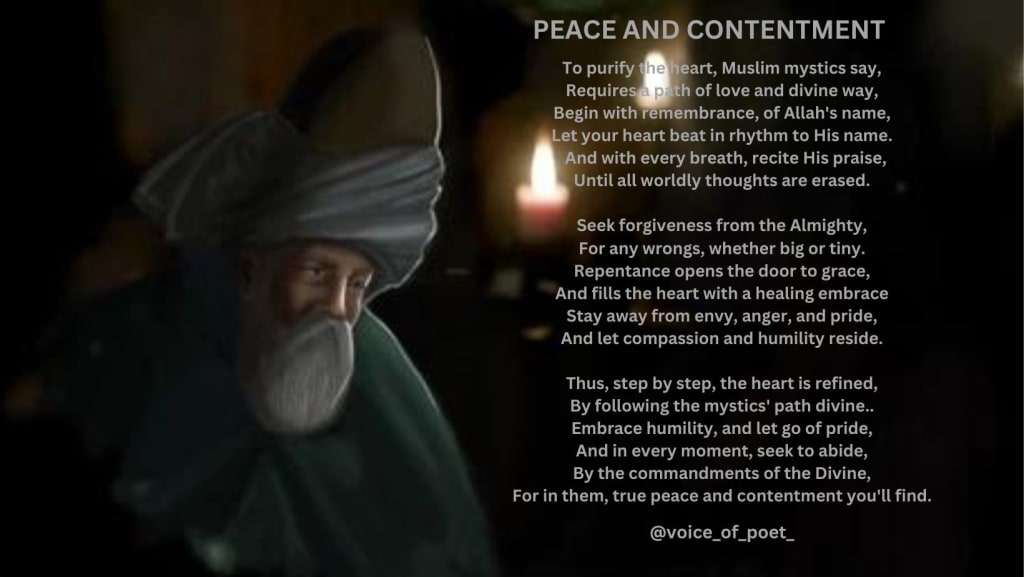
Sufism, the mystical tradition of Islam, has produced many famous and influential poets, philosophers, and spiritual leaders throughout its history. One of the most prominent figures in the world of Sufism is Jalal ad-Din Rumi, a 13th-century Persian poet, and mystic whose teachings and poetry continue to inspire millions of people around the world today.
Rumi was born in 1207 in the city of Balkh, in what is now Afghanistan, and he lived most of his life in present-day Turkey. He was a scholar, theologian, and teacher, but he is best known for his poetry, which explores the themes of love, spirituality, and the search for truth. Rumi's poetry has been translated into many languages and has been widely read and studied by people of all faiths and backgrounds.
Rumi's approach to Sufism was one of inclusivity and love. He believed that the path to enlightenment was not through rigorous adherence to religious dogma or ascetic practices but through love and devotion to God. He taught that the ultimate goal of the Sufi was to become one with God, and that this could only be achieved through the complete surrender of the self to the divine.
One of Rumi's most famous teachings is that of the "whirling dervishes," a practice that originated with his followers after his death. The whirling dervishes are a group of Sufi practitioners who spin around in circles as a form of meditation and devotion. The practice is meant to symbolize the idea of surrendering oneself to the divine and becoming one with God.
Rumi's poetry is filled with imagery and symbolism that reflects his mystical worldview. He often uses the metaphor of the lover and the beloved to describe the relationship between the soul and God. In his poetry, God is portrayed as the ultimate lover, and the human soul is the beloved. The poems explore the themes of longing, separation, and reunion, as the soul seeks to reunite with its beloved.
One of Rumi's most famous works is the Masnavi, a collection of poems that explore the themes of love, spirituality, and the search for truth. The Masnavi is often referred to as the "Quran in Persian" because of its spiritual and moral teachings. The work is divided into six books, each of which explores a different aspect of Sufi philosophy. The Masnavi is still widely read and studied by Sufis and scholars of Islam today.
Rumi's teachings and poetry continue to inspire people around the world today. His message of love and inclusivity has made him a beloved figure not just in the Islamic world but among people of all faiths. His poetry has been translated into many languages and has been widely read and studied by people of all backgrounds. His message of love and devotion to God has resonated with people of all cultures and has helped to bridge the divide between different faiths and beliefs.
In conclusion, Rumi's Sufism was characterized by his message of love and inclusivity, and his poetry continues to inspire people around the world today. His teachings emphasize the importance of surrendering oneself to the divine and becoming one with God, and he believed that the path to enlightenment was through love and devotion rather than through strict adherence to religious dogma. Rumi's message of love and inclusivity has made him a beloved figure not just in the Islamic world but among people of all faiths and backgrounds, and his poetry continues to be widely read and studied today.Overall, Rumi's Sufism emphasizes surrendering oneself to God through love.
About the Creator
BUSHRA TANVIR
I am a poetess and article writer
Keep reading
More stories from BUSHRA TANVIR and writers in Humans and other communities.
YUNUS EMRE [SUFI POET]
Yunus Emre was a 13th-century Turkish poet and Sufi mystic who is widely regarded as one of the greatest poets in Turkish literature. He is known for his powerful poetry that speaks to the hearts and minds of people from all walks of life, and for his teachings on spirituality, love, and the nature of existence. His poems continue to inspire people today, nearly 800 years after his death.
By BUSHRA TANVIR3 years ago in Humans
Bad Parenting
“Mommy, look. I can do it mommy. I can do it. Watch me. Mommy. Mommy!” I heard a young boy shout for attention in the park. He’s wobbling on his little bike, tongue sticking out, one leg down. Another push, and off he goes. Wobbly at first, swerving left and then picks up speed.
By Elizabeth Woodsa day ago in Humans




Comments
There are no comments for this story
Be the first to respond and start the conversation.