
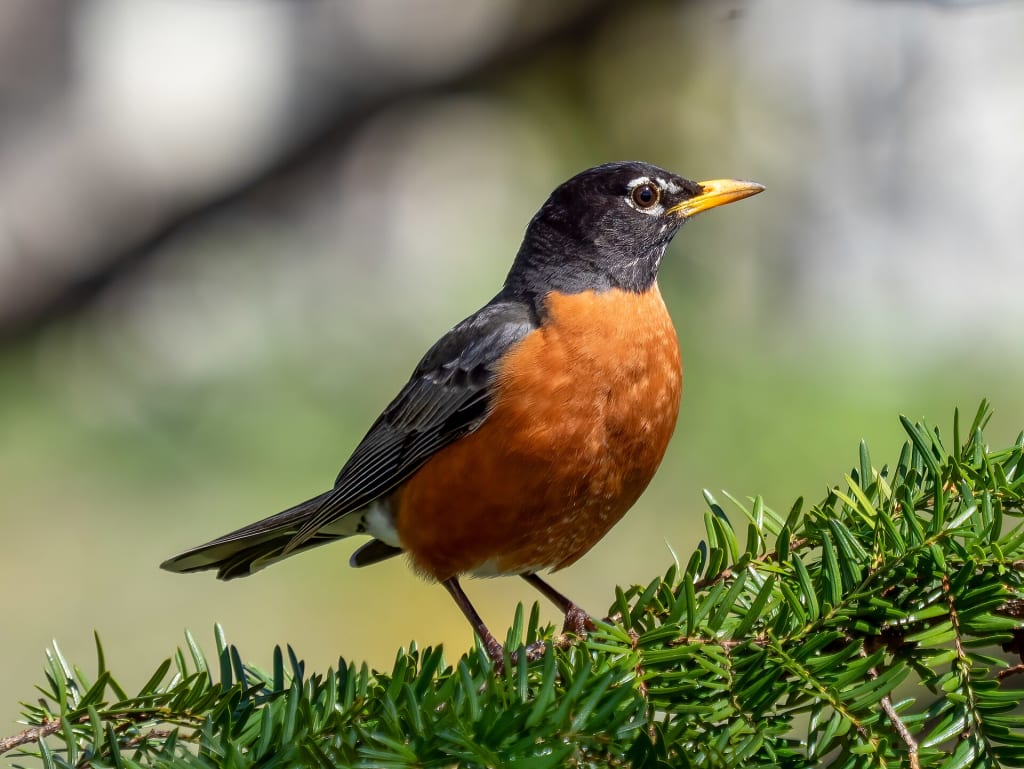
Legend has it that the red on the robin's breast was dyed crimson by the blood of the Lord Jesus.
(I)
In the late 18th century, the nation of Huilaitede underwent a revolutionary transformation. The old aristocracy was forcibly suppressed, gradually withdrawing their sharp edges, biding their time for a comeback. Yet, the momentum of the new nobility surged like a torrent, causing the old nobles, huddled behind rocks counting their coins, to gasp in dismay. They finally realized that the world was no longer dictated by bejeweled young masters and misses.
To preserve themselves, most old nobles chose the humiliating path of intermarriage with the new families they once deemed "only fit to polish their shoes," attaching themselves to powerful clans. Only the vast and influential Ospor family remained standing amidst the falling ranks of their peers. At a social ball hosted by the aristocracy, the Ospor patriarch boldly declared to the head of the Eche family: "As long as a single Ospor breathes in this world, the emerging class will never overthrow the old nobility."
Thus began a century-long covert struggle between the old aristocracy, led by the Ospors, and the new nobility, spearheaded by the Eches.
(II)
"Should I use cadmium yellow here?"
Hurley set his brush on the palette and turned to look at Lance, who stood behind him, contemplating the artwork with his back turned.
"Cadmium yellow is too bright; add some ochre," Lance replied, his gaze still fixed on the painting The Kiss of Judas. Hurley mixed the colors hesitantly as instructed, dabbing the brush lightly onto the canvas. The yellow was indeed perfect.
"How did you know?" Hurley asked, delighted, his sapphire-blue eyes reflecting the sunlight streaming through the stained glass. Lance Eche finally turned around, walked to Hurley's easel, took a large brush, and pointed it at Hurley's face. "I don't know how to mix colors, but I know your painting habits." He scooped generous amounts of ochre and cadmium yellow onto another palette board, slathering them down. Hurley winced. "That paint is expensive! You don't need that much!"
Lance, characteristically self-assured, ignored him and continued, "You're too cautious, in everything you do. No color fits the piece perfectly by itself; you have to be bold in mixing. Watch." He swung his arm, stirring the yellow and ochre together vigorously like paste. The mixture first showed distinct streaks of yellow and brown, then took on a faint reddish hue, like diluted blood, before finally achieving the perfect russet-orange of the robin's breast.
Hurley watched, stunned, clutching his shirt. The instantaneous transformation replayed in his mind, frame by frame – the collision of chemical elements, the blending of oily pigments, each moment dreamlike and magical... He couldn't help but marvel at the wonder of art.
"You can mix other colors from this base; it'll last you the whole painting," Lance said, handing the palette back to Hurley. He glanced casually at the paint splatters on his pearl-grey sleeve and pointed proudly. "Like this."
Though long accustomed to Lance's sharp tongue, Hurley, being two years older, felt slightly undermined by the lecture. The Ospors and Eches had been rivals for generations, and he and Lance, as future heirs, had been compared since infancy – political acumen, business sense, even down to table manners and fashion. They were evenly matched in almost everything, except painting. Hurley had always fallen short against Lance.
For some unknown reason, Leonard Ospor, the current patriarch, adamantly refused to let his eldest son indulge in artistic pursuits. But Hurley was innately sensitive; a single encounter with a masterpiece in a museum had kindled a deep passion for oil painting. However, trapped in a life of constant scheming, his relationship with his father remained strained. The father wanted his son wholly dedicated to the grand task of reviving the family; the son longed for his father to understand his need for relaxation and art. Cut from the same stubborn cloth, neither would yield.
Eventually, Leonard severed all avenues for Hurley to access art or artists. Even the decorative paintings in their mansion were replaced with family photographs. Desperate to learn, Hurley could only "condescend" to secretly seek guidance from Lance, the oil painting expert, under the guise of "academic exchange."
Hurley pondered for a long moment but couldn't find a retort. He swallowed his frustration and focused on finishing his Robin.
"Hey, talking to you," Lance murmured, reappearing silently and clapping a hand on Hurley's shoulder.
Startled, Hurley jumped slightly, replying coolly, "What is it?"
"Lunch here?" Lance looked down at Hurley seated before him. His brow was relaxed, eyelids perpetually drooping slightly, making the question seem casual. Yet, the subtle tension in his pressed lips betrayed his true intent. Sunlight streamed through the window, illuminating the white-tiled studio. Lance's auburn hair caught the light, a single strand at his forehead turning golden.
Hurley was amused by his awkwardness: Just say you want me to stay for lunch, why be so tsundere? He decided to tease him. "No, I have to go tutor Anria." (Using her formal name for effect).
"That won't do," Lance grabbed his hand, pulling him towards the dining room. "It's already made; can't waste it."
Hurley silently chuckled behind him.
The Eche villa spanned four floors, each at least three hundred square meters, with a labyrinthine layout. The journey from the top-floor studio to the first-floor dining room was long and winding. Along the way, Hurley noticed Lance glancing back at him frequently, as if afraid he'd vanish. The attention from the heir of the leading noble family filled Hurley with a sweet, honeyed warmth.
However, seated at the grand dining table, the pleasant illusion was shattered by an exclamation.
"Oh dear!" Penelope, Lance's mother, picked up a damp white napkin and hurried over to Hurley. "Hurley, how did you get paint on your lovely face?"
Before Penelope could wipe it, Hurley pulled a small mirror from his pocket – Leonard insisted he carry one to maintain impeccable appearance, though he rarely used it. Two smudges of ochre paint were perfectly placed on either side of his philtrum, the ends even curving upwards like a whimsical mustache. So that's why Lance kept looking back! He was enjoying the joke!
Hurley smiled graciously as Penelope cleaned his face, thanking her politely. Then, he shot a meaningful look at the sly fox seated opposite him.
The fox, Lance, was sipping blueberry yogurt, waiting for a servant to cut his steak. Sensing he'd been caught, he met Hurley's gaze without a trace of embarrassment.
What are you looking at? I didn't put it there, his pale grey eyes seemed to say.
Hurley had no defense against Lance's audacity. He could only shrug and let the slight pass.
The Eche chef was undoubtedly among the world's finest; even the notoriously picky Lance found every dish impeccable. But as Hurley dined with them more often, Lance noticed something: Hurley only ate light foods – mushrooms, greens, and a few select items – barely touching rich meats or fish.
Could he really be ill? Lance wondered silently.
So, in the lull after Penelope excused herself for a garden stroll and the servants went to fetch Hurley's black horse, Lance got straight to the point: "You're so picky eating. Stomach trouble?"
Hurley stopped dead in his tracks near the entrance hall shoe cabinet. He didn't speak.
Lance, ever direct, stood silently facing him, waiting.
They stood face-to-face in the grand foyer, an awkward tension filling the air.
"...Father said I can't tell anyone," Hurley finally broke the silence, his voice low.
Lance seemed to understand, yet not quite – what was so taboo about dietary habits? Considering the delicate nature of their families' relationship, he didn't press further.
Lance Eche was born with an almost arrogant pride. The mundane socialites of the aristocracy couldn't catch his interest. For his first fifteen years, he had no friends, coupled with a naturally aloof and often rude demeanor that left elders silently fuming. He was profoundly alone. Yet, meeting and getting to know Hurley, his lifelong rival, at his sixteenth birthday banquet, changed everything. Lance found his first true friend. He began learning to consider others, tempering his sharp edges. Penelope was moved to tears, practically ready to adopt Hurley as another son.
But no matter how deep their private bond, publicly, they remained sworn enemies. The boundaries of family divided people into castes. An invisible, intangible chasm still lay between them.
Soon, "Ulrich" was brought around. Hurley swung himself gracefully into the saddle, waved at Lance, and rode out of the Eche villa gates into the quiet afternoon.
Not a cloud in sight.
(III)
Truthfully, Lance had noticed the Ospor heir long before.
He was eight, accompanying his parents to a green golf course... he forgot the exact occasion, likely some tedious social function. He hadn't wanted to go but relented upon hearing he might see "that cute, well-mannered Hurley-something."
Though rivals from birth, their actual meetings were rare, let alone conversations. Lance rarely attended events, content within his vast villa's walls. Rumors also said Young Master Hurley was frail, his family hesitant to take him out. What illness? Why? Leonard Ospor kept such details strictly guarded.
Every young noble had a childhood pony. Lance's was named "Tut." The origin was absurd. For Lance's fifth birthday, his uncle brought a fine Barb stallion. The white horse refused to stay in its stall, constantly straining against its halter, sputtering ("Tut-tut-tut!") at anyone nearby. Even professional grooms struggled. As a last resort, they brought Lance, hoping for some owner-horse bond. Miraculously, though sprayed with slobber, the equally strong-willed Lance decisively spat back ("Tut-tut-tut!"). The horse calmed down. Penelope shrieked, rushing over with her skirts gathered to wipe his face. His uncle roared with laughter: "Lance and this horse are two peas in a pod! Let's call him 'Tut'!" And so it was.
Compared to the spitting, temperamental Tut, Hurley's Ulrich was docile to a fault.
Pure black, lean, its slightly long mane gleaming healthily in the three o'clock sun, it stood motionless beside the field, its young master beside it. This seemed Hurley's first major outing; he looked timid, his sapphire-blue eyes, clear as amber, darting nervously around. He wore a white short-sleeved shirt, blending into the distant clouds from afar. Leonard wasn't with him; only two expressionless maids stood nearby. They hovered on the crowd's periphery, isolated from the buzz.
Lance couldn't quite describe the feeling seeing him evoked. He instinctively felt he should go keep him company.
He lacked experience with friendly interaction. He worried his sharp tongue might make the fragile-looking boy cry.
Lance paced anxiously, his stiff leather heels nearly grinding the tender grass beneath. Mustering courage, he started towards Hurley, only to be intercepted by a man in a tailored suit. Worse, Hurley seemed pleased, offering the man a slight smile!
Something dared to thwart Lance Eche's wishes.
Furious, he stomped hard on the turf, leaving a dent in the meticulously maintained slope. Groundskeepers nearby winced but dared not protest.
Lance took a deep breath, opened his eyes, and saw not the golf course sky, but a pair of gleaming O'Keeffe shoes.
"Dear Mr. Eche, may I offer you a toast?" A mustachioed middle-aged man smiled, raising his glass.
Who is this? Annoying, Lance thought.
He glanced at his wristwatch. Only five minutes had passed since he'd escaped the crowd seeking conversation by slipping into this secluded hallway, yet it felt like an eternity.
Memories are fleeting.
Even a staunch materialist like Lance couldn't help but wonder if his twenty-five years of offending people had angered God, depriving him of joy.
The man, seeing Lance stare at his watch silently, opened his mouth to speak again. Lance raised a hand, cutting him off. Those who knew him recognized this habitual gesture of dismissal.
Leonard Ospor raised an eyebrow almost imperceptibly, his broad smile unwavering, and walked away.
He looked supremely confident.
This Ospor ball wasn't merely social; its true purpose was to flaunt Hurley's success in establishing the "Orenbeller" industrial branch in Franc City, a flex of muscle against the new nobility.
More intriguing than speculating on Leonard's latest veiled threats was the prospect of seeing the long-secluded heir, Hurley. After coming of age, he had vanished into the Ospor mansion for nine years. Leonard claimed he was pursuing advanced studies in Economic Management, too occupied for distractions, even cutting off correspondence. While others praised this diligent, self-sacrificing heir bearing the family's revival, Lance thought Leonard was spouting nonsense.
Hurley was methodical, understanding the need for balance – why else sneak out for painting lessons? Besides, with the Ospor family's rapid rise and tensions brewing within the new nobility, the heir needed to navigate treacherous waters, understand alliances, not lock himself away for nine years studying useless theory. Even if Hurley were an idiot, he wouldn't abandon everyone he knew. Lance had sent letters; all were returned by the butler with rehearsed, polite refusals. Sometimes, Hurley's disappearance felt so complete – Lance almost feared he was dead. Hurley always found ways to unsettle Mr. Eche.
So, filled with questions and anticipation, Lance dressed impeccably for tonight's event.
(IV)
"Mr. Ospor, that brooch suits you perfectly," the butler, Li, said respectfully, standing beside the mirror.
Hurley deliberately pinned the small silver robin brooch at a 45-degree angle, making it appear as if struggling against its clasp, yearning for the sky.
"It's beautiful, but lacks one thing," he admired the little bird in the mirror. "It needs a ruby accent."
At nineteen, he had embraced Christianity. Legend held that as Jesus hung on the cross, a robin perched on his shoulder, its breast feathers stained crimson by his blood. Hurley vaguely recalled Lance demonstrating how to mix that very color in their youth. The thought struck him – it had been nine years since they last spoke.
He drifted for a fleeting moment, then quickly composed himself. Accompanied by Li, he walked towards the dazzling grand ballroom.
Hurley was unprepared for Lance's presence.
What was this proud recluse doing here, personally attending his father's boastful affair?...
Thankfully, Lance was absorbed in his drink across the room, unaware of Hurley's gaze.
"Sir, the Master insists you dance with Miss Hill at least once tonight," Li murmured from two paces behind. Hurley gave an ambiguous, noncommittal hum.
Both men were tall and striking, drawing immediate attention upon entering.
"Look! It's Mr. Hurley!"
"Ah... devastatingly handsome."
"So many will bring gifts... will mine seem too plain?"
Like a wolf scenting prey, Lance snapped his head up, glass clenched. His sharp gaze locked onto the radiant figure at the center of the constellation.
The man wore immaculate beige. A silver brooch glinted on his left lapel, its detail unclear from this distance. His shirt was buttoned to the top, a stark black cravat adding weight. Lips pale pink, nose aquiline, eyes piercing, his neatly combed golden hair parted 2/8 at the forehead. Impeccable.
Hurley was still Hurley, yet Lance sensed a difference.
He started forward, ready to demand answers about the past nine years, but the large, mustachioed Leonard inconveniently appeared beside a microphone, calling for quiet.
"Ladies and Gentlemen, good evening..." Leonard, though past fifty, was robust. His voice carried the steady authority of age, untouched by frailty.
Lance seethed, forced to listen to the drivel. He couldn't push through the stationary crowd. He drowned his fury in champagne, glass after glass.
Half an hour later, Leonard's veiled speech ended. The gift exchange began.
Perhaps the champagne had fogged his mind; Lance missed his chance to reach Hurley. Gavin Hill got there first.
Under Lance's venomous stare, a group of men in black suits wheeled a green-draped object to the center of the room. The crowd instinctively formed a circle.
"Leonard mentioned your faith, Hurley," Gavin said genially, wrinkles crinkling around his eyes. He took Hurley's hand with one of his and slowly lifted the drape with the other. "I present this Kiss of Judas to you. May all ugliness and betrayal flee from you henceforth. May our Hurley embrace the light and a bright future."
Even Lance, jostled at the crowd's edge, saw Hurley flinch backward as the drape fell away.
The Kiss of Judas depicted Jesus's betrayal. Judas, for thirty pieces of silver, identified Jesus to the Roman soldiers with a kiss. Cold tones dominated, starkly contrasting justice and evil, light and darkness.
In the art world of the time, the painting was widely interpreted as a hymn to the greatness of the Truth Jesus represented.
Yet, Hurley had abandoned his truth to follow Jesus.
Hurley lacked Lance's freedom to ignore unpleasant people or refuse distasteful tasks. He was cautious, constantly reading others, fearful of missteps, bending as far as he could within his limits to please. Without this, he wouldn't be the celebrated "Mr. Ospor" today.
He suffered from a hereditary gastritis passed down his lineage. It was severe in childhood; if other children were coddled, Hurley was fed pills. The condition wasn't life-threatening, but significant. Hurley had always shown exceptional intellect and bearing, and Leonard had earmarked him as heir since infancy. The other nobles agreed. So, Leonard fiercely guarded the secret of Hurley's illness, his mind sharp and suspicious as a needle point: What if someone poisoned him? What if they tampered with his medicine through the family doctor? Hurley's life was already fragile – Leonard had spent fortunes to save him as a child. And then, he fell in love with oil painting.
In the 19th century, oil paints were crude, often containing toxic elements. Without proper ventilation, fumes could cause asthma, pneumonia, or even fatal respiratory infections. Having nearly lost his son once, Leonard couldn't risk another tragedy. He blocked Hurley's access to art at any cost, becoming the wedge driving father and son apart.
As the stalemate persisted, Hurley came of age. His "gift" was the news of his younger brother's descent into severe autism.
The Ospors had only two sons, both afflicted. Nearing fifty, Leonard faced the stark reality of his lineage. Beyond being a shrewd capitalist, he was a devoted husband and father. But the dual pressures of his sons' conditions and the volatile economy pushed him to the brink. He couldn't lash out at his gentle wife or daughter; his younger son needed solace. So, Leonard's pent-up rage exploded onto Hurley, whose health had stabilized. He struck him, grabbing his collar and throwing him down, deliberately smashing treasured bottles of wine.
Hurley lay amidst dark liquor and shattered glass, stunned. He understood: his father aged, his brother suffered, the family desperately needed him. The Ospor revival rested on his shoulders alone.
That night, Hurley sat alone in his room. No one knew what transpired, but the next day, he was transformed. He began meticulously grooming himself like other young nobles, apprenticing at his father's factories, studying economics, cultivating future allies, even embracing Christianity... Yet he refused all outside contact henceforth.
Leonard, seeing his son's transformation, rejoiced, gathering the family for celebration. At dinner, Hurley formally apologized to Leonard, condemning his youthful rebellion and ignorance, asking his father to overlook the past and guide him in his duties.
Polite, yet distant. Less like father and son, more like business partners.
Endure. Submit. – The mantra echoed constantly.
Lost in self-deception, Hurley almost convinced himself he truly revered Jesus, genuinely sacrificed his self for the family.
But as The Kiss of Judas was unveiled under the chandelier's glare, his own ugliness struck him.
Who has no self-interest? Judas betrayed the Father of Truth for silver. Hadn't young Hurley betrayed his family's duty for fleeting joy? Judas was no true believer; neither was Hurley. He used Christianity as a shield, a justification to abandon his dreams, a tool for navigating society's treacherous waters.
He was not the light-embracing "Mr. Ospor." He was Judas, dwelling with betrayal and darkness.
He had betrayed Jesus. More profoundly, he had betrayed himself.
(V)
"Stop! Where have you been all these years?" Lance shouted, sprinting into the moonlit garden, propriety abandoned.
Ahead lay a large artificial lake, holding a perfect reflection of the moon. Hurley finally stopped, bending over, hands on knees, gasping for breath. He looked up to see Lance trampling prized flowers, cutting diagonally towards him.
Two minutes earlier, Hurley had abruptly pleaded illness, deftly deflecting eager invitations. Once out of the ballroom, he strode purposefully away. The venue was Leonard's choice; Hurley knew its maze of corridors. He quickly lost persistent followers, except for Lance, who doggedly navigated the turns. Just as Lance reached out to grab him, Hurley broke into a run, fleeing like a ghost.
"Go away," Hurley ordered coldly.
Lance swept his wind-tousled hair back fiercely. "Answer me first. Where were you?" Irrationally, the image of this impeccably dressed gentleman overlapped with the timid, wide-eyed child on the golf course seventeen years ago, sapphire eyes shining in the dark. Lance couldn't bring himself to be angry; he forced calm into his voice. "Hurley, I'm the only one who came this far, the only one chasing you. I'm not like those sycophants. You know me. I'd never breathe a word... Or do you think I'm unworthy of knowing?"
Hurley straightened up. His gaze wandered over the ground, resting on roses crushed into the soil, a flicker of pity in his eyes. Then, he met Lance's intense stare without flinching.
"Mr. Eche," Hurley began, perhaps warmed by running, unbuttoning his jacket. "I've been well these years, but exceedingly busy. I neglected to contact you. My apologies for causing concern."
"You used to call me Lance," Lance murmured softly, his brows forming a faint '八'.
Hurley had always been weak to this feigned vulnerability. The contrast with Lance's usual haughty indifference was jarring, stirring an urge to cradle this rare fragility.
Lance, despite his sharp edges, possessed a fiercely loyal heart. At least he faced himself honestly, followed his impulses. Moreover, nearly all of Hurley's youthful joy was tied to Lance: Lance reaching out first, Lance patiently teaching him, Lance genuinely asking about his health without agenda...
Lance represented the purest, most innocent chapter of his life. That's precisely why he dared not touch it again.
He feared. Feared that Jesus wouldn't conquer Judas. Feared he might falter, rendering nine years of swallowed bitterness and sacrifice meaningless.
So, in the gentle evening breeze, within the quiet garden, Mr. Ospor pronounced the sentence: "Mr. Eche, I am merely a self-serving mediocrity, the 'vermin' you speak of. I apologize for troubling you with my youthful ignorance. I shall trouble you no more. Goodbye."
He offered Lance a perfectly polite, utterly impersonal smile.
Lance stood frozen, thunderstruck, mouth slightly agape, breathing air. He didn't even register Hurley walking away.
When he turned back, the vast garden held only him.
(VI)
In the early 1840s, Hurley Ospor successfully established the "Orenbeller" industrial branch in northwestern Huilaitede. The Ospor family subsequently executed a 180-degree strategic pivot, rocketing to the top of the industry rankings.
Hurley Ospor proved a capable manager. While excelling at the branch, he also assisted his increasingly weary father, Leonard, with the Orenbeller headquarters. He revitalized the old guard with fresh talent; the young brought innovative ideas for profitable transformation, while the veterans' expertise ensured quality, bolstering the company's reputation. "Orenbeller" entered countless homes. The eagle-head logo became synonymous with the mustachioed patriarch Leonard and the perpetually debonair heir, Hurley.
Hurley's wedding to Miss Hill was set for May 16th, 1847. Before then, he made an exceptional request to his father.
"Mr. Gavin Hill gifted me a famous painting to celebrate the branch's success," Hurley, now thirty-two, spoke with increasing "Leonard-esque" formality. "I wish to paint an oil myself for Miss Hill in return, as a token of my sincerity. I will paint in a ventilated area. Please rest assured."
Leonard turned from the window – his eyes were deeply lined, lower lids sagging, temples greying, his face etched with age. "Very well. But be careful, child. Don't let the paint touch your skin."
On May 7th, Hurley took his painting supplies alone to the cliffs of Demor Sea.
It was a clear day, cloudless. Hurley stood on a sea cliff, listening to waves crash against rocks, watching seabirds skim the sand.
He began.
He set up a large easel nearly his own height, positioned the canvas and paints, prepared the palette.
With a large brush, he scooped generous dollops of ochre and cadmium yellow, slathering them onto the wooden palette. He swung his arm, stirring the yellow and ochre together vigorously like paste. The mixture first showed distinct streaks of yellow and brown, then took on a faint reddish hue, like diluted blood, before finally achieving the perfect russet-orange of the robin's breast.
He forgot himself, forgot caution. He slashed and splashed wildly. His realistic Robin became abstract, hovering between reality and void.
Hurley lost himself in art again, oblivious to time.
By the time he finished, it was three in the afternoon.
A fierce sea wind whipped his golden hair wildly. But it wasn't enough. He craved freedom – unshackled, unrestrained freedom! Freedom undefined by man or religion! Freedom as boundless and joyful as a bird in flight!
The easel toppled violently in the gale. The Robin, caught by the roaring wind, soared up and plunged towards the cliff edge.
Hurley lunged after it. Reaching the precipice, waves roared below, wind screamed. He felt like a sprinter before a roaring crowd, about to cross the finish line!
A sharp clink – his watch struck the silver cross pendant on his chest. In the split second before The Robin vanished over the edge, Hurley ripped the chain free and flung it down. Then, he laughed aloud, spread his arms wide, and followed the robin into the vast, blue sea.
A fisherman, laden with his catch, saw a flash of white plunge from the sea cliff in the distance. It seemed to be chasing something – a robin?
The wind and waves were too loud. Even close to shore, the fisherman didn't hear the impact. He only glimpsed a tiny splash before it was swallowed by the churning sea, leaving no trace.
The fisherman paid it no further mind. He hoisted his bag of fish and headed home, humming a tune.
Behind him, the waves crashed endlessly.
(VII)
Hurley had prepared meticulously.
He had planned this leap for five years: establishing a self-sustaining system at Orenbeller, ensuring operations continued smoothly even if one part faltered; training two capable deputies to manage the factory alongside his sister Anria, preventing any single authority; securing the loyalty of key nobles with generous profit shares, seeking neutrality, not support.
Yet, he departed abruptly, leaving no words behind. Why he jumped, his unfulfilled wishes, any message for anyone – Leonard would never know.
At the somber funeral, all nobles who attended that fateful ball were present. Leonard, burying his child, wept openly. Only the Eche family was missing one member—
Lance awoke from a three-day stupor in his lavish bed, eyes gritty and bloodshot. He struggled upright, found no slippers, and walked barefoot on the cold tiles to the floor-to-ceiling window.
He yanked open the heavy curtains. Sunlight flooded in, illuminating swirling dust motes. Lance waved irritably, unable to dispel the floating specks.
Inside, five or six empty bottles lay scattered; the room reeked of alcohol. Outside, the sky was a clear, pristine blue – like his eyes.
Lance didn't know what had happened to Hurley. He only knew one thing for certain: Hurley had been profoundly unhappy for the past nine years. The boy who watched paint mixing with wide-eyed wonder, who unknowingly painted himself a comic mustache, who toiled relentlessly for fourteen years for his family's revival – that man would not have surrendered life lightly.
He burned to know everything – Who had driven Hurley to this? Who had stolen the innocent boy? But what use was it? Even the powerful Leonard remained baffled by his own son's death. What right did an outsider have to demand answers?
Hurley Ospor truly became like that little robin. Chasing some distant, pure refuge, he hurled himself fearlessly into the churning sea, steadfast and resolute unto death.
All that remained for the world were countless, enigmatic old legends.
(VIII)
Dusk settled. Work hours ended.
A young boy skipped out of a building bearing an eagle-head logo, navigating confidently through the city's towering structures. Dense traffic blared horns, filling the streets with life. A street musician strummed a guitar, playing an unfamiliar folk tune. Groups of university students laughed and chatted, their backpacks all stamped with a small inscription: "Orenbeller."
The boy reached his doorstep, about to call for his brother, when something in the neighboring shop window caught his eye.
A modest-sized storefront bore a sign in elegant script: Eche Gallery.
Drawn by the vibrant oils displayed, the boy entered quietly.
A boy of about fifteen sat stiffly upright on a wooden chair, spine straight as a pine. He held an antique wooden palette smeared with a large patch of russet-red paint. He'd clearly been painting for some time. Hearing the entrance, he turned. Pale grey eyes regarded the visitor silently.
"Excuse me," the younger boy said shyly. "Your painting is beautiful. Could you teach me?"
The older boy, interrupted, felt a flicker of annoyance. But seeing the younger boy's sapphire-blue eyes, clear as gemstones, his heart softened. He pulled out sketch paper and a pencil. "Try this first. I need to see if you're talented enough to be worth teaching." He pointed towards the window on the right. "Draw that."
The younger boy followed his finger. Perched on the windowsill was a plump robin. The distinctive patch of feathers on its breast glowed a deep, unmistakable red in the setting sun.
About the Creator
Keep reading
More stories from zhimin wang and writers in Humans and other communities.
The CEO of Everything
They say "jack of all trades, master of none," but they forgot to mention the part where the jack of all trades is also the camera woman, the makeup artist, and the person currently yelling at a tangled Wii microphone cable in a her own bathroom while recording herself singing and trying to make it look realistic and professional. (As professional as you can make it with nothing but a cell phone camera and a mic that doesn't work)
By Sara Wilson7 days ago in Humans
Rachel Reviews: The Spiral Archive by Pieter Hendrik
It's difficult for me to know where to start with a review of this book as it was, for me, an entirely unique experience and one that I'll probably never have again. I don't want that to be interpreted as unenjoyable but it has left me scratching my head a little and ruminating on its content, its themes and its characters.
By Rachel Deeming7 days ago in BookClub



Comments
There are no comments for this story
Be the first to respond and start the conversation.