
Respect Your Qualifiers
The value of acknowledging that we only sort of maybe know things

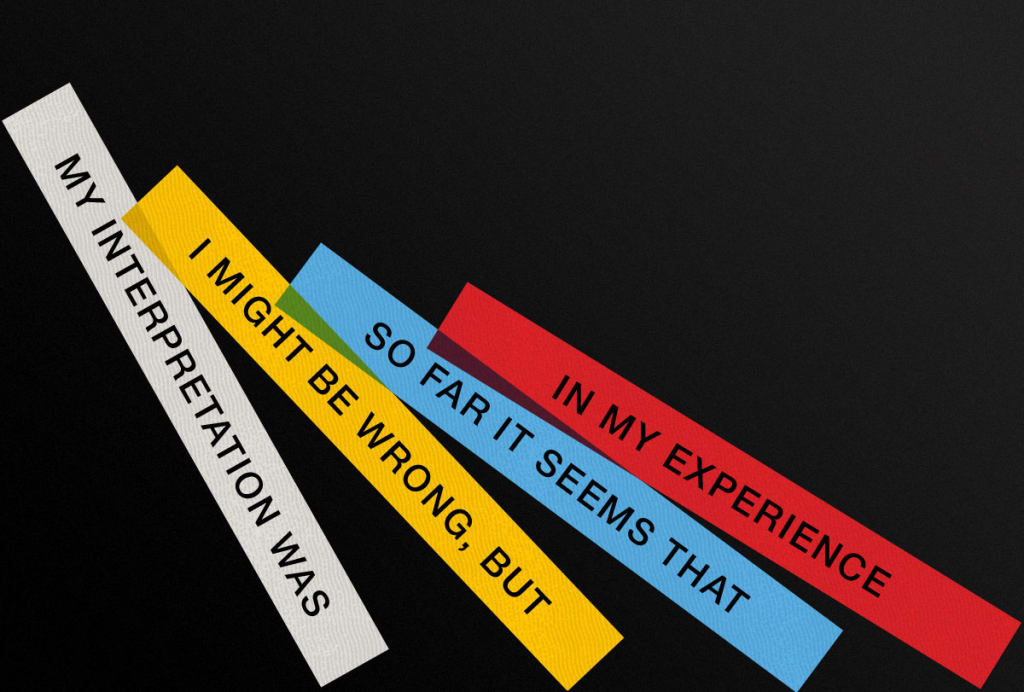
If you’ve ever heard a scientist talk about research, you’ve probably noticed our fondness for qualifiers. We like to saturate our rhetoric with them, accompanying nearly every assertion with a recognition of the limits of our understanding and a readiness to reexamine our conclusions.
This is actually a critical aspect of science. Science runs on honesty and humility (at least enough humility to admit that you could be wrong), so we reflect these values in the way we talk. When talking about our research, we like to emphasize the context in which our data were collected, possible sources of error, other explanations for what we’re observing, and all the experiments that might prove us wrong. We talk openly about what we don’t know and when suggesting that we might know something, we’ll usually qualify it with an ‘it seems’ or a ‘so far’.
Certainty is a bad look for scientists, which is why we try so hard to avoid it, or at least avoid clueing other people into it. But I would argue that certainty is a bad look for everyone. It implies a kind of cerebral stagnation, an inability to grow. An individual who is certain of what they know can never learn or be surprised. Their worldview can never be updated in accordance with new information. Pretending that the universe is not chaotic and mysterious, but rather well-defined and well-understood is pretty comforting, I’ll admit, but swaddling oneself in conviction only serves to constrain curiosity and stifle fascination. In essence, it threatens everything that makes humans (and science) so great.
This isn’t to say that we all need to go full-on Descartes every day and drive ourselves mad constantly questioning the nature of our realities. We need to feel at least somewhat confident that we know stuff about how the world works. We’re only primates after all. But despite the discomfort uncertainty can cause, it’s worth owning the fact that there is always a lot to learn and there are infinitely many ways to be surprised.
Just as recognizing that we can be wrong sometimes (or most of the time) is an important practice for everyone, the scientists’ habit of qualifying assertions with a heavy dose of agnosticism is also, I believe, a valuable practice to institute in our everyday interpersonal interactions. Like science, productive dialogue and sincere consideration of alternative perspectives require honesty and a recognition of fallibility and bias.
Imagine how much more civil and effective twitter beefs would be if both parties used some of those extra characters to include a qualifier or two; something that connotes, ‘I might be wrong’. In the analog version of my social life, I find myself saying, “In my experience...”, “I don’t remember the source of this information, but…” and “my interpretation was…” quite often. In the digital sphere, this might well translate as “idk tho ¯\_(ツ)_/¯”. Regardless of how it's done, recognition of what we don’t know leaves us room to grow and opens us up to more meaningful human connections.
Our species has a rich history of getting it all wrong. But we’ve advanced (in many ways, but unfortunately not all) from the days of witch trials and bloodletting to the modern days of cell phones and quantum physics. Our success thus far has depended on continually revealing the depths of our ignorance- and there is still much that we are yet to understand. The idea that generations of the distant future might look back on us as primitive and misguided is, to me, deeply inspiring and mystifyingly beautiful. Our progress over the last 350,000 years (or so) has been pretty impressive, but we still have a lot of room to grow. And any hope we have of continuing our progress, both social and scientific, relies on our willingness to learn, to be wrong, and to change our minds in accordance with the evidence.
We are human and we are fallible. Let’s be honest about it. Respect your qualifiers.
About the Creator
Kelsey Schultz
Neuroscientist and all-around science enthusiast. I believe that honesty, curiosity, and critical analysis can enrich our lives by providing a deeper understanding of ourselves, our world, and each other.
Keep reading
More stories from Kelsey Schultz and writers in Humans and other communities.
Fail Better
I tried to hide my embarrassment and frustration, but I’m sure my averted gaze and nervous fidgeting made it obvious that I had bad news to share. I’d been a member of the lab for a few months but, looking at the state of the project, you might not have guessed that. Progress had been slow, and I now had to report to my mentor not only that I’d failed again to get our experiment working, but also that I’d broken over a thousand dollars-worth of equipment with one clumsy mistake. I managed to get the words out with a flimsy stoicism and prepared myself for reprimand. He gave me a look that was somewhere between understanding and amused and said “Happens to everyone! You did good. Just fail better next time.”
By Kelsey Schultz4 years ago in Humans
Bradley Cooper and the Quiet Weight of a Career Earned Slowly
Bradley Cooper is often described as a movie star, but that label only tells part of the story. What makes him interesting is not just fame or talent, but how long it took for both to fully arrive. His career did not explode overnight. It grew through small roles, awkward risks, public missteps, and quiet persistence. Over time, Bradley Cooper became someone audiences trust to feel deeply on screen. He carries sadness, confusion, love, and regret in ways that feel familiar rather than polished. That honesty is why his work stays with people. To understand Bradley Cooper today, you have to look at the slow road behind him, not just the spotlight he stands in now.
By Muqadas khan5 days ago in Humans



Comments
There are no comments for this story
Be the first to respond and start the conversation.