
Real Love Doesn't Demand Your Suffering.
Prioritize Your Peace, Then Truly Thrive.


There is a lesson we all must learn, perhaps the most fundamental one, about the value of our own well-being. It’s a quiet truth that echoes in the deepest parts of us, a call toward a life built on solid ground, not sinking sand. For so many years, we are taught, implicitly and explicitly, to pour ourselves out. We nurture careers, raise families, support friends, and constantly strive to meet the expectations of a demanding world. We believe that sacrifice, constant giving, and even enduring discomfort are badges of honor. We treat our own spirits like an endless reservoir, one that can be drained without consequence. But that, my friends, is a deeply flawed premise.
The truth is, your own cup must be filled first. This isn't selfishness; it is stewardship. It is the practical, necessary foundation for every good thing you wish to achieve or share. Think about it: when you board an airplane, what are the clear instructions? Secure your own mask before assisting others. Why? Because you cannot effectively help anyone if you are gasping for air. This principle holds true in the everyday messiness of human relationships. Taking care of yourself—tending to your mental landscape, protecting your peace, nourishing your body—is the prerequisite for a meaningful existence. It allows you to show up, not as a depleted shadow, but as a fully energized, present participant in your own life and the lives of those you cherish.
The Confusion of Connection
This journey toward self-stewardship becomes even more complex when we navigate the treacherous waters of human connection. We are wired for belonging, for deep, resonant love. Yet, in our desperate yearning for this closeness, we often stumble into toxic circuits—patterns of interaction that deplete, diminish, or damage us. These are the relationships, whether romantic, familial, or platonic, that demand a constant, debilitating emotional performance. They are the cycles where your inherent goodness is conditional, where your vulnerability is weaponized, and where your attempts at resolution only seem to fuel the next crisis.
The real difficulty lies in the fact that these damaging patterns often masquerade as profound devotion. We confuse drama with passion, volatility with intensity, and co-dependency with commitment. We tell ourselves, “This is what real love looks like—it’s challenging, it requires constant work, it demands this ultimate sacrifice from me.” We believe that if we just hold on tighter, try harder, or suffer longer, the reward will be true acceptance. This belief is a deep psychological trap. It is a fundamental betrayal of your own inherent worth. Love is not meant to be a constant struggle for survival. Genuine connection should be a harbor, not a hurricane. It should feel steadying, not chaotic.
The Courage to Disconnect
Breaking free from these circuits requires courage—the kind that comes from deep, quiet self-recognition. It begins with pausing and asking yourself a series of tough, honest questions: How do I feel when I leave this person's presence? Am I energized, or am I utterly drained? Is my spirit expanding, or is it shrinking to fit a mold that was never meant for me? The answers to these questions will be your north star. Do not intellectualize or rationalize away the heavy, sinking feeling in your stomach. That feeling is your innate wisdom speaking.
The act of separating yourself is not an act of failure; it is an act of profound self-respect. It’s a statement that says, “My peace is non-negotiable.” It is the process of setting firm boundaries, which are simply the rules of engagement that you establish to protect your soul. Learning to say "no," to detach with love, or to walk away entirely is the ultimate form of self-care. It means choosing your mental and emotional health over the comfort of a familiar, yet damaging, routine.
Ultimately, your responsibility is to cultivate a life where you feel whole, centered, and safe. When you make the intentional choice to care for yourself—to rest, to reflect, to pursue joy, and to seek out connections that genuinely nurture you—you do more than just survive. You open the door to true, sustaining happiness. You demonstrate to the world, and most importantly to yourself, that you are worthy of a love that lifts you up, not one that holds you down. This journey is lifelong, demanding continuous vigilance, but the return on this investment is the most beautiful, authentic version of yourself. Choose your own light; it is the most powerful force you possess.
About the Creator
Doblalova
It's me, hi I'm the problem it's me...
A Historic Declaration
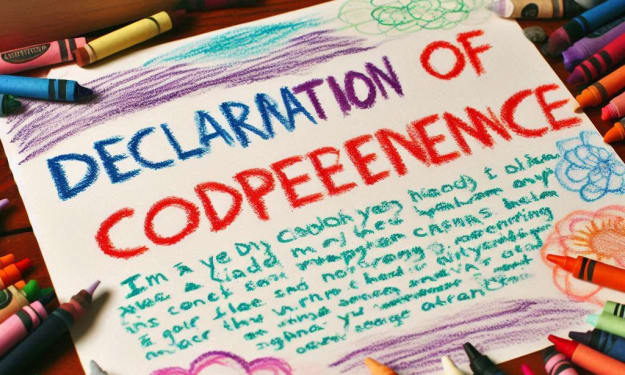
We the People of the Husbands of the United States of America, in Order to form a more perfect Union, and I mean you...with me...establish Justice, insure domestic Tranquility, provide for the common defence, promote the general Welfare, and secure the Blessings of Liberty to ourselves, after Puberty, do ordain and establish this Declaration of Co-Dependence.
By Gerard DiLeo5 days ago in Humans
Telepathy and the Digital Age
We live inside a system that promises connection. It tells us that every thought can be expressed, every voice amplified, every identity discovered and affirmed. It offers platforms, profiles, feeds, and timelines — architecture for the modern mind. It claims to organize the chaos of human expression into searchable order, to make the world legible through code and pattern.
By Chase McQuade5 days ago in Humans
This Is What I Do When People Throw Rocks At Me
Rocks have been thrown at me for a greater part of my life. Some have been small and missed hitting me. When people don't get a reaction from me, they throw bigger rocks with a better aim. Many have been hurled at me with precision over the years. For a long time, I thought my only options were to dodge them or be crushed by them.
By Margaret Minnicks6 days ago in Confessions



Comments
There are no comments for this story
Be the first to respond and start the conversation.