
Pocahontas and John Rolfe: The UNTOLD Story of Their Complex Marriage and Its Lasting Impact
When you think of Pocahontas, you might picture a Disney heroine singing to raccoons, but the real story of Pocahontas and her marriage to John Rolfe is far more complex—and, spoiler alert, much less musical.

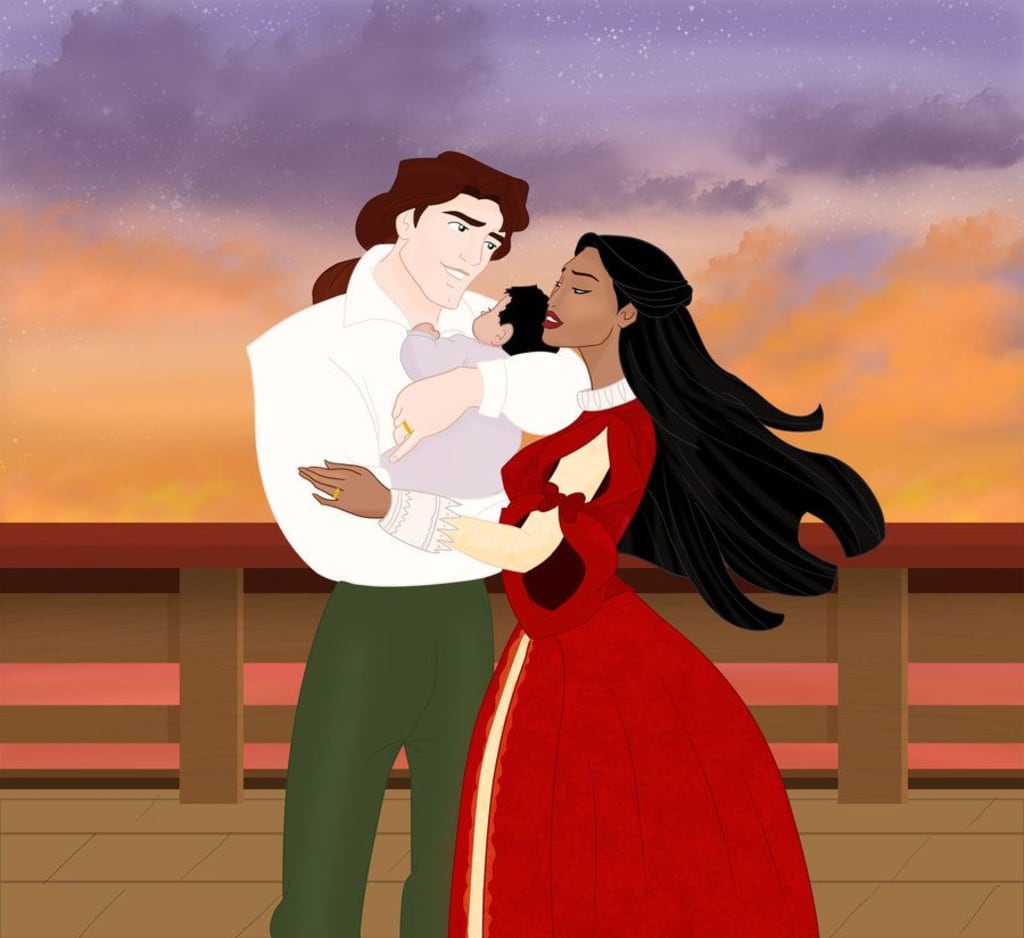
When you think of Pocahontas, you might picture a Disney heroine singing to raccoons, but the real story of Pocahontas and her marriage to John Rolfe is far more complex—and, spoiler alert, much less musical. It’s a tale that mixes love, politics, cultural clashes, and the dawn of American colonization.
So, how did a Powhatan princess and an English tobacco planter become the most talked-about couple of the 17th century? Let’s dive into the whirlwind story of their union, which has been romanticized, scrutinized, and dissected for over 400 years.
Pocahontas: The Princess with Many Names
Born around 1596, Pocahontas was the daughter of Wahunsenacawh, the powerful chief of the Powhatan Confederacy. Known as Amonute among her people and Matoaka in private circles, “Pocahontas” was actually a nickname meaning “playful one.”
She grew up in what is now Virginia, in a society deeply rooted in tradition and governed by her father’s expansive influence. By the time the English arrived in Jamestown in 1607, Pocahontas was likely around 10 or 11 years old—not the romanticized adult heroine of legend.
Enter John Rolfe: The Tobacco King
John Rolfe, on the other hand, was a businessman through and through. Arriving in Jamestown in 1610 after a shipwreck in Bermuda, Rolfe was obsessed with tobacco—a crop that would eventually turn the struggling English colony into a booming economic hub.
But life in Jamestown was anything but glamorous. The settlers faced starvation, disease, and frequent clashes with the Powhatan people. Rolfe, widowed during his journey to the New World, was focused on survival and success, not romance. Yet fate had other plans.
The Kidnapping That Changed Everything
In 1613, Pocahontas’s story took a dramatic turn. She was kidnapped by the English during a tense period between the settlers and the Powhatan Confederacy. Taken to Jamestown, she was essentially held as leverage to negotiate peace.
While in captivity, Pocahontas was introduced to English customs, baptized into Christianity, and given the name Rebecca. This period marked a transformation for her—not just in faith, but in her role as a bridge between two worlds.
A Strategic Union
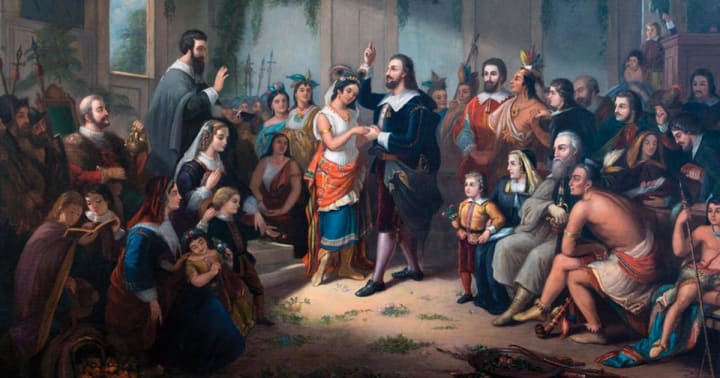
John Rolfe entered the picture around this time, and their eventual marriage in 1614 wasn’t just a romantic pairing—it was a political and economic strategy. Rolfe himself acknowledged the gravity of his decision in a letter, stating that he hoped the union would “advance the good of the plantation” and “honor God.”
For the English, the marriage symbolized a fragile peace between the colonists and the Powhatan. For Pocahontas, it likely represented survival in an increasingly hostile situation. Whatever the motivations, their wedding marked the first recorded marriage between a Native American and an English settler, a union that symbolized the complex interplay of love, diplomacy, and power.
The Messed Up TRUE Story of Pocahontas
Life in England
In 1616, John Rolfe, Pocahontas, and their young son, Thomas, traveled to England. There, Pocahontas was paraded as a symbol of the “civilized savage,” a living example of the supposed success of English colonization efforts.
The trip was a whirlwind of banquets, portraits, and introductions to English high society. Pocahontas met King James I and became something of a celebrity. However, beneath the pomp and circumstance lay the harsh reality of her situation—she was far from home, surrounded by unfamiliar customs and people.
A Tragic Ending
Pocahontas’s story took a tragic turn in 1617. As the family prepared to return to Virginia, Pocahontas fell ill, likely from pneumonia, tuberculosis, or another Old World disease to which she had no immunity. She died at the age of 21 and was buried in Gravesend, England, far from the land of her ancestors.
Her death marked the end of her short but impactful life, leaving behind a legacy as a symbol of cultural convergence—and conflict.
The Legacy of Pocahontas and John Rolfe
Their marriage didn’t create lasting peace, as the fragile truce between the Powhatan Confederacy and the English settlers eventually crumbled. However, the story of Pocahontas and John Rolfe endures, often romanticized as a tale of love bridging two worlds.
In reality, their relationship was far more nuanced, shaped by the turbulence of colonization, the clash of cultures, and the political machinations of the time. Pocahontas remains a figure of fascination, representing resilience, adaptability, and the complexities of history.
Final Thoughts
The marriage of Pocahontas and John Rolfe was more than a union of two individuals—it was a symbol of a pivotal moment in history, where two vastly different worlds collided. Was it love? Strategy? Survival? Maybe all three.
One thing’s for sure: their story is as rich and layered as the history of early America itself, and it continues to spark debate, inspire art, and captivate imaginations. Pocahontas and Rolfe’s unlikely union may not have had a fairy-tale ending, but its impact on history is undeniable.
About the Creator
Keep reading
More stories from Marveline Merab and writers in Humans and other communities.
Richard Burton and Elizabeth Taylor: A Love Affair for the Ages (and Tabloids)
Love stories aren’t supposed to come with two marriages, two divorces, and enough diamonds to blind a small nation—but then again, Richard Burton and Elizabeth Taylor weren’t your average couple. Their relationship wasn’t just a romance; it was a full-blown Hollywood saga, filled with passion, betrayal, glamour, and drama that kept the tabloids frothing at the mouth for decades.
By Marveline Merababout a year ago in Humans
The Coming Climate Migration. Which U.S. Cities Prepare and Which Stay in Denial.
Climate migration no longer sits in the future. It unfolds now. Floods displace families. Heat strains cities. Drought limits water supply. Insurance retreats. People move when daily life breaks down. The United States faces internal migration driven by climate pressure rather than borders.
By Wilson Igbasi6 days ago in Humans



Comments
There are no comments for this story
Be the first to respond and start the conversation.