

It didn’t snow much anymore, since the weather had changed. M. liked walking, keeping her eyes on the ground, seeing the earth that humans had covered up in so many places, seeing the traces of activity in the landscape. A glove on a low wall, flattened, yet pointing forward. Three individual fruit pies, in boxes, left on the edge of a parking lot. M. stopped and tied a fallen purple scarf to a parking meter, so that it might better flag down its owner. Some people lived outside; a scarf could be an important thing
M. walked on to work over the bridge, seeing the sun light up the harbor. She nodded to Heron, who every day stood still in the shallow low tide below the bridge. He nodded back, before returning his laser gaze to the fish in the harbor. M. walked on to the other side of the bridge.
At the end of the bridge the land was flat, formed of all the unwanted items people had pushed out of their houses a hundred years ago. Workers kept buildings the new buildings that filled this last empty space. Still, the sea was coming, and might take this flat land back; that was why M. had a job.
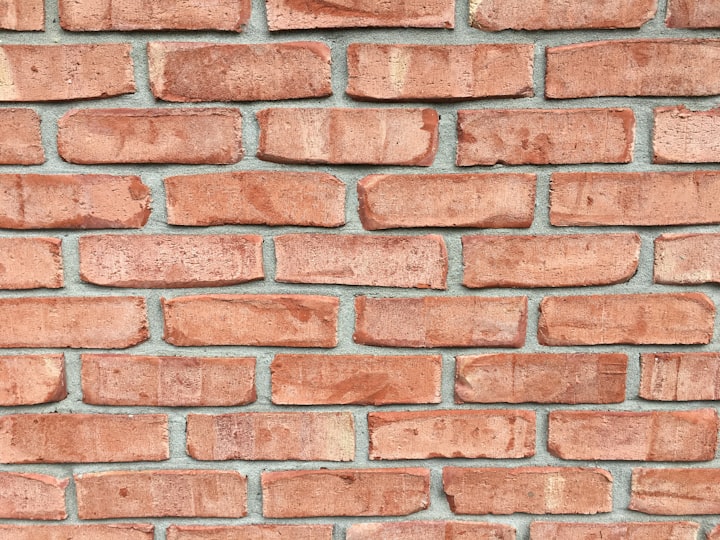
M. worked as a material enumerator; that is, she numbered the bricks in an old building with a yellow wax pencil, noting their positions in a diagram, and taking photographs. The building would be disassembled, to keep it from being swallowed by the sea, and then put back together again on the inland edge of town, swallowing a new bit of forest in the process. M.’s numbers and records would be used to reassemble the building. It felt like rewinding a tape or film, then playing it again in a new place, familiar and strange.
She spent the day numbering, working around the massive posts and beams that formed the inner skeleton of the building. At times she paused and thought about what big trees these beams had been, and felt sad to think of them being cut down, even if they had made a beautiful structure. Some of their grandchildren would have the same fate when the building was moved.
It was almost the end of the day and M. had finished numbering one section. She decided to move her scaffold to the opposite wall for the next day’s work, climbing to the uppermost level to leave her tools in a safe place. Her gaze was close to where a beam and a post met, and she noticed something had been tucked into the small space between the structure and the wall.
She tugged at it, and a small black notebook came out. The pages were filled with beautiful pencil drawings of boats in the ocean, of rocks and plants, There were also some notes and symbols she didn’t understand. As she went through the pages, there were more and more sketches of pieces of a building both like and unlike the one she stood in. M. was stunned at the beautiful work of this unknown artist. “I must show this to Heron,” she thought. “He flies around and knows the shoreline and can tell me what this means”.
Heron was in one of his familiar spots, as M. crossed back over the bridge.
“Heron!” she called out. “I must show you something!” He swallowed a fish, and looked at her with a mix of curiosity and annoyance. The sun would go down soon, and he might like to find just one more snack. M. stepped carefully from rock to rock, approaching him, and took out the notebook. “Look,” she said. “All these pictures of the water, of buildings. It’s a little like here, but different. Do you know where this is?
Heron looked carefully at the drawings and flipped through the pages with his pointy beak. “This is how the harbor looked years ago - I remember my parents talking about how there was more grass to hide in, more rocks to perch on.” He shook his head. “I have only a few spots I can fish in now.”
M. felt his sadness as she held the notebook up for him. He reached the end and noticed a little pocket at the back.
“What’s in here?” he asked.
M. hadn’t noticed the pocket, but now she could see something inside. She pulled out a folded piece of light green paper. It was an old, old restaurant menu. Luxurious meals to be had for forty cents! It was so strange to think of when people would go and eat in a room with strangers. On the back of the paper there was another sketch of a building, similar to the one M. was working on, but with some variations on the design.
“A hotel, with a restaurant,” Heron explained. “The gulls used to tell me that it had the best garbage - they would go there and wait for the end of the night.” He laughed, with a tear in his eye; he thought the gulls were crazy, eating trash. But soon he might have to look elsewhere for food too. “You should go there.” he said, nodding towards the address on the menu.
The next day, M. headed to the address on the building; curious to see if it was still there.
She walked through a corridor of old brick buildings, some missing their signs, feeling a bit lost. Looking up, she saw a large painted sign on the side of a tall building - the green and white lettering matched the menu she carried. It seemed dark and private - like you needed a card or a badge to enter.
M. jumped; some bird poop narrowly missed her, splattering on the sidewalk. She looked up to see a gull circle overhead, alighting at the edge of the building and throwing their head back, laughing at the sky. M. then saw an older woman, sitting in a window on a high floor. Their gazes met.
“Miss! Miss!” The woman waved. “Could you get me some milk from the store?”
M. sensed this was an opportunity to learn more. “Of course, how will I bring it to you?”
The woman threw a set of keys down. “Take these, you can get in the back and come up in the elevator to 5B.” Oh, and get some chips for my friend here.” She gestured with her thumb towards the gull perched above.
Upstairs, M. pressed an old-fashioned buzzer. A tiny, elegantly dressed woman opened the door. She seemed at once frail but illuminated with a particular energy. A black and white cat leaned against her leg.
“Thank you so much dear, I’m Gabriella, so good to meet you. So many people don’t want to help these days. I don’t go out much, don’t want to catch anything...won’t you come in for tea?”
“Why yes, thank you,” M. replied.
M. was intrigued by the person before her, and her equally distinctive surroundings. A curved sofa covered in a vibrant fabric, art on the walls and papers and books piled in the corners. “Here, give our friend outside their chips”, gesturing to the window. M. leaned out and the gull swooped down, grabbing the small bag, spilling a few chips. She saw them fly to a lower rooftop where their offspring, little grey fuzzballs, waited to be fed. The kettle on the stove began to sing.
M. helped Gabriella bring the tea to the table, and had a seat.
“So do you live nearby?” Gabriella asked. “I haven’t seen you before.”
“No, I live across the bridge, but I work in the city. I work down by the water. I came this way because I was interested in this address. Can I show you something?” M. pulled out the little notebook and the menu. “I found this old paper from this building and wanted to see if it was still here.”
The woman squinted and reached for her glasses. She was silent for a bit and stared at the paper. She looked at M.
“You found my notebook. I hid it away because back then, people didn’t understand my design.
Some people were angry, and thought a woman couldn’t do architecture. I left it there, hoping someone would find it and understand. I let it go; I went on and designed other things.”
“You designed this building I work at? The one that is supposed to be moved?”
“Yes, and I’ll show you my ideas. Let me get some more of my drawings.” She pulled out some big sheets of paper from a low, flat cabinet and spread them on the table.
“I designed the building so the water could come and go, if there was ever a flood.” M. noticed that some of the building was raised up, with openings - the building was not like that now. “I wanted the building to work with nature. I did all of the calculations to make it strong enough.”
“So they didn’t build it like you intended? M. asked.
“Yes, and now they are having to move it! I warned them that the water must come and go.”
M. thought about all the time that had passed, and how far ahead Gabriella’s thinking was.
Her design would have saved so much money, all the money that would be spent moving the building, all the destruction of cutting down the forest to make room for it.
“We have to show this to someone,” M. said.
****
M. walked over the bridge. It was early fall now, and a little darker in the mornings, and she liked feeling the cool weather. Still she could make out Heron, who was focused on eating a lot of fish before his winter journey south. She made a note to wish him well before he left.
At the end of the bridge, where the land was flat and workers still worked on new buildings that looked like old buildings, M. met Gabriella who waited in her new little car. They had both been awarded $20,000 for alerting the city that the building had not been built as intended, and providing the original plans. They had saved the city much, much money, as well as the trouble of moving the building across town.
Gabriella was happy to be able to afford a car for her errands; both she and M. were even more pleased to have saved part of the forest on the other side of town. They drove to the building that Gabriella had designed, that M. worked on; the city had given them jobs managing a construction crew that would implement Gabriella’s original designs for the building.
M. rubbed away one of her yellow pencil numbers from the bricks.
About the Creator
Keep reading
More stories from writers in Humans and other communities.
Subtle Signs Your Body Responds to Emotional Energy.
Emotions influence more than thoughts. They shape how your body reacts in ways you might not notice. Understanding these signals helps you recognize emotional patterns and maintain better mental and physical health.
By Wilson Igbasi7 days ago in Humans
Dead and Wearing Green
She was wearing that green dress when I first saw her, five years ago to the day. Flowing meadow fabric draped over long legs, thick auburn hair flowing down her back. That smile. Of course, she is still beautiful now. But now she is no longer alive.
By Karen Cave5 days ago in Fiction



Comments
There are no comments for this story
Be the first to respond and start the conversation.