
Pittville Park
Or, How Wisdom is Learned, Not Taught

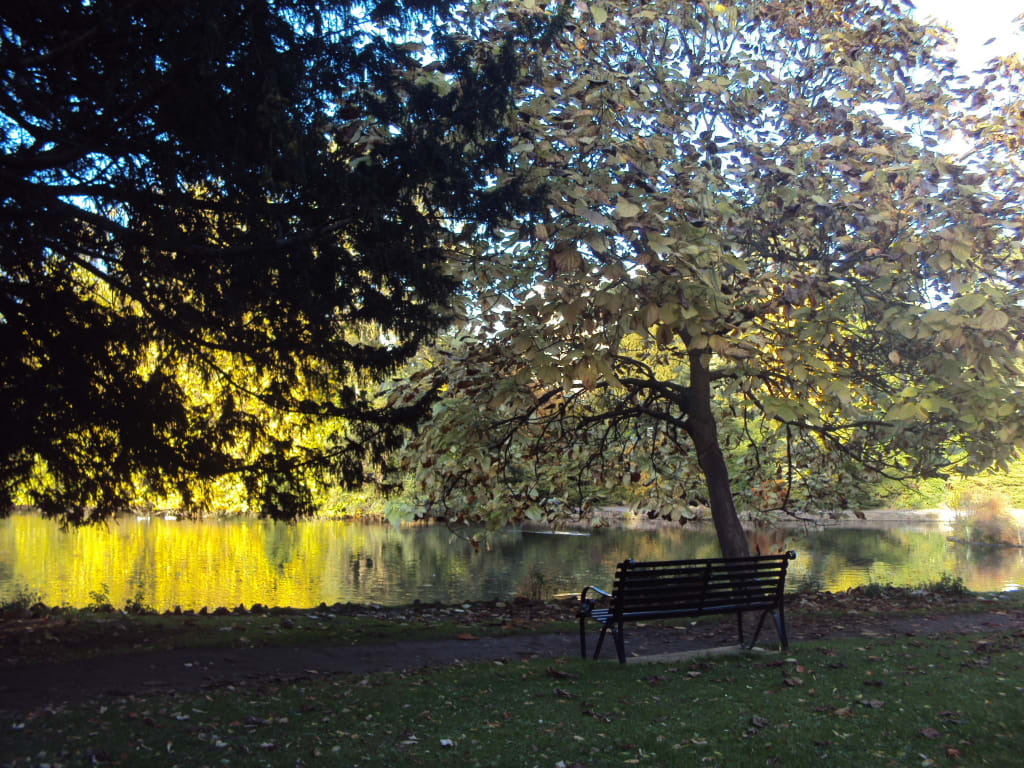
On a clear, bright Saturday morning, Toby scurried along the sidewalk to Pittville Park, hoping his favorite bench would be unoccupied.
The sun's rays shone translucently through red, yellow, and orange foliage. As he passed the cemetery, he was struck by the sense of peace it offered. Centuries-old headstones tottered, crumbling; new headstones stood firm, and every now and then a wooden stake was hammered into the ground at the head of a fresh mound. He wondered what the stakes were about. Given the storm of thoughts and emotions in his own head, the peace he sensed at the cemetery was tantalizing, as if it were pulling him in, beckoning.
As he did every Saturday and Sunday morning, he entered the park through the ornate wrought-iron gate. Ducks congregated in the wide river and children were running every which way, some followed by dogs or friends and others chasing dogs or friends. Students and lovers sat on blankets, studying. Or not studying.
It was not uncommon for his favorite bench to be occupied by the time he got there. Yet, if it was free, he would sit and read, write in his journal, watch the ducks, compose a few lines of poetry, or let his mind wander as he enjoyed a peaceful morning.
Finally Toby came within sight of the bench, and was overjoyed to find it yet unclaimed. He hurried the last few steps and triumphantly sat down, basking in his victory, taking in all that was around him. The storm in his mind momentarily abated. The ducks circled the river bank, the dogs circled the children, the students circled back to class notes, and the lovers circled back to promises of eternal devotion.
Suddenly he noticed a little black notebook beside him. “Someone must have just left this,” he thought, “I can’t imagine it sat here overnight. They would have come back for it by now.”
At first he tried to ignore it, though his curiosity rapidly grew to an overpowering pitch. To distract himself, he got his own notebook out of his book bag and jotted down a few thoughts he had had on the walk from his apartment. "The cemetery was bright this morning, welcoming even—welcoming in the sense that it offers peace, closure. Who wouldn’t want to be in such a place of solace after the storm and stress of the outside world? I'll go there tomorrow and read." He put down his pen.
The notebook still sat there.
He opened Hesse's Siddhartha where he had left off the morning before. “He was full of ennui, full of misery, full of death; there was nothing left in the world that could attract him, that could give him pleasure and solace.” The degree to which these words resonated in his own soul was uncanny, unnerving; all existence seemed like meaningless suffering. He closed the book. It was too much.
The notebook still sat there.
The ducks were nowhere to be seen, and even the children, their friends, and their dogs were oddly absent. The lovers and students were far too busy with their own concerns to notice him.
The notebook still sat there.
“Maybe I’ll just see if there’s a name and contact info inside.” Upon closer inspection, he noticed that it looked as though it had been well-worn in by its rightful owner. The corners were bent and there appeared to be a coffee stain on the edges of the paper. Yet it was thin, elegant, and clearly asking to be opened. He unbound the elastic band, and opened it, obediently.
Inside the cover there was no name, no contact information. But there was a white envelope, unaddressed. To Toby’s shock, it was unsealed and stuffed with cash.
His heart started to race. “Who keeps this much cash in an envelope?” Had he just picked up money for a drug deal, for something on the black market?
Having carefully placed the envelope on his lap, he quickly turned to the little black notebook’s first page. It was a list of names, each crossed off, thirty or forty. On the next page were more names, in different handwriting, each crossed off. On the next and next pages there were more and more names, each set in different colors of ink, each in a different hand, all of them crossed off.
Now close to panicking, he flipped about halfway through the book to where the last names had been written. There several dozen names had been written, again in a different handwriting and ink than the previous set of names, though this set had not been crossed off. “Is this a hit list or something? Abigail Hill, Steven Chenoweth… Who are these people?”
For a moment he sat motionless, his gaze rapidly roving from the list of names in the notebook to the envelope of cash on his lap. Whatever he was going to do, it must be done quickly. “I doubt someone would just leave this out in the open if it was for something illegal… But I can’t just leave it…”
Toby suddenly sat up straight and, as calmly as possible, looked around. Nobody was looking in his direction. He placed the envelope back in the notebook and carefully placed it in his own bag. Attempting to retain an air of nonchalance, he scurried back to his apartment. When he got home, he slammed the door shut and bolted it. He got out the notebook and set it on the couch, sitting just as awkwardly as he had on the park bench, yet now in the safety of his own home.
***
Toby wasn't sure how long he had sat there, staring at the black notebook, before he worked up the courage to reopen it. There was the envelope full of cash, there the mysterious lists of names. He counted the money; $20,000. That was more cash than he had ever seen in his life.
Next, the list of names. He began with the last list, which had not been crossed out. He searched the internet and found that they were all dead—every last one of the forty names had a recent obituary posted online. They were all also residents of his city. "So it can't be a hit list," he surmised, "they're already dead."
He searched the names in the previous list which had all been crossed off. He found to his immense relief and curiosity that all but one of the people to whom the names belonged were still alive, so far as he could tell. They were all likewise residents of his city. "So it's definitely not a hit list," he murmured aloud. "But why are they on the list?"
He began at the beginning of the book and worked his way to the end, picking people at random to search online, sometimes finding that they were alive and well, otherwise finding that they had died some time ago. The only commonality among all the people whose names were written in the black notebook was that they all appeared to live in his city.
Utterly befuddled about the notebook's purpose in connection to the $20,000, he put the notebook back in his bag, retrieved his worn paperback copy of Siddhartha, and started to read.
The rest of the day was not very productive. He attempted to read, to knock out a chunk of his literary theory paper, to even clean the apartment, but his mind kept coming back to the mysterious black notebook and the envelope stuffed with cash. He fell asleep on the couch that night, the black notebook on the floor, inviting him to discover its mystery.
The next morning Toby went to the cemetery as he had planned to do yesterday, hoping for a peaceful morning of reading and journaling. Before he sat down under a giant oak tree, he noticed again the stakes at the heads of the fresh graves. Upon closer inspection, he could see that a name had been written in permanent marker on it, which read, “Steven Chenoweth, 1950-2021.” Surely he had just heard that name before?
And then it hit him: this name was in his little black book. He hesitantly scuttled to another post nearby: “Abigail Hill.” His heart began to beat as quickly as it had the day before, and running to each of the posts, he found that every single name on them had been written in the little black book by its last owner.
Confusion and wonder filled his mind. Certainly there was a connection to his notebook, but what was it?
A man was driving by in a small excavator. Toby hailed him and asked why there were stakes at the fresh graves. The man wore a welcoming smile. “These folks were indigent cases and couldn’t afford headstones, so until Uncle Sam sends the funds, the stakes will have to do.”
“Any idea when the funds will come in?” An idea was forming in Toby’s mind.
“Not the foggiest. But the way things are going lately, certainly not before winter.”
“Great, thanks,” Toby responded. The friendly man hopped into his excavator and drove off, leaving Toby alone with the departed. Something deep within him seemed to shift; he was suddenly filled with a flush of resolve.
His despair about the meaningless of life was forgotten, buried at that spot.
He sprinted after the excavator. Having finally caught up to it, sweaty and winded, he hailed the man again. “How much do headstones cost generally?” he wheezed, bending over to catch his breath. The man looked startled, but responded cheerily enough anyways, “Not over a buck fifty for a cheapo. Maybe five hundred for a nice one.”
“Where can I buy forty?”
***
Two Octobers later, Toby woke up before the rising of the sun. He pulled a little black notebook out of his desk, and placed a thick envelope inside the front cover. He flipped through the pages one last time, perusing the names he had joyfully crossed off two years ago. And now, a sense of closure, of overwhelming peace, filled him as he gazed upon the forty names in his own handwriting that he had written over the previous two years. It had taken him that length of time to earn $20,000 above and beyond his living and school expenses. Every Saturday and Sunday he had worked at a restaurant to raise the money, and he picked up tutoring hours during the week as well. Now, at the end of his labors, he was filled with an inexpressible lightness.
The sun's rays shone translucently through red, yellow, and orange foliage. The park was empty. Finally Toby came within sight of the bench, and was glad to find it unclaimed. He gently placed the notebook on the bench, lingering for a few moments as if to thank it, and left.
Several hours later he came back out of curiosity. A middle-aged woman sat at the bench. She held the notebook and envelope in her hands, a startled expression on her face.
The ducks circled the river bank, the dogs circled the children, the students circled back to class notes, and the lovers circled back to promises of eternal devotion. And as Toby walked to the cemetery, his own mind circled back to a line towards the end of Siddhartha: “Wisdom is not communicable. The wisdom which a wise man tries to communicate always sounds foolish.”
About the Creator
Keep reading
More stories from writers in Humans and other communities.
Time to change your life.
Is it even possible for you to change your life? A lot of people, more than there should be, are unhappy with their lives. But what are they doing about it? Usually nothing. People talk about how shitty their lives are and want change, but are they not taking the actions to change?
By Jen Phillipsa day ago in Humans
Instructions Included Challenge Winners
For the Instructions Included challenge, we asked writers to tell a story through instructions and to trust the form to carry what could not be said outright. Across the top entries, that trust paid off in many different ways.
By Vocal Curation Team4 days ago in Resources



Comments
There are no comments for this story
Be the first to respond and start the conversation.