


“I wanted people to think about themselves, about their lives, about their own mortality.” - Damien Hirst
Modern Art in the 21st century seems to have no boundaries; an artist can use anything to create art. While some materials are unusual and fascinating, some materials may cause us to step back in shock, as is the case with Damien Hirst’s Superstition.
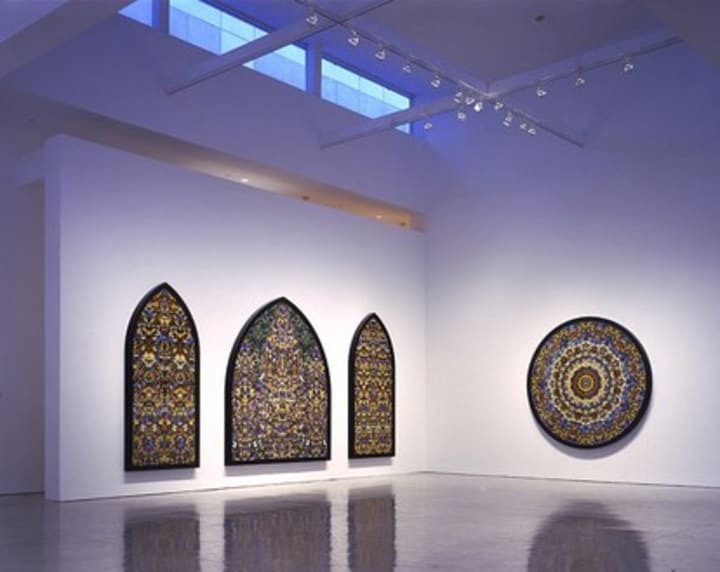
Classified as paintings, Damien Hirst rendered images reminiscent of Medieval stained glass windows and Asian mandalas. However, Hirst did not use glass, sand, or flower petals to create these paintings. He used butterflies. Not surprisingly, Hirst has been harshly criticized over the use of butterflies and the adverse effects of an already diminishing population. In his article, “The Misplaced Outrage over Damien Hirst’s Dead Butterflies”, Giovanni Aloi echoes the concerns of many environmentalists:
“killing butterflies for the making of art is unethical.”
However, his shocking use of butterflies adds meaning to the work and as expressed above, he is inviting us to reflect on our own mortality in addition to the reality that life is fleeting and fragile, much like the wings of a butterfly:
“Hirst’s art contemplates mortality from more than one perspective. The death of the animals and butterflies is heightened by the temporality and fragility of the art created with them.” - Dr. Irina D. Costache
The way artists use materials to highlight meaning is not always as clear as Hirst’s, often leading the observer to make their own conclusions about the work. This is where personal experience and culture play a role in finding meaning in art. Superstition and other works by Hirst evoke emotions in very different ways. First, the paintings convey emotion literally. Stained glass windows and mandalas have a spiritual significance often bringing a sense of peace and comfort, plus they are quite beautiful. Second, Hirst’s imagery conveys ideas metaphorically - the use of butterfly wings as a representation of flight as well as delicate and fragile. This seems to be his main mode of expression.
The use of color, line, texture, and composition in his work adds another dimension for the observer to sink into. While his work may be disturbing to some, there are others who appreciate the work. At the very least, his work has evoked emotion and a reaction, which is a hallmark of art - albeit negative. In her book, How Art Works, Ellen Winner states that the
“[key] to why we seek negative emotions in art, yet avoid them in life, is that art provides a safe space to experience these emotions and to turn inward to savor them -- safe because we know it is art, not reality. This knowledge allows us to observe the art and our negative reactions with a kind of disinterestedness.”
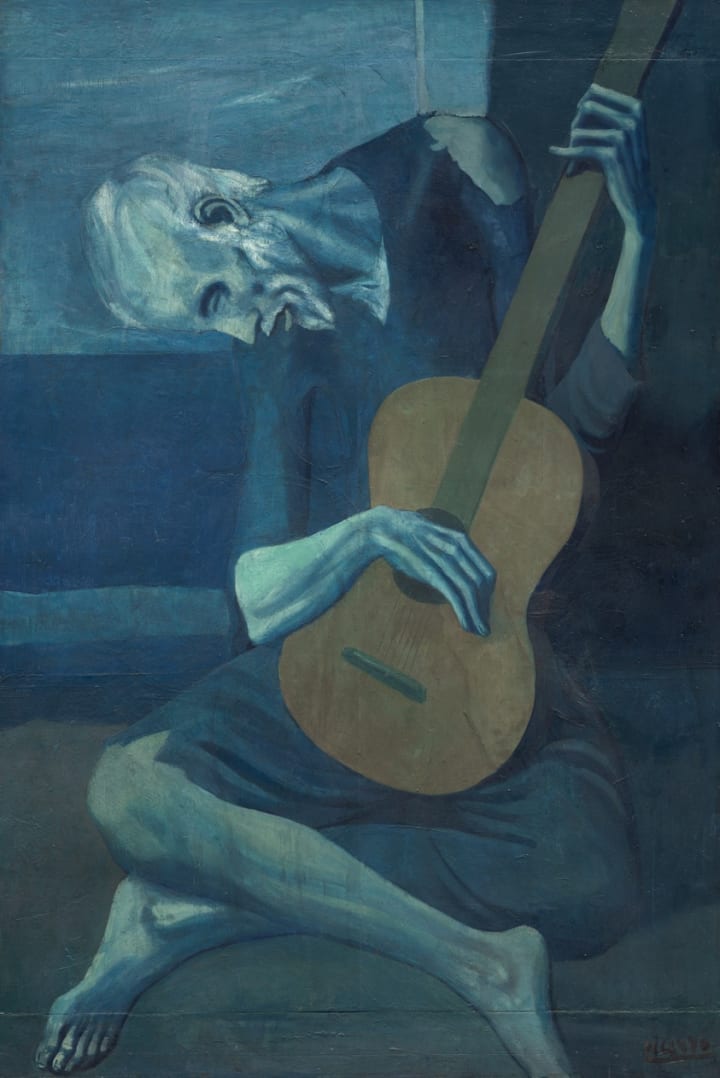
As an observer, there are other works of art that cause me to contemplate my own mortality and that of family and friends. For instance, Pablo Picasso’s The Old Guitarist pours sorrow and grief, unlike any other painting I have observed. The blue pigment and the distorted form of the man add to these feelings. On a personal level, the image of an old man playing the guitar reminds me of my father, who loved to sing and play the guitar. His passing, ever-present in my mind, has been one of the most painful experiences in my life and I feel those deep emotions of grief when I look upon The Old Guitarist.
As an artist, I have used all kinds of materials to create art. I have a great love for nature and often incorporate elements of nature in everything that I make. I had thought about using newsprint paper in a clay sculpture of a decaying tree trunk. The meaning and metaphor speaking to the source of the newsprint paper and the effects of production on our natural resources. However, after considering the carbon that would be created during the firing process, I have chosen to remove this material from this project. To replace the newsprint, I have gathered seed pods from the trees on campus. These will be dipped in porcelain slip and added to the sculpture so that I have nature within the decaying - death gives life which eventually dies.
References:
Aloi, Giovanni. “The Misplaced Outrage over Damien Hirst's Dead Butterflies.” Apollo Magazine, October 2, 2019. https://www.apollo-magazine.com/damien-hirst-dead-butterfly-wings-outrage/.
Costache, Irina D. The Art of Understanding Art. Chichester, West Sussex, UK: Wiley-Blackwell, 2012.
Winner, Ellen. “Chapter 7: Drawn to Pain.” Essay. In How Art Works: A Psychological Exploration, 88–100. New York, NY: Oxford University Press, 2019.
About the Creator
Rebecca A Hyde Gonzales
I love to write. I have a deep love for words and language; a budding philologist (a late bloomer according to my father). I have been fascinated with the construction of sentences and how meaning is derived from the order of words.
Keep reading
More stories from Rebecca A Hyde Gonzales and writers in Humans and other communities.
Lines:
British aesthetician Clive Bell once stated: “Everyone in his heart believes that there is a real distinction between works of art and all other objects.” French conceptual artist Marcel Duchamp challenges this statement with the “ready-made” found objects such as the Fountain and the Bicycle Wheel. “Duchamp believed that any ordinary object could be elevated to the status of an artwork just by an artist choosing that object.”
By Rebecca A Hyde Gonzales4 years ago in Humans
The Voice in the Dark
In the history of big cities there are moments when everything turns into chaos and people don't know where to go in those moments only the people with real character and tarbiyat can lead others to safety this is the true story of Rick Rescorla who was born in a small town in England and later moved to America he was a man who had seen many wars and he knew that safety is not something you get by luck it is something you prepare for every single day
By Hazrat Umer4 days ago in Humans



Comments
There are no comments for this story
Be the first to respond and start the conversation.