


On the first day of sixth grade, Mr. Amberly asked my class what our dreams were. Marga wanted to start her own business. Antoine wanted to go to space. Twins Jeremiah and Samuel wanted to start a band and tour the world. Mr. Amberly was pleased; he smiled and stroked his moustache as he listened to response after response of high hopes and valiant dreams. The line of voices led in my direction, and then it was my turn to speak.
“I want to be a taxi driver.”
Mr. Amberly frowned, and the students laughed. Having been seated in the middle of the classroom, I was in a rather compromising position, as each and every student had an excellent view of the human spectacle who had uttered those shocking words. The other students could not control their laughter, and repeated the phrase to themselves and to each other, forever engraving it in their memories.
Sitting in that seat, I did not understand why the students laughed so, nor did I understand why I had any good reason to be embarrassed. I wanted to be a taxi driver, and that was that. It was a practical sort of dream, I thought, one that carried little risk but promised reward. I didn’t think it was very difficult to become a taxi driver, but taxi drivers were needed and had a place in society. People were always hailing taxis and saying they needed taxis and lamenting that they could never catch any empty taxis when they needed one. I did not think that a new business, another astronaut, nor a world-touring band could bring any more value to the world than a dedicated taxi driver.
It was also practical because it not only seemed possible that I could accomplish it, but also rather probable that I would. I did not know the steps to start my own business. I did not know how I could convince NASA to put me in a spaceship. Nor did I know how a band would be formed—never mind how a band would tour the world. But I knew that to become a taxi driver, the first thing I needed to do was wait until I was sixteen to get my Learner Permit.
“Teddy,” Mr. Amberly said in his grave voice, “your dream is to be a taxi driver?”
“Yes sir.”
Mr. Amberly’s frown deepened until the creased between his brows could very well have been mistaken for rash streaks of dark ink.
My “shocking outburst” troubled Mr. Amberly so deeply that he found it necessary to notify my parents about their son’s lack of ambition. Apparently, he had been “concerned about the words but more concerned about the sincerity with which they were spoken.” My parents, although not particularly pleased with what I had said, did not take my young, naïve words seriously enough to reprimand me. They did, however, make an effort thereafter to take me travelling more so that I might see more of the world and ultimately expand my scope of my thinking and dreaming.
It was only after some days of reflection that I finally understood why the grownups had been concerned. When grownups ask children about their dreams, it is not the dream for which they perk their ears. It is a trick question, if you will, crafted over generations to test the ambition of the successors of the world. If the successors want to be taxi drivers, subway operators, plumbers, and technicians, the grownups worry that the future is bleak. If we say that we want to be celebrities, CEO’s, doctors, and lawyers, the grownups feel safe. Even if we don’t quite understand what exactly a lawyer does, expressing the desire to become one earns praises and smiles and pats on the back.
Mr. Amberly loved this phrase: “Aim for the moon. If you miss, you’ll land among the stars.” This phrase was confusing to me for a long time, and I did not think that it was relevant to anyone but Antoine, who, as you may recall, wanted to go to space. But even so, it was still not very relevant to Antoine, because at the tender age of eleven I understood that as an astronaut, you couldn’t afford to miss. If you missed the moon, you would probably never be able to come back. It was simply not very good advice. But you know, I should have understood what Mr. Amberly meant by those words and used it to understand the question about my dream. Grownups like it when you aim for something near impossible so that even if you miss, you might end up in the higher-end part of the possible. If you don’t aim high enough, they worry that if you miss it you might not make anything of yourself at all. Regardless of whether one really becomes a taxi driver—to which I’d like to point out that many people do—grownups don’t like it when that is the dream.
And so, I learned that although grownups are practical, they do not like practical children. Children are supposed to be idealists who imagine the impossible and reach for the improbable. Sometimes, a child might achieve the improbable; most will not. But for grownups, it won’t do for children to dream in the realm of the possible and stretch for the probable. Grownups live in a frightening world of taxes and deadlines and responsibilities, and they need children to help them feel safe about the future. In the end, it is all about security.
At the end of the year, before we all left for summer vacation, Mr. Amberly once again posed the question. He had once again been frightened by his taxes and deadlines and responsibility, and he needed to feel secure once more. This time I understood. A couple of the students’ responses had changed, but the ambition which they reflected had only grown. Mr. Amberly’s smile beamed brighter and brighter.
When it was my turn to speak, I looked around the class. Some students stared at me with a mischievous impatience gleaming in their eyes. Some mouthed the word “taxi.” Some giggled. The creases between Mr. Amberly’s brows were beginning to resemble a child’s paint strokes.
“I want to be president.”
There was a pause, and then Mr. Amberly was glowing again. Reassured that the future would not be bleak, he nodded with his eyes closed, his fingers on the end of his moustache and his smile plastered to his face. The class erupted into polite applause and stared at each other in surprise. My parents were notified, and they spread the word to my grandparents when they visited for the summer. I was showered with praises and smiles and given pats on the back.
So you see, I’m afraid I was a little slow in my youth. The other students, they had surely figured it all out before I did, and they knew that you couldn’t say what you wanted to say—you had to say what the grownups wanted to hear. On the first day of sixth grade, they had been laughing at me for failing to realize this simple truth.
About the Creator
A Historic Declaration
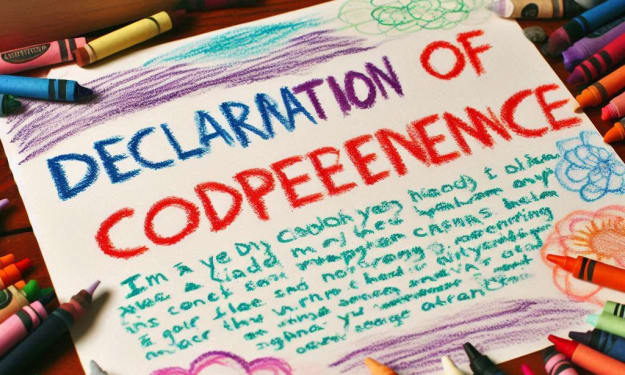
We the People of the Husbands of the United States of America, in Order to form a more perfect Union, and I mean you...with me...establish Justice, insure domestic Tranquility, provide for the common defence, promote the general Welfare, and secure the Blessings of Liberty to ourselves, after Puberty, do ordain and establish this Declaration of Co-Dependence.
By Gerard DiLeo7 days ago in Humans
Nurturing the Inner Compass: Talking to Children About Spirituality, Energy, and Intuition.
In a world increasingly dominated by technology and materialism, the importance of nurturing a child's spiritual, energetic, and intuitive understanding often gets overlooked. While traditional religious education provides a framework for some, a broader, more inclusive approach to spirituality can help children connect with themselves, the world around them, and a sense of something greater than themselves. This connection fosters resilience, empathy, and a deeper appreciation for the interconnectedness of all things. But how do we introduce these complex concepts in a way that resonates with young minds?
By Wilson Igbasi5 days ago in Humans
A Knight of the Seven Kingdoms Series Review (Season 1)
As one of the biggest properties in fantasy, A Song of Ice and Fire remains immensely popular with audiences. After reaching far into the past with House of the Dragon, a second spin-off was on the cards. A Knight of the Seven Kingdoms serves up a bite-sized slice of action and drama, but it still claims a spot among the best small-screen titles.
By Robert Cain6 days ago in Geeks



Comments
There are no comments for this story
Be the first to respond and start the conversation.