
"On Death And Dying"
Five stages of grief in "On Death And Dying"
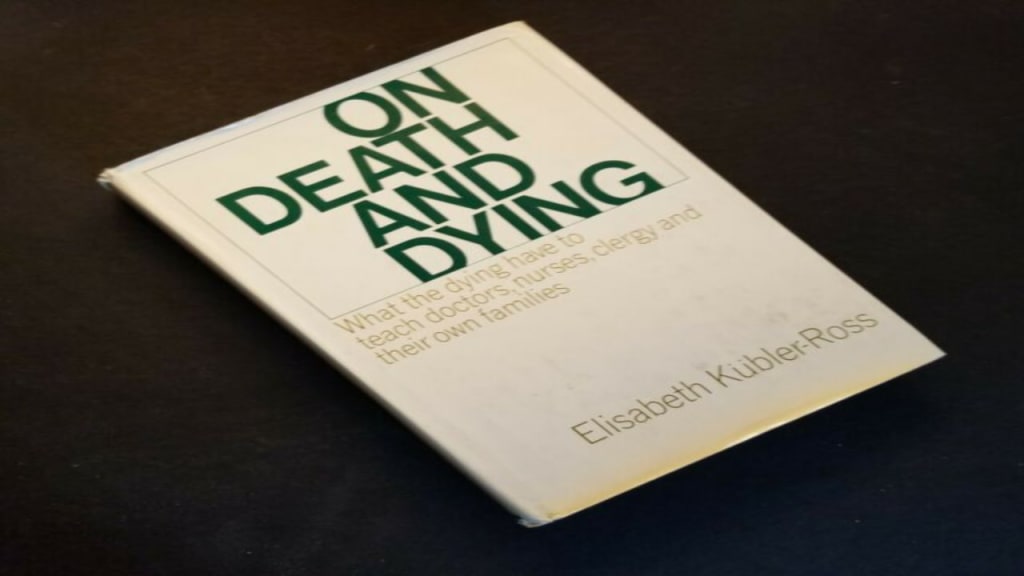
Kubler-Ross referred to five stages of grief in her book "On Death And Dying" published in 1969. These stages are just as applicable to the normal range of feelings people experience when they are handling change on personal level or in the workplace.
We experience that all types of change involve loss at some level. So the "Five stages" model has been very usefully used to comprehend people's responses to change for many decades.
The five stages of grief Kubler-Ross wrote about are considered to be universal and are experienced by people from all walks of life. These are:
i. Denial
ii. Anger
iii. Bargaining
iv. Depression
v. Acceptance
When Kubler-Ross wrote about these stages she was very cautious while explaining that these are typical normal reactions that we have towards some tragic was of the opinion that these should be termed defense mechanisms or coping mechanisms. And this is exactly how they function when we relate the model to coping with change.
Kubler-Ross was thought that we do not move through the stages one at a time, in a straight, direct, and step-by-step manner. That would be far too easy! What practically happens is that we inhabit different stages at different times and often even move back to stages we have been in before. She said the stages can last for different periods of time and will replace each other or exist at times side by side.
Let's have a look at how people might react in each of these five stages.
1) Shock or Denial
"I can't believe it", "This can't be happening", "Not to me!", "Not again!"
Denial is typically a temporary defense that gives us time to absorb the news of change before moving on to other stages. It is the initial phase of numbness and shock. We don't want to believe at all that the change is happening. The feeling is that if we can just pretend that the change is not happening, if we keep it at a distance, then maybe it will all go away. A bit like an ostrich sticking its head in the sand.
2) Anger
"Why me? It's not fair!" "NO! I can't accept this! “
When we realize that the change is real and will affect us, our denial usually turns to anger. We move to the second phase, and now we get angry and look to blame someone or something else for making this happen to us. Reality and its pain re-emerge.
What's interesting is that our anger can be directed in many different directions. We see people annoyed with the boss, friends, colleagues, family, themselves, or even God. Sometimes even the economy or the government to is blamed. You might notice others finding fault with the smallest things even.
3) Bargaining
"Just let me live to see my children graduate."; "I'll do anything, can't you stretch it out? A few more years.”
This is a natural reaction of those who are dying. It's an effort to delay what is inevitable and unavoidable. We often see the same sort of behaviour exhibited by people facing the reality of change.
We start bargaining in order to put off the change or find a way out of the existing state. Most of these bargains are secret deals with God, others, or life, where we say "If I promise to do this, then you make the change not happen to me".
4) Depression
"I'm so sad, why bother with anything?"; "What's the point of trying?”
When we realise that bargaining is not going to work, the reality of the change sets in. At this point we become aware of the losses connected with the change, and what we have to leave behind. This has the potential to move people towards a dejected state, they feel down and depressed with low energy.
People dealing with change at work may reach a point of feeling demotivated, discouraged and uncertain about their future. In such cases, one might notice employees asking why they should keep giving their best at work when they were unsure that their jobs were safe; and the organisation was obviously not committed to them.
Studies show that there is an increase in absenteeism at this time as people use sick leave and take 'mental health' days.
5) Acceptance
"It's going to be OK."; "I can't fight it, I may as well prepare for it.”
As people realise that fighting the change is not going to make it go away they move into the stage of acceptance.
It is not a happy space though, but rather a resigned attitude towards the change, and a sense that they must get on with it. Now for the first time people might start considering their options. It may be considered as a bit like a train heading into a tunnel. "I don't know what's in there, I have to keep going on this track, I'm scared but have no option, I hope there's light at the end..."
This can be a creative space as it forces people to discover and look for new opportunities. People learn a lot about themselves, and it is always good to acknowledge the bravery that acceptance takes.
Remember, Kubler-Ross said we cycle between these stages. One day you might feel acceptance and while getting coffee at work the next morning you hear news that throws you right back to anger. This is normal!
Although she does not include Hope as one of the five stages in this model, yet she adds that hope is an important thread running through all the stages. This hope is the belief that there will be a positive end to the change and that there is some meaning that will eventually be learnt from the experience.
It's also a huge relief to know that these reactions and feelings are normal, and are not signs of weakness or that they are falling apart.
The Kubler-Ross model is also very useful to identify and understand how other people are dealing with change. People immediately get a better sense of their own reactions and why colleagues are behaving in a particular way.
One thing however should be remembered that grieving is a personal process that has no time limit, nor one right way to do it.
Live, so you do not have to look back and say: 'God, how I have wasted my life'.
Elisabeth Kubler-Ross, (1926-2004)
About the Creator
Keep reading
More stories from Iqra Malik and writers in Humans and other communities.
5 Top Websites Paying $25-$750 to Freelance Writers For Writing Articles
Freelance writing provides an excellent opportunity to earn money while working from home. It's interesting for a writer to make money with your skill. You can work with neighborhood or worldwide clients. You can work with websites that look fascinating to you.
By Iqra Malik3 years ago in Journal



Comments
There are no comments for this story
Be the first to respond and start the conversation.