
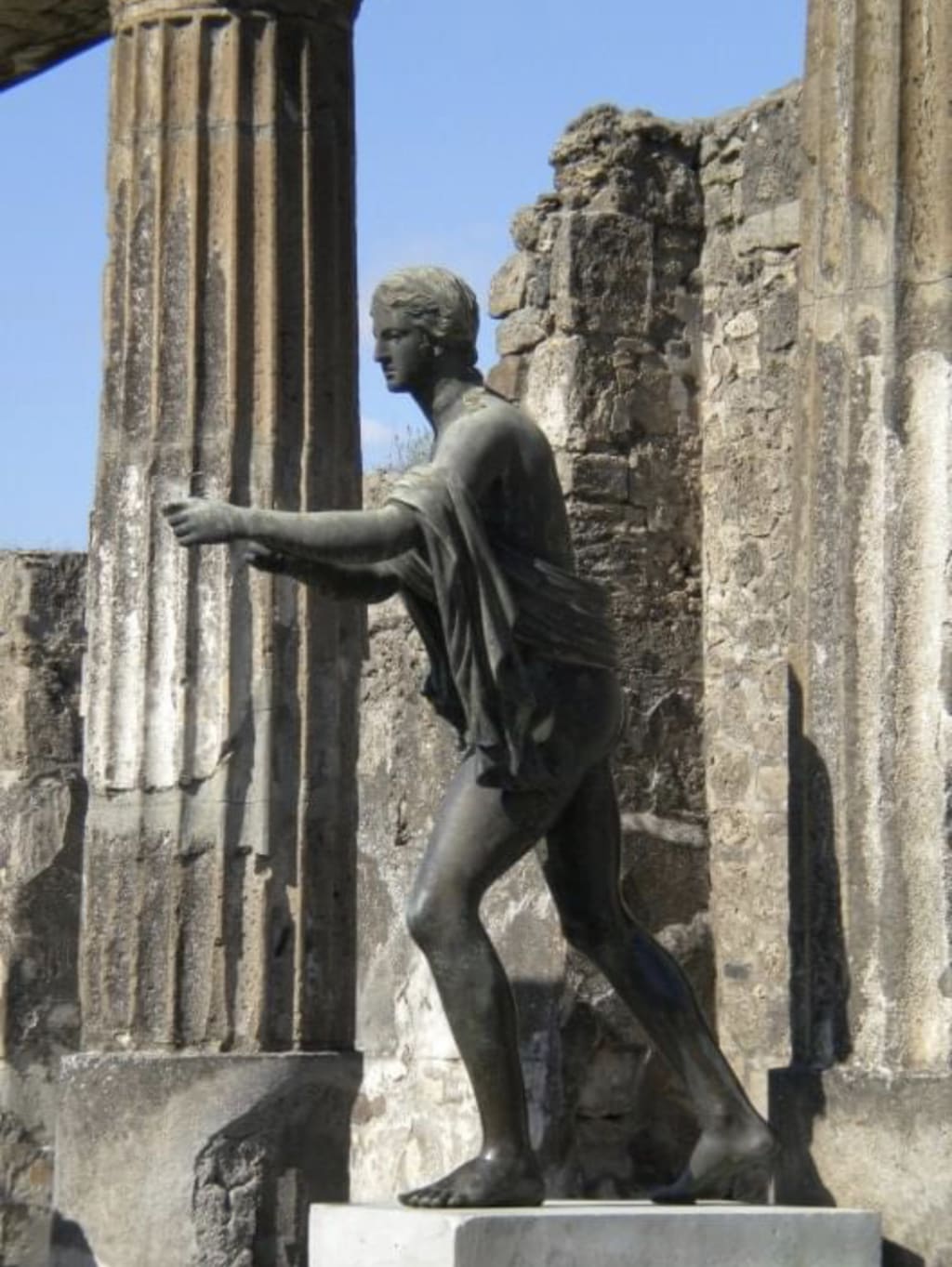
“The shadow still isn’t right,” Peter mumbled to himself as he compared his pencil sketch of the Foro Romano to the real thing. He’d anticipated this would be a quick sketch, but the shadows were proving particularly tricky, and he found himself obsessed with getting the details right. After softening the shadow with his finger and deciding it was still not good enough, he turned the page on his little black notebook and began again.
The old man looked on from a distance. He could tell the young artist was frustrated from his expression and the definitive way he turned the page. His angry motions to soften the shadows with his fingers were intimately familiar to him. He recognized that frustration, that drive to get the details just right, and felt a pang of sadness and a prick of excitement at the same time.
It was the young artist’s stillness that had made the old man notice him. Unlike the tourists, in a flurry of movements and conversations and selfies, he remained in place, hunched over a little black notebook. He’d been visiting the Roman Forum for the first time in over a decade, searching for the inspiration that had eluded him for twice as long and had observed the young artist for two hours, before watching him glance at his phone, pick up his sketching items in a jolt and sprint away. The old man didn’t even try to follow him, much as he was intrigued, for his old, weary bones would never allow him to keep pace. Instead, he showed up the day after, at the exact same spot at the exact same time, on a hunch he’d read the young artist’s drive correctly. He’d be back until he got the pencil sketch right.
It was what he would have done 60 years ago, when he too had been a budding artist and tortured himself over the details of each sketch and watercolor. “An artist never ends his search to emulate the perfections of nature and light, despite knowing he’ll never achieve them,” he’d been famously quoted as saying. Of course, when success came and the demands of commercialization caught up to him, he gave up the pursuit for perfection. The fame that came suddenly in his forties forced him to churn out piece after piece but allowed him to stop torturing himself. His name was synonymous with genius, and the prices his pieces commanded synonymous with value, so no one was looking close enough to notice they weren’t as sharp or bright or smart or great as the ones he’d started out with. The art he sold for those twenty years wasn’t exactly mediocre, but it wasn’t his best work and certainly didn’t reflect any growth or improvement, since he’d stopped caring about either.
Then, when he turned 60, his muse left him and his well dried up and he could no longer sketch or paint. He didn’t have ideas anymore and his will had left him, and he spent the next twenty years doing nothing but drinking and occasionally buying drugs and prostitutes and being a fixture of society in Rome and slowly squandering the fortune he’d made. Now, his 83 years weighed heavily on him and the prospect of his own mortality was becoming more real to him with each new day and each new ache and he’d recently become consumed with the idea of making a splash again, one last time. Of leaving a legacy.
His hunch had been right. The young artist had returned the next morning. Again, the old man watched the young one work from a distance, improving upon the sketch he’d started the day before. That afternoon he went back to his studio, feeling inspired for the first time in over two decades. He wondered what about the young man had stirred in him the desire to pick up a paintbrush again. Was it seeing himself reflected in the young artist? Was it seeing the determined look to get it perfect on his face? Was it a more primal competitive spirit waking up in him? Was he taking some of the inspiration from the young man’s muse?
On the fifth morning, the old man followed the same routine he’d followed for five days. This time he noticed less frustration in the young artist’s demeanor and a lot more stillness as he compared his work in the little black notebook to the Roman ruins that extended before him. “He’s close,” the old man realized with a sense of heartbreak. He knew that after today, the young artist would not return. He hadn’t even realized his legs were slowly shuffling until he was right next to the young artist.
“Ciao,” said the old man, simply. The young man looked up and stood immediately.
“You’re…you’re Edoardo Manera,” the young artist stumbled, reverentially.
:::
“That’s as good as it’ll get,” Peter thought ruefully as he looked back and forth between his sketch and the Foro Romano. He didn’t know why those shadows had given him so much trouble, but he was ready to move on to the next location. And yet, if I lighten this piece here… he sighed. He’d often bumped into trouble as an art student because his assignments were always late – he’d never known when to call a piece finished. Over the past couple of years, without the structure of school, this search for perfectionism had gotten worse, to the point that not a single piece he’d worked on was finished. Not finished enough to show to gallerists or prospective agents or even to try and sell at the County Fair back home in Idaho. And so, all the introductions the teachers at his program offered to make had been ignored, and the calls interested gallerists and agents made after seeing his pieces at the final art school show had gone unanswered, and the student that had once held the most promise out of his entire generation had never achieved a thing.
As a last-ditch effort to kickstart his career as an artist, he’d used his meager savings to buy a one-way ticket to Rome, hoping for the inspiration that had served so many of the artists he admired. During his two months there, he’d made ends meet while working odd jobs here and there that paid him under the table, since he didn’t have a work permit. In between jobs, he explored Rome, taking notes of anything that inspired or moved him and sketching different sites and people in his little black Moleskine.
His reverie was interrupted by the shadow of a man walking over, and when Peter looked up, he was shocked to see it was Edoardo Manera himself, one of the true living great artists. Peter knew that Edoardo was a Rome local, but he’d never even dreamed about meeting one of his idols while here.
“I’ve been admiring you while you work,” Edoardo said after Peter got over his shock.
“I’m… I’m a huge admirer of yours,” Peter managed to get out.
“Might I see the end result?” Edoardo said as he extended his hand to see the notebook. Peter silently handed it over, and Edoardo opened it on the third Roman Forum sketch and compared it to the other two, nodding his head as he did so.
“I can see why the shadows were complicated to get right, especially with this light, but the composition is excellent. What’s your name? You’re a talented artist, I can tell.”
“Peter Clarke,” he quickly responded. “I went to art school but can’t say I’m much of an artist at the moment, sir.” Peter took a quick look at the time, he needed to leave in five minutes to make his restaurant shift on time. If he didn’t, he might be out of a job since this would be his third strike and Giuseppe would be waiting for an excuse.
The old man looked at the little black notebook and asked, “might I see the rest?”
Peter nodded, ruefully smiling at the improbable chance one of the greatest living Italian artists would approach him out of the blue and ask to see his art just when he had to run to work.
“Signor Manera?” the old man had been engrossed in the notebook, looking at the sketches and notes Peter had made during his time in Rome. “I… I would love to stay and chat, but I have to get to work soon… I cannot be late or I’ll get fired. I’m…it was an honor to meet you, Sir.”
The old man looked at him and asked, “would you like to have a caffè tomorrow morning with me?” He didn’t know what had come over him, but he wanted more time with this little black notebook. “Could I keep this and return it then? Caffè Lo Spuntino, Via Spadari, 9 in the morning?”
All Peter could do in his shock was nod and repeat after the old man, “Caffè Lo Spuntino, Via Spadari, 9 in the morning,” before picking up his art supplies and sprinting off to work.
Edoardo spent all day perusing the black notebook. It was full of beautiful sketches of the main sites in Rome, as well as quaint observations about life there. He was particularly moved by the sketches of the inside of the Pantheon depicting Raphael’s tomb and the beautiful inscription next to it:
"Here lies Raphael,
by whom Nature feared to be outdone while he lived,
and when he died, feared that she would die with him"
And that’s when the idea began to take in his mind. The next morning, he showed up at Caffè Lo Spuntino in Via Spadari at 9 in the morning with a plan. The young artist was already there and smiled at him eagerly, breaking Edoardo’s heart. But he had to go through with it before he changed his mind.
“I’ll give you twenty thousand dollars for the notebook,” he said by way of greeting, setting the notebook on the table like a treasure and then lifting a bag he’d been carrying onto the table. “It’s all here if you’ll sell it to me. No questions asked.”
Peter stared at him in disbelief, his brain making sense of everything that was happening and making connections at the speed of light. “Are you publishing it as your own?”
The old man shrugged, “Maybe.”
Peter thought about it for a minute. He had been keeping the notebook for himself, not intending for the world to see it. He did need the money, but would he be willing to sell his art to someone else and let them publish it as their own? The old man’s interest must mean it was worth something, and he’d surely make a lot more than $20,000 if he ever published it. Peter considered negotiating, but the truth was he’d never get anyone to buy something like that for publishing from an unknown artist. As Edoardo Manera’s art it had value, but as his art, it was just scribbles. The old man had the advantage here. He wasn’t particularly attached to the notebook; he’d replicated the sketches and made similar notes elsewhere. Then it came to him, the best possible solution. He took yet another minute to make sure he wasn’t missing anything and then took the notebook in his hands and responded.
“I’ll accept the money and give you the notebook to do with it as you please and never say a word to anyone about it. If,” at this he said the old man stiffen. Of course he hadn’t been expecting a counteroffer. “If,” he proceeded, slowly and deliberately “if you agree to set me up with a meeting with your agent and tell the world I’m your protégé and greatest legacy.
About the Creator
Keep reading
More stories from writers in Humans and other communities.
Time to change your life.
Is it even possible for you to change your life? A lot of people, more than there should be, are unhappy with their lives. But what are they doing about it? Usually nothing. People talk about how shitty their lives are and want change, but are they not taking the actions to change?
By Jen Phillips2 days ago in Humans
“The Home That Taught Me How to Live”
I used to think advice only mattered when it was spoken clearly and loudly. I believed wisdom came in long speeches, strict warnings, or dramatic moments. But growing up, I slowly learned something deeper: the strongest advice often comes quietly, through family, through daily actions, and through love that never asks for attention.
By NAIB REHMANabout 22 hours ago in Humans



Comments
There are no comments for this story
Be the first to respond and start the conversation.