
Not White
Luck is a Circumstance of Birth

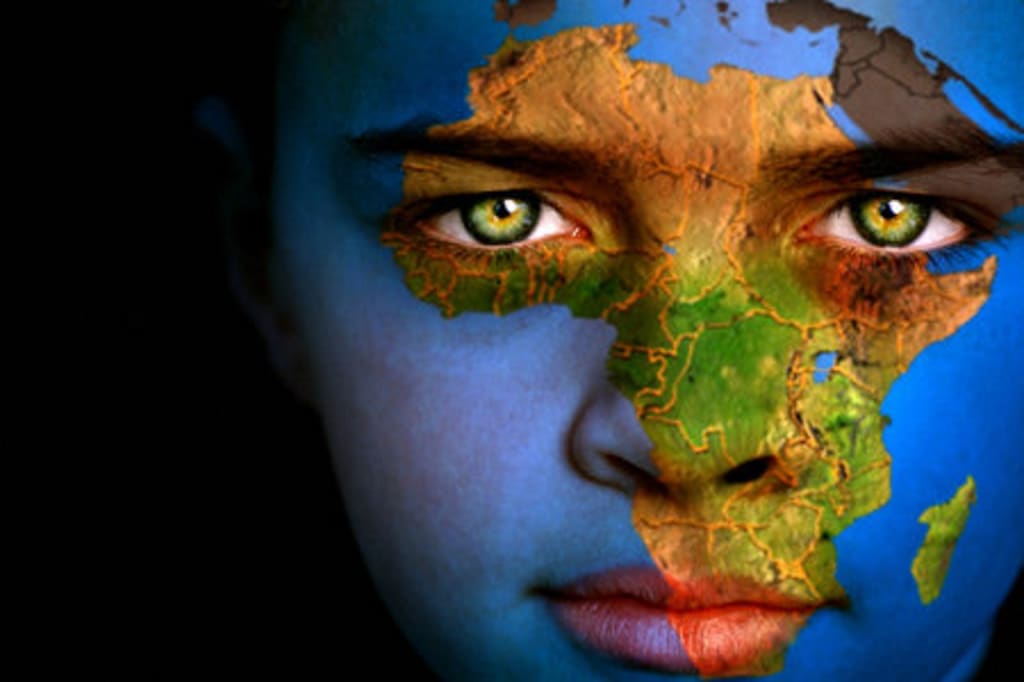
I am called lucky.
My skin is the color of the burnt sugar Grann stirs with her old wooden spoon as it bubbles and then cools to make sweeties. They tell me I was born the color of new butter, but Grann raised me up to worship and play in the sun. Until my first blood, she placed totems blessed by loas under my bed on every new moon. This, she said, is what sweetened my blood, pulling up the browns, oranges, and reds to color my skin’s surface.
My hair is the color of sunlight filtering through an oak tree’s dying leaves in the Fall. I witnessed a true Fall, once, as a Philadelphia child. One Fall day jumping in bright, dead leaves. One Fall day before we were chased back to New Orleans to escape the shame of a baby like me coming out of a mama like mine.
I remember my father laughing with me in the leaves. They were bright red and orange and gold. I still marvel at how something that is dying can be so beautiful.
Jumping in those dead leaves is my earliest memory.
My eyes are as green as the grass grows on the first day of true Summer. Granpapa says the color green means power, like the goddess Aja, like the alligator in the Lafourche that once saved his life when others were trying to take it, like the lushness of the jungles from where the First People first sprang.
Yet, I am not called lucky because the many colors of my hair, my skin, my eyes worship the Great Mother, Erzulie, and all Her glorious Creation.
My mama named me Chans, meaning lucky in my family’s old tongue of Creole, despite these things.
I am lucky my family’s name protects me, a half-caste baby conceived by a Black woman and White man. A long time ago I would be called a mulatto.
There are many who wish someone like me dead, who still want people like me to be disposed of as abominations. That a woman like my mama would lay down with a man like my father is inconceivable. Everyone knows that it's the women of every tribe who carry the power and the name. What my mother did was an affront to our family, and to the blood that was spilled to cast the White man back across the sea.
I used to wonder, but I now understand why I am lucky.
In a country where the worst thing you can be is a White man, and the second worst thing you can be is a White woman, I am lucky. I am lucky that the White blood of the slave masters on my mama's side and the White blood of my father did not fully manifest itself in me.
I am lucky, because of all of the bright colors running through me, I was born Not White.
____________________________________________________
It is my 12th, and last, year in school. It is the 19th year of my soul's journey within this body on this earth.
We have never celebrated White History before, but this year my school must observe it.
Three years ago the Great Council passed a law declaring the integration of Whites into the Four Tribes' school system. All White children from age 8 years old to 19 years old are bussed off of their reservations to Learning Lodges with the rest of us every day.
Some of their leaders have been fighting for their rights to learn, work, and live with the rest of us for hundreds of years. Because of pressure from great countries like Brazil and Kenya for us to forgive the past, efforts have been made to start letting Whites be part of our society again. It’s part of a bigger global effort by African, Latin, and Asian nations to help Europe and its descendants with development, infrastructure, and education.
Because of my family’s importance in representing New America, we have to publicly support it. Behind closed doors, we don’t want it.
White people are humans like us, with souls, but not as good as we are. Physically and emotionally they are less than us. They are devoid in spirit.
Even though my father comes from their tribe, I agreed when Grann fussed and banged pots around, talking about the destruction of our way of life as we knew it. I disagreed with my mama when her sad eyes flitted to mine and showed a gleam of hope that there could be a new future.
We were taught that before the Great Cause, all White people did was kill, rape, pillage, and steal. They did nothing worth celebrating. All achievements were reached off of the backs of the civilizations they conquered and stole from.
All Not Whites across the world know these truths, yet here I am, sitting in History class, listening to Gria Lee talk about White people’s history before the Great Cause.
I roll my eyes and look around me to see if my classmates are as bored as I am. Most roll their eyes or make faces back in agreement.
Some of them do not.
Since integration, some of my friends look at me like they are seeing my true colors, the ones I have been told to hide my entire life, the glint of emerald in my eyes, the pearly undertone of my skin, the fire shade of my hair that does not kink no matter how much wax I use or how small I make my braids every night. These colors remind my friends that I have as much of Europe as Africa running through my veins.
As I find myself often doing lately, I rejoice inside, thankful that my family’s name is in the Great Book.
I am protected.
A White girl with red hair and blue eyes raises her hand. Elizabeth is known for asking foolish questions, “We Whites ain't all bad people. Abraham Lincoln was the last White leader of Old America and he tried to do good. Some of us even tried to end slavery before the First People revolted. We just want to have all the same things you do. A chance to learn and get a good job and be happy. Why we still paying for what our dead great-grands did? Just because I got white skin I'm unlucky? We're just like you.”
She nods her head toward me and points, “Look at Chans, her skin and hair, and look at me. She’s so bad then?”
I feel the red in me rise, prepared to call her the name we are forbidden to call them. But then, I remember the plans of my grandparents for me, and the expectations of the Elders, and the sad eyes of my mama.
I hear whispers around me. I know the blood rushing up to my skin is bringing out the yellows and golds, making my hair look even brighter. I feel shame but remain silent.
My best friend, Kaima, throws her pen at Elizabeth. She gestures to the Not White people in the room, even Gria Lee. “Our people were great kings and queens. We built pyramids, created mathematics, and designed sewer systems while your people were living in caves and eating raw meat. We taught you people how to bathe, how to pray, how to season your food. And all you did was steal and hurt our people, taking what you could not do yourself. You're nothing like us and never will be. That’s why, slaver.”
We're not supposed to say that word out loud.
The Not Whites in the class laugh at my friend's speech.
Kaima never lies.
She is my best friend. Her skin is as dark as the night sky during the new moon, luminous in its darkness. Her hair is soft and billowy like cotton. She wears beauty and strength as her colors.
I sometimes envy that she can trace her ancestors back to one of the last ships to bring slaves from Africa. I often envy that there is no questioning the purity of her blood. I always love her.
I look at Gria Lee to see what she will do. She bites her lip and turns back to the board, letting Kaima's words go unchecked. I’m sure she doesn’t want Elizabeth and her kind here either. Whites are not as smart as the rest of us, and they are always causing trouble. Bussing them in from their neighborhoods to mix with us three years ago caused a storm all over the country, from our nation’s capital in New Orleans spreading out to all 32 Great Halls across the land.
There are rumors that Gria Lee is also half-caste, but it is not as much of a shame on her as it is for me. Whites in Old America didn’t quite enslave her people. Asiatics came here willingly, and got paid for their labor. Still, during the Great Cause, they, along with the Mixtecs and Natives joined the First People, free Blacks like my ancestors and revolted slaves. The Four Tribes joined together for the Great Cause.
Today, Not Whites comprise the Four Tribes of our country. My family sits at the Table of Elders in New Orleans along with the other families tasked with running the country. Our names are in the Great Book for helping to end the scourge of slavery and freeing this nation from the evils of the White race.
The First People killed the slave masters and sent those they pardoned back to Europe. The Whites that stayed were placed in servitude to build a new nation, New America. Their debts were eventually paid, but their sins will never be forgotten.
The way I look is a daily reminder of these sins. The sins of my mother for laying with, and loving, a White man, and the sins of my father’s people for existing as a virus on this earth.
I leave History class with my skin feeling hot, and feel the brightness of my colors stifling me.
Kaima and my other friends call my name, but I run down the hall to escape into the sun.
____________________________________________________
Brandon Branch and his friends stand in front of the exit. Some wear shirts or pins with flags of their ancestors’ native countries on them, Ireland, France, England, Germany, and even the old flag of this country before the Great Cause set us all free.
White Pride they call this, wearing old flags, talking about the White tribe as inventors, thinkers, and emperors from a time long ago.
They know these stories they believe are all lies, but they do it anyway. They should let it go. They lost. We won.
We won because we are the First People from where all life sprang. We won because we had the might of the Natives, Mixtecs, and Asiatics on our side. We won because the drums we brought with us from our homelands in Africa were steadily building to a crescendo of war while they sat fat and lazy in their big houses out of the sun. They beat, maimed, raped, and stripped us of our identities. Yet, we raised their children and cooked their food and built their country with our blood, sweat, and sacrifice.
The songs we sung while in the fields were filled with promises of freedom and vengeance. We used the drums and their cold religion to mask our plots and schemes. We danced at night to rejoice about how time would soon come to fertilize our lands with their blood.
The ancestors looked to Haiti as an example, a nation shining as a beacon of hope that the masters could be defeated. Toussaint Louverture's victory inspired them to first throw off their mental chains of bondage. They waited one generation, prepping their children to slowly poison and make complacent the White masters.
When the war drums sounded, the four tribes of Old America rose up. We killed the first born children, the fathers, and the mothers. Most of those left were the babies who knew more of the slaves than they did of their own families.
The slavers who lived, they either fled across the ocean in defeat or stayed and became servants to us. We rebuilt this country in our images. Their numbers will never again swell. The Elders ensure this.
They can never be trusted again, and they never will be.
To know I come from that blood sometimes disgusts me.
For that, I sometimes resent my mother.
For that, I will never acknowledge Brandon Branch or any man like him.
He winks at me, blowing a kiss as I push past him and his friends to find the sun. He foolishly flirts. He doesn’t know that if I only said the word, by dawn he could be hanging from a tree in the bayou, his manhood stuffed into his mouth as both a warning and a curse.
I look down at the ring on my right hand. Its colors glint in the sun. Mama gave it to me the night I first danced with Erzulie in the swamp like all the women in my family have before me, even before we were free.
The sun I was raised to worship comforts me as does the ring winking and twinkling on my hand. Its gems are the colors of our country’s flag; blue, green, and red. Blue is for the oceans the ancestors of the Four Tribes crossed, whether willingly or in chains, to create new lives in a new world. Green is for the land the Four Tribes reclaimed as our own. Red is for the blood all of our ancestors shed to be free.
Colors comfort me like sweeties or prayers or a song.
For some reason, I think of my father. After my mama was threatened with imprisonment for breaking the law and living with a man like him, Grandpapa made her come home. He used the power of his name to protect his daughter and the baby she bore out of love, loving me despite the shame my existence brought onto his family.
I had secret meetings once a year with my father until I learned my name’s true meaning. When I learned why I was named Chans I asked Mama to stop taking me to see him. Then, I asked him to stop calling me. Then, to even stop writing.
Not soon after that he died.
The last time I saw him he told me it was good my skin had darkened from spending all of my time in the sun. He said it was good that my hair had lost its baby straightness and begun to curl, even under water. He told me to press my thumb down hard on my nose every day to make it rounder, flatter, less like his.
I laughed at him, but even then, I could see in his eyes that he hoped it would work.
It didn’t.
I sit down on a bench and take out the small mirror I keep in my satchel, gazing into it at all of my colors.
I close my eyes and think back onto the day when I played in dead leaves. I remember the love he had for me and wonder what the world would be like if there were no tribes and we were only just people.
Kaima comes and sits next to me, wrapping her arm around my shoulder. She turns her face up to bask in the sun as the tears begin to fall down my cheeks.
I remember how my papa had pink and olive and tan and sometimes even brown as his colors. That's the thing I've never understood about what we call them. They have so many colors. We all do.
None of us are really just one color. All of us are Not White.
About the Creator
Keep reading
More stories from writers in Humans and other communities.
The Angry Man in Your House
"If you grow up with an angry man in your house, there will always be an angry man in your house" This statement has caused plenty of controversy online, people say its a statement that blames victims while also undermining those who break traumatic cycles to form health relationships... but if I'm honest now that I'm in my 30s it makes more sense to me than ever, and I'd argue that its not just about fathers and uncles.
By S. A. Crawford5 days ago in Humans
Finding Serious Relationships While Dating Locally In A Digital World
In the contemporary world, dating has become both an opportunity and a challenge to the singles who would like to be in serious relationships. Local dating, be it in the form of apps, social media, face-to-face connections, etc., is also commonly affected by the digital culture, and it might blur the intention and promote more informal interactions. The singles that want to find meaningful relationships have to navigate this world with purpose, clear expectations, and understanding of digital and real relationships. When it comes to local singles, the judicious use of digital tools to complement the traditional methods of building relationships can help them to get better odds of getting partners that are interested in a long-term commitment and that are emotionally compatible.
By Grace Smitha day ago in Humans
Should We Not Try to Get Too Political?
Here's something you often hear people say, "I try not to get too political." I understand the sentiment and I sympathize with it... while at the same exact time, I completely disagree with the notion. Whether it's referring to social media or wherever, it's kind of unavoidable. You can attempt to sidestep it, not engage, leave the less important things for actual politicians to discuss... you can want it to not take over your life, your conversations, your relationships, and that makes perfect sense.
By Stephen Kramer Avitabile7 days ago in Writers




Comments