
Newton's Secret Studies: Pyramids and Prophecies
Unpublished documents reveal Isaac Newton's exploration of the Bible, pyramids, and apocalyptic prophecies.

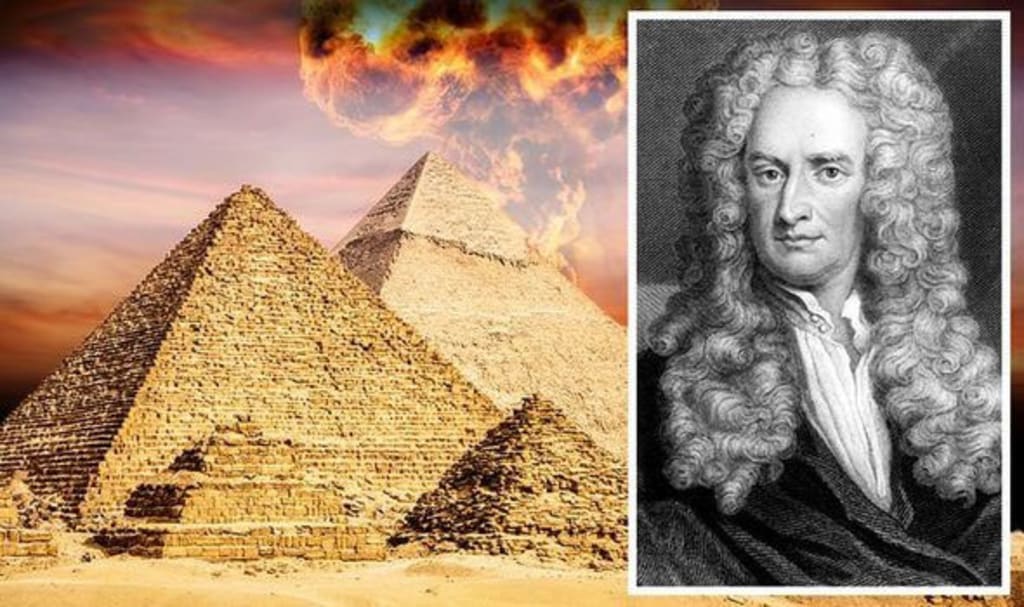
Isaac Newton, the British scientist widely regarded as one of the greatest and most influential figures in the history of science, is most famous for his groundbreaking theories in mathematics, physics, and gravity. He revolutionized the way we understand the laws of motion and universal gravitation, providing the foundation for classical mechanics. However, mathematics and physics were not the only fields Newton devoted his time and energy to. It wasn’t until two centuries after his death that it was discovered that Newton had also engaged deeply in the study of alchemy and theology—subjects that were far outside the scientific mainstream of his time.
Recently, previously undisclosed documents have surfaced, revealing that Newton sought to decipher the mysteries of the Bible and predicted the end of the world. Among these findings are three pages of scribbled notes on the Egyptian pyramids, which Newton believed contained the key to profound and esoteric knowledge. One of these papers has scorch marks, likely from Newton’s dog Diamond, who was notorious for knocking over a candle and setting fire to his owner’s notes.
"This is fascinating material because it shows Newton’s desire to unlock the secrets of the pyramids... these documents lead readers into the most profound questions that Newton himself was investigating," said Gabriel Heaton, a manuscript expert at Sotheby’s, speaking with the Observer. The documents, now up for auction, are expected to fetch hundreds of thousands of dollars, providing a rare glimpse into the unorthodox side of Newton’s research that had long been hidden from the public eye.
Newton’s fascination with pyramids began in the 1680s, at his family’s Woolsthorpe Manor. Unlike his scientific peers, who were focused on astronomical observations and the application of mathematics to explain natural phenomena, Newton believed that ancient structures such as the Great Pyramid of Giza held the answers to fundamental questions about the universe. He attempted to uncover the units of measurement that were used in the construction of these ancient monuments, believing that by determining the size of the Great Pyramid, he could calculate the circumference of the Earth.
But Newton’s ambitions went far beyond mere measurements. He hoped that understanding the dimensions of the pyramids would provide a key to unlocking the ancient systems of measurement that were used by the Egyptians. These, in turn, would reveal insights into the construction of other monumental structures, including the fabled Temple of Solomon, which Newton believed was tied to apocalyptic predictions mentioned in the Bible.
"The Egyptians were thought to possess knowledge that had been lost to the modern world—secrets of alchemy and other ancient sciences that we have only recently begun to rediscover," explained Heaton. "Newton was particularly interested in these lost secrets, and he was determined to find evidence that would confirm his suspicions about ancient wisdom."
Newton’s obsession with alchemy and the mystical properties of the ancient world was not limited to his studies of pyramids. He was also deeply fascinated by the concept of esoteric knowledge—hidden wisdom that could explain the mysteries of the natural world and the divine. This preoccupation with the supernatural led him to spend countless hours attempting to decode the Bible and predict the precise moment when the world would come to an end.
For Newton, alchemy was not just a mystical pursuit, but also a scientific endeavor. He believed that the ancient Egyptians had uncovered secrets about the nature of matter and the processes of transformation that could be used to manipulate the physical world in ways that modern science had yet to discover. In his alchemical experiments, Newton was searching for the Philosopher’s Stone, a legendary substance said to have the power to transform base metals into gold and grant eternal life.
At the same time, Newton’s religious beliefs were unorthodox for his time. While he is often regarded as the father of modern science, his deeply held convictions about the nature of God and the universe were far removed from the rational and empirical thinking that would later define the Enlightenment. Newton believed that science and religion were not at odds, and that the study of nature could reveal the divine truths hidden within creation.
Newton’s religious and alchemical studies were so important to him that he considered them to be more significant than his work on gravity and motion. Despite his monumental contributions to science, Newton believed that these achievements were secondary to the "greater" research he conducted in alchemy and theology. The scientist himself regarded these studies as the pursuit of the ultimate truth, one that transcended the boundaries of physical reality and entered the realm of the spiritual and the metaphysical.
The idea that science could eventually replace religion was a notion that was not shared by Newton. He viewed his scientific endeavors not as a challenge to religious faith, but rather as an extension of his belief in the divine order of the universe. Newton often argued that the study of nature, through the lens of scientific inquiry, would reveal the hidden hand of God at work in the world. He believed that the ultimate purpose of his scientific research was to uncover the divine wisdom that lay behind the laws of nature.
"Newton did not think that his work in science could undermine religious faith," said Heaton. "For him, the study of the natural world was a way to glimpse the mind of God. He spent years trying to predict the end of the world, and this is why he was so interested in the pyramids. He believed they contained the secrets of the universe and the divine plan."
Newton was often described as a complex and contradictory figure—brilliant and visionary, yet also deeply paranoid and obsessive. His contemporaries frequently depicted him as secretive, neurotic, and prone to fits of anger and bitterness. He was known for his unyielding determination to uncover the truth, even if it meant alienating those around him.
Professor Patricia Fara, a historian of science at the University of Cambridge, offers a somewhat less flattering view of Newton. "He was a man who thought of himself as a messiah," she said. "He believed that he had been chosen to reveal the secrets of the universe and save the world. His obsession with alchemy and the apocalypse reflects this grandiose vision of his own importance."
Despite his eccentricities and controversial beliefs, there is no denying that Newton’s contributions to science laid the groundwork for much of modern physics and mathematics. His laws of motion and theory of gravity are still taught in classrooms around the world, and his work continues to influence scientific thought to this day.
However, the newly discovered documents reveal a different side to Newton—one that was deeply immersed in the mystical and spiritual dimensions of existence. His studies of the pyramids, alchemy, and the Bible show a man who was not content with merely understanding the physical world. Instead, Newton sought to uncover the ultimate truths that lay behind the fabric of reality, truths that he believed could only be accessed through a combination of scientific inquiry and spiritual exploration.
As these documents are auctioned and their contents are studied in greater detail, they offer a fascinating glimpse into the mind of one of history’s greatest minds—a mind that was not just focused on the natural world, but also on the mysteries of the divine and the ultimate fate of humanity.
About the Creator
Eleanor Grace
"Dream big.Start small.Act now."
Keep reading
More stories from Eleanor Grace and writers in Humans and other communities.
The Hidden Power of Shame: A Survival Instinct Shaping Society
Why Do We Feel Shame? "Don't be shy! Just go and talk to her." Have you ever received this advice before? The feeling of shame and embarrassment is something we all experience, yet we are often told to overcome it. It is an uncomfortable emotion, and many believe it is a weakness that should be avoided at all costs. But if shame is so undesirable, why has it persisted throughout human evolution? Why do we, the most intelligent species on Earth, still carry this seemingly unpleasant emotion?
By Eleanor Grace10 months ago in Humans
Autonomy Is The Real Privilege
Good morning, freedom-seekers! Today we’re gonna be looking at autonomy. A strange word, I know; one many would probably look at blankly and run away from on sight. We’re gonna figure out what it actually means, consider how it’s achieved, and decipher just how deeply most of us are tangled up in dependence without realising it.
By That ‘Freedom’ Guyabout 6 hours ago in Humans
Is Costco Open on MLK Day? What Shoppers Need to Know
Holidays often arrive quietly, then disrupt plans when we least expect it. Martin Luther King Jr. Day is one of those days. It is a federal holiday with deep meaning, but for many people, it also brings practical questions. Work schedules change. Schools close. Errands get delayed. Somewhere in the middle of reflection and routine, a simple question comes up every year: is Costco open on MLK Day? For families planning grocery runs, small business owners stocking supplies, or anyone trying to manage time wisely, this question matters. Understanding how Costco treats this day helps avoid frustration and last-minute confusion. The answer is not complicated, but the context around it is worth understanding.
By Muqadas khanabout 12 hours ago in Humans




Comments
There are no comments for this story
Be the first to respond and start the conversation.