

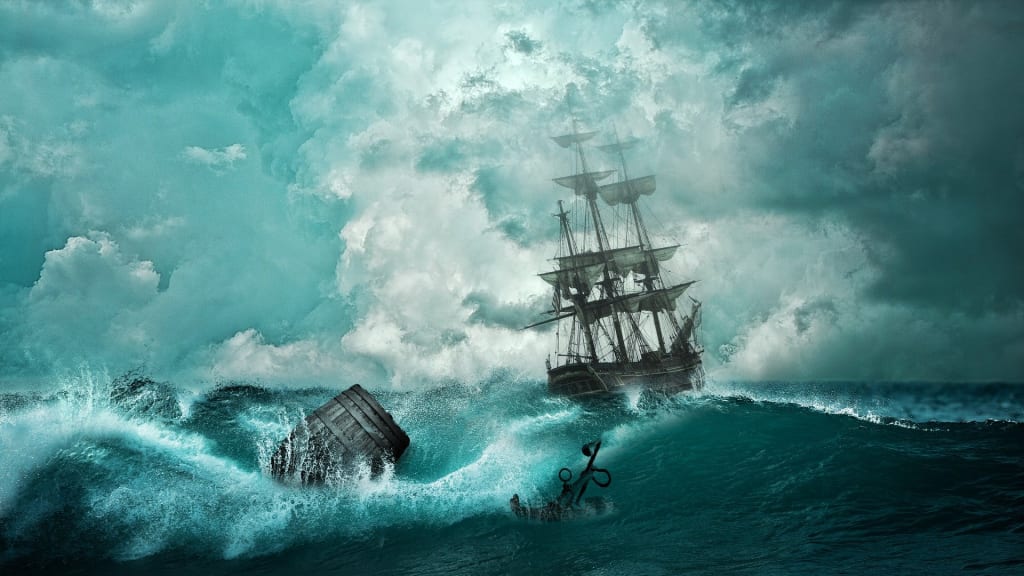
If the ship had known why it was headed for the new land, it would have refused its mission a long time ago. Too long ago to even remember the faces that it left behind at the shore, where hefty men, set in their frame, and set in their ways, held back grieving mothers in tears, from their children as they walked on board. Once the last child's feet stepped onto the ship, the remaining men followed suit without haste, and what looked like to be the leader of the group, wearing tan pants with a cream cotton shirt and black shawl, signaled to the Captain to leave. But the ship knew nothing concerning the destiny that awaited its trepid young passengers, and so compliantly set sail along the path that so many other ships had gone before, heading straight for the Atlantic Ocean.
This summer was unlike the past three trips, which had yielded more than fair winds for the sailors on board. But this voyage was different, and the weather seemed to almost start to understand the sin of the men who lead the mission, along with their prior journeys, and decided their punishment was long overdue. But it was helpless in administering justice, for the children also suffered from every tempestuous surge, whispering softly among one another as they tried to comfort their own kind.
The three months morphed into one period of time, and the days were lost in the weeks, and the hours were only known by every second, as each second tried to prolong the heaviness of life on the ship. For every day was grim and every night was torture. But the children mainly knew the night, for they were kept in the storage room, reserved for them and the barrels of rice and sacks of coffee beans. Yet they had only tasted the rice – when one of the children asked the men for a sip of coffee, the response was that it was being saved for the end of the trip, to share with others. And so the children understood, because they were all taught that food was to be rationed among the people. Yet the men failed to tell them that there was no portion allocated for them. The coffee was to be shared, but not with them.
They were all boys. All twenty-five of them were still in their youth, with the youngest being 10 and the oldest no older than 18, all with the same length of hair. The same boys who were once chosen because they were well-fed and showed signs of strength, now showed signs of starvation, with their gaunt faces and cheekbones jutting out of their faces. Even the cheese which the men had on board had started to mold, and the rats were just as in need. One child, named Obi, aged 15, became sick with fever and smallpox, his body breaking out into rashes. He was separated from the other children to get fresh air for several hours every day, but it was in vain, for within a few days he died and his body placed in a barrel. Seeing death for the first time, this was a mystifying event for many of the children, filled with sadness and stoicism. It was all the sympathy they could muster because life was no better than death for them these days. Whether to envy him or to grieve him they did not know, except for another boy who seemed to be Obi’s relative; his face was not found without tears for several days afterwards.
“Prepare a letter for his mother” commanded the leader of the men when he was informed of the child's sudden demise. He looked distressed and quickly changed his mind “what good is it, he was dead to her when we took him. Never mind the letter”. "It will just make matters worse for her" he muttered to himself. He terrified the children at most points, but every now and then, a side of him that was remorseful and empathetic, usually reserved for his own people, came out. The reality of the waves hit him, and he pointed his finger towards the stern “throw the barrel far, and don’t let any of the children see it”.
A month later, when all the men no longer bothered to hold their peace, hurling their frustrations at each other, angry at their call in life to endure the hardships at sea, the ship saw the trace of land on the horizon. The harsh words that came out from the men quickly lost their viciousness and even a smile or two was exchanged among them as they looked forward to seeing their wives and the land they called home.
In anticipation for what was to come, the children were led out of the heart of the ship, and they squinted from the sunlight that struck them and lit up the new world ahead. Even amongst themselves, they started to smile at each other and dared an attempt at joy, as they realized that they had finally made it to where they were headed. One of the men came and stood next to two of the children as they looked towards the land. “That is the land of the brave. You work hard and it will be worth it because we are building the envy of the earth.” The boys, shocked because they were spoken to in an almost kind manner, quickly accepted the statement and nodded, without making eye contact, showing that they were listening. They pretended to understand what the man was speaking about, but each boy knew that himself and the other were completely unaware of what the man referred to.
“In line!” yelled one of the men, and the children ran from where each was standing peering over the side of the ship into a straight line, each hastily trying to stand next to the friends that they had made over the past three months. Two of the men grabbed the fresh rope that laid on the side of the quarterdeck and tied it around the hands of each of the children, binding them one to the next. The rope was loose around the youngest boys’ hands, so they tightened the knot around their hands by themselves, in an effort to be helpful.
As the ship approached the land, every set of eyes was fixed on the piece of land, which over the course of two hours had turned from just a raised line, to some spikes and various colours, showing signs of civilization, and then finally what looked like a port with other ships also nearing. The ship was in much worse condition than the others that approached the land, with the main mast showing signs of shredding, and the hull thoroughly faded and chipped, lined with rust.
The land was now some sort of city with people, yet each structure was far enough spaced and all the people were in small groups, each group trying to complete some task, while others lingered or waited near the shore, looking out towards the ocean. The children eagerly watched the men, on the ship, and the men on the land. There was even a few women who were with some of the men, and also some children. Now close enough to see everything, yet shocked into silence, none of the children dared to say a word to each other while the men on the ship were present, yet the older ones noticed what lay before them. Something their mothers had mentioned something to their fathers of so many months ago. There seemed to be some people well-fed and healthy, while the ones who were working were lean, almost gaunt and bony like the children themselves. And there was a stark difference between the two groups, and the difference was clear enough to once again bring sadness to the boys’ eyes, and the clarity made them understand, without any words, that their journey was not a desirable one, even less their purpose, and that their lives would not be their own.
About the Creator
Keep reading
More stories from Prarthana Chandran and writers in Humans and other communities.
Are Fat People Disabled or Are Disabled People Fat?
There is a question people ask quietly, sometimes without even realising they are asking it. It lives in looks, assumptions, and comments muttered under breath. It sounds like concern, but it is actually judgement. It goes something like this: why are so many fat people in pain? Why are so many fat people using mobility aids? Why are so many fat people struggling to move?
By No One’s Daughter6 days ago in Humans



Comments
There are no comments for this story
Be the first to respond and start the conversation.