
More to Me than Winning
Entry for "The Remarkably Real Challenge"
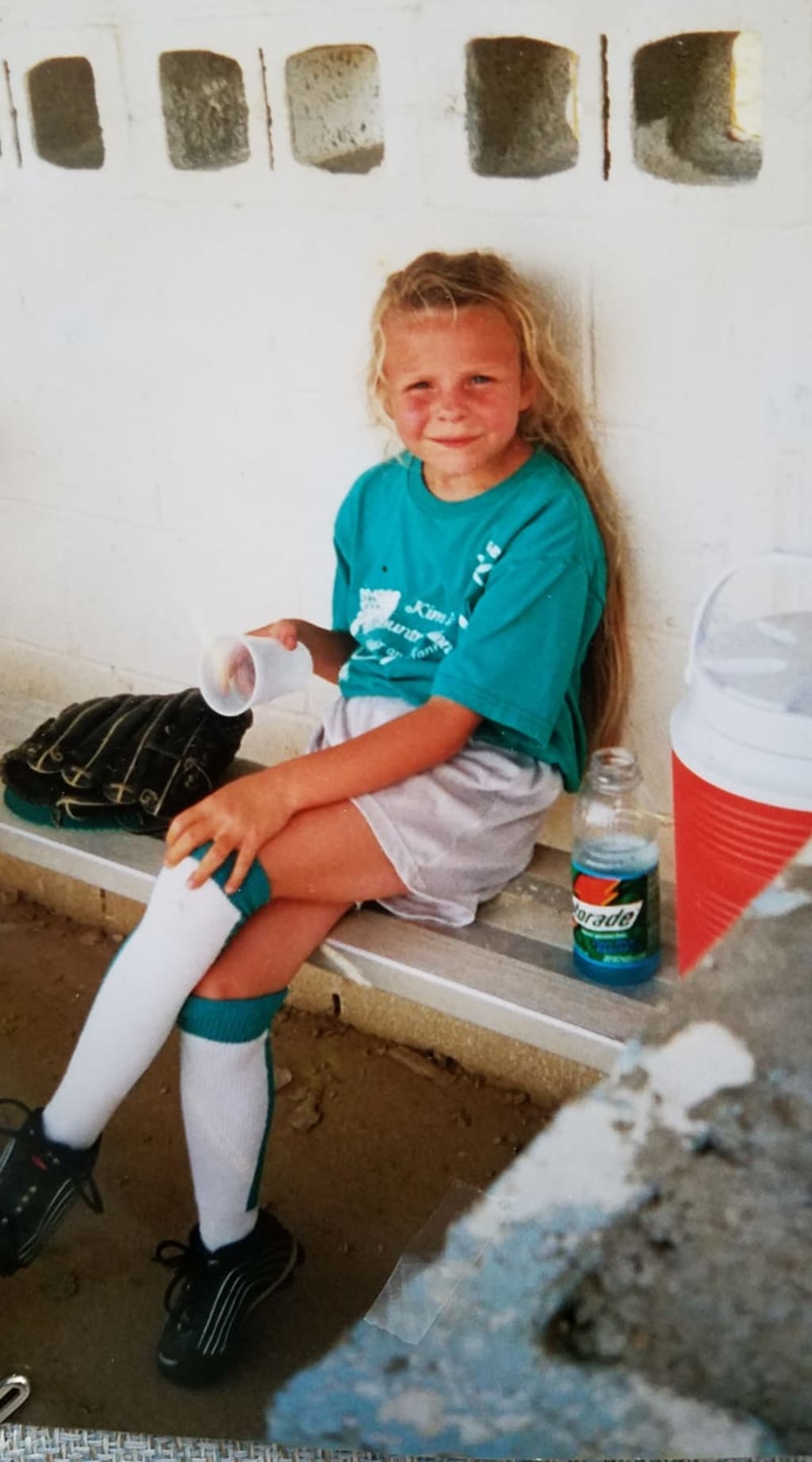
I have always had a complicated relationship with softball. Well, perhaps not always. I can faintly remember a time where playing softball was an expression of my youth--a period that felt like limitless potential for growth. In my deeper memories, I am surrounded by other kids whose uniforms are entirely too big and who had snot dripping from their noses (though, I always seemed to be the snottiest somehow). That was a simple enough time; we didn’t know much of anything, and so little was expected of us. We were a recreation league team, full of girls with varying experience. If not for the choice our parents made to stick us in a team together, I’m not sure some of us would have ever met at all. Looking back, there is something nice about that. In no way were we actually very talented at this sport, but we showed up anyway and learned.
Admittedly, some of us were quite a bit more serious-natured, even in youth. Enter a particular dirty blonde, curly headed girl, with long legs and a toothy, awkward grin and squinting eyes. And yeah, that’s me in this old photo that my dad keeps hung up in his work cubicle. That's me, a girl who literally refused to look her coaches in the eyes for years, but who seemed nonetheless to stare intensely into things not quite seen or understood. That’s just how I was--serious--to a fault, I would even say. For example, I would never cry in front of anyone. Funny to call them softballs really, because they hurt like hell when hurled at you, nailing you right in your weakest spots at times (elbows, knees, ankles, stomach, or right in the helmet, making your head ring with vibrations). I would just spring into action though, as if I had never even felt it. Coaches, including my dad, would force me to stop so they could check on me. I would grit my teeth and say ‘I’m fine, I'm fine!” And you know, I strangely was fine. Something about being there, in that game, taking the blows and bouncing back up, it was all very straightforward. It felt good.
But then, at some point (and I struggle still to find out where the shift occurred) it did not feel good anymore. I think someone recognized my dedication to the sport, when I was around 10 years old. There was a coach trying to form his own travelling, competitive team. He plucked girls from the rec league who looked like they could be promising. I was actually younger than many of my 12-year-old cohorts, but I was learning faster in this new environment. I found something with them (which, spoiler alert) I eventually lost. Friendship, a more substantial kind than I had yet known as a youth. We spent so much time together, bleeding and sweating together, losing a LOT of games together, and I had never felt so connected to other people and to softball as I had then. This type of relationship had some sort of perfect balance that is very rare to find--a combination of playfulness and maturity, and of constructive challenge and unconditional support. Considering everything that followed, that slow decline into one of the darkest times in my life, I could still never regret those years I spent with those girls. They made everything worthwhile. It didn’t matter to me that we lost so often. I was playing.
I found my niche in the outfield, soaring to catch pop-flys and hurling the ball toward home with all my might. Exhilarating, and it always had an instant payoff, which is that sound and feeling the ball makes when it lands squarely in the mitt. And to be honest, I was still a bit of a quirky kid, with hair that was way too long and messy with curls and waves. I wore my socks too high on my thighs and my visor way too low on my serious brow. But we were, if anything, a team of misfits--all shapes and sizes. All drawn into this experiment of a team, competing against feeder teams for high schools filled with solidly middle class girls. Those teams had a purpose different than ours; girls on feeder teams had the ulterior goal to show their worth as athletes to the adult men who eventually would be their high school coaches. Now that I look back as an adult, I can see why that arrangement doesn’t sit right with me. Something about it seemed...still seems...predatory.
You’re probably wondering by now why I said things started to change for me then, considering I have only talked about the good things. My trauma, in truth, has nothing to do with those teammates I adored so much; they actually saved me, I am sure of it. My mother has had very high standards for me since I was a child. She was a strict but loving, authoritarian type--the kind of “Do what I say because I say so kind of parent.” I don’t doubt she loves me. Even now, I see that she wanted to help me, and just did not do so in a healthy way. She wanted me to be ready for a world of unfairness and harsh conditions. As strict as she was, I always justified it by saying “At least she was present.” She helped me with homework, we did crafts together, she came to all my events. She cared. Just sometimes, I wonder if there wasn’t some greater motive. And sometimes, I wonder if any of my accomplishments were really my own.
The situation with Mom got worse. And it stayed bad for a long time. Her mental health suffered a devastating blow when I was in 4th grade. Her mother, my grandmother, died of Emphysema. It sent our family reeling, because when my mother suffered, we all did. That was the year she slapped me in the face for failing a school assignment. Later I heard her tell an adult “Her grades are a little lower this year because she is having a hard time coping with her grandma’s death.” Well, that was partly true at least. But more accurately, I see now that I was shouldering the load of a parent’s grief, when I did not even fully understand what grief was myself. I had never experienced the death of a loved one before, but I was expected to know what my mom needed from me. I got the message loud and clear when the slap happened; she needed me to be infallible. Or at least not such a failure that it would necessitate her interventions. She never did apologize for that. My dad came into my room to comfort me, to tell me that my mom regretted hitting me. But no apology.
I threw myself into my schoolwork, and into softball which I tried to make an oasis for me. When you’re in the game, you’re supposed to only be in the moment. I was really good at that. My mom could try to yell from the sidelines every time I made a mistake, but there was a freedom on the field that came from the barrier fences between us. She was just an onlooker, and I was alive and active, creating something she couldn’t do. Those moments didn’t last. Every post-game car ride lecture about all the things I did wrong would have me biting my lip and digging my nails into my palms. Biting back tears, biting back quips, because talking back resulted in even longer spheals. And I couldn’t get away. I turned myself into stone. I stared out the window and I would never cry. I wanted her to know she did not affect me. I wanted to be above it. But even writing this, I feel the sting in my eyes and the choke in my throat, and the burning tightness of my muscles as I strained to keep stone still. I WAS affected. I DID feel every cut of her words. And that was a seed of doubt, a wriggling thought that I really must not be trying hard enough and therefore wasn’t good enough for this sport I so loved, that poisoned me slowly.
I was a master at passivity, in outward appearances, but inside I was always screaming at myself that anything less than perfection wasn’t good enough. Mom’ criticisms, but in my voice, I told myself that I couldn’t let my mom “win” and I had to prove myself. So to my friends, I was the sweet, kind, and a bit naive little sister they adored and wanted to protect. (Well, some wanted to corrupt me just a little, to get me to loosen up, and I can completely appreciate that now.) It wasn’t until adulthood that I learned some of them had been shocked to hear my mom berating me in a hotel room one night, during travel season. They said they hadn’t known she could be like that, and I believed them. I was the paragon of a well-adjusted and successful child, always helpful and patient, though a bit serious. How could they have known?
I pretended as if my mom wasn’t even there. I immersed myself in the practices and games and allowed myself the release I so needed. But, as you can now imagine, my sense of self-worth hinged greatly upon my personal achievement in the game. Every missed play or error, every dropped ball or strikeout, I weighed these against my successes to try to calculate whether I was in the “deficit” or whether I had been at least adequate. Those were the only two options I could be graded with, as praising myself just wasn’t something readily done. I hadn’t learned it, and so my mind clung more readily to losses than wins. Being benched occasionally was a reality I had to face; it was fair to give everyone equal playing time and that rule was not imposed with malice on my coaches' part. And still, I started to weigh that too. I considered how much more sure and steadfast I had to be once back on the field, since I had a smaller window to test my skills and prove myself. And wouldn’t you know it...that way of playing wasn’t fun.
High school softball was another beast entirely. Girls that had known each other since childhood dominated the scene, as they all came from the same feeder teams. And then there was me (and maybe a couple others like me). I don’t exaggerate when I say my history and family ties (or lack thereof) made me a second-class teammate. That’s small-town politics for you. But at least the Freshman were on equal footing as the “fresh meat,” necessitating that we defer to our elders while we learned. The coach was a no-nonsense man who had a long tradition of winning seasons to uphold. Softball is huge in my hometown. The team is a highly trained and disciplined one, making it even more imperative to show a work ethic that fits that team culture--and I was no doubt a bit behind in visibility to my peers.
That disadvantage didn’t dissuade me in the least though. I felt I was ready for that challenge, and completely optimistic that this would be the highest achievement of my passion yet. I had never played for any other reason than that I loved playing. And, if I’m being honest, I was a bit sheltered in my Freshman year. Luckily for me, a few of the Senior girls took me under their wing. One gave me my new nickname, Sunshine, because I reminded her of Olive from “Little Miss Sunshine.” I had never seen it, but it felt important. I felt important. And I admired those girls like heroes too; not only were they gorgeous, smart, and highly talented athletes, they were welcoming and fair. They were standout leaders, and I wanted so much to be like them. I didn’t play a lot in official games, but I was happy to be growing and it felt nice to be in a winning team which was no less than a well-oiled machine. My coach even complimented me at an awards ceremony, for being a “student of the game.” I soaked everything in like a sponge--a strategist. It made me feel like I was soaring. And better still, my mom had no part in it. She couldn’t take any credit for these titles that I had earned.
All of this made me think I was free from the oppressive thoughts that plagued me during travel ball season. The truth is, I just wasn’t facing them. And there will always be people out in the world, in our communities, who feel the need to use vulnerabilities against others. The Seniors moved on, and I moved up, but only relatively speaking. The class just above mine was itching to take hold of the power they had “earned” by being upperclassmen at last. A power which they wielded immaturely, to say the least of it. Many of them didn’t strike me as being particularly talented, but that did not matter to me. What did matter was the lack of sportsmanship and dedication. I didn’t feel the warmth and camaraderie anymore. I felt the aura of an environment where people in charge are just satisfied with letting each other fend for themselves. But that’s not what it means to be a team. And one fateful day, I don’t know what came over me, but I decided I was no longer inclined to just accept the hierarchy.
It was a simple enough thing; we were instructed to get into groups for an exercise in which one group would start out batting and the other group would field. Then we would switch. My dad’s voice was in my head then, saying that my weaker area is batting, so try to jump in as much as I could to the batting exercises first. That way, if the groups switched twice, I would get more practice. I ran and got my batting gear and hustled to get the first spot in line. It felt like any other day. The groups were unevenly stacked though, as too many people had jumped in the batting line, so the coach called out that some people needed to switch. It never crossed my mind to volunteer. A group of upperclassmen were behind me in the line. The clique, of course, did not want to separate. These, also happening to be the meanest of their class, looked in my direction and made the choice for me.
“Sunshine, go to the other group.”
As anxious and meek as I was for a child, you should have heard how clearly and calmly I said:
“No, I think I’ll stay right here.”
Then, an uncomfortable silence among us. I had issued a clear challenge.
“Sunshine, move.” she repeats, the bite in her tone a venomous warning. “I won’t.” I say, and by what strength, I don’t know. By now my face was getting warmer, luckily hidden a bit by my helmet. I stood firm. And her face was getting redder too. I watched as it first flashed with confusion, and then something akin to a sort of disbelieving disgust when she had told me to move. But then, we just stared at each other. What could any of them do? They had no right to subjugate me. I had always held back, for my mom’s sake, but I owed these girls nothing.
Suddenly, a freshman I had known since childhood piped up. She said “I’ll go” and dashed off. Lucky her. I felt grateful, and then almost immediately felt bad for her, that she had been forced to act maturely when placed in a situation she should not have been in. Then I was called a word I have never been called since. It starts with a “C” and ends with a “T,” and if you don’t know it, that’s good. My foe passive-aggressively called out a “thank you” to the girl as she fled. And then her close friend, in a snarl adds, “Yeah, thanks for not being such a c***!” And that was that. I said nothing else and turned away. I stepped up to the plate, but I can’t say I remember much afterwards. I was on autopilot, while my thoughts spiraled in many different directions. It was a bitter victory. I was back again to the gnashing teeth and the clenched chest that suffocated me. Back again to the intense feeling of loneliness that comes from learning that you can only ever really rely on yourself. I knew I wasn’t wrong to have called them out. I had done the right thing. And I still suffered. That was the loneliest thing of all.
That’s not the end, but we are close now. I fought back tears of embarrassment as I told my dad, and then my coach, what had happened to me. I wouldn’t cry. I hadn’t even cried when I had broken my finger in practice the season before. I refused, even as my finger swelled and purpled and a trusted teammate told me it would be okay--that she would cry if it were her. I couldn't be weak in front of these people. The coach took in the information I gave. And he handled it, I suppose. He made the girls sit out some games, and probably even explained to their parents (long-time affiliates/assistant coaches of the team) why. And no one apologized. And we never spoke of it again.
But my coach did speak to me about a few weeks later, about my performance and the reality that I would likely be sitting out a lot again this year. He had felt transparency was the best way to approach me, and can honestly admit that I appreciated that. He wasn’t saying I had to quit, but prompted me to consider what that would mean for me. I had never even considered it before--the idea that I could quit. This enabled me to make one of the best decisions of my life, though the cruelty of the situation hit me so hard at the time. I had worked so much harder than any of those girls, just to stand on the same field as they did. Just to call them my teammates. Just for them to call me...you know. I had sat in the stands and watched every practice when my finger was broken, often working on my honors-level homework simultaneously. I cheered and encouraged everyone from the dugouts during the games. I was always present. I loved softball.
Coach explained that so many of these girls I worked with had little else in their life except the sport. They weren’t scholars, weren’t organization leaders, weren’t artists, but I was all of those things. He had seen how involved I was in other areas, including that my academic team (in English) was wiping the floor consistently in competitions with even the best schools. He recommended that I focus my energy elsewhere. I took the information in, a bit numbly. I wasn’t mad, though I willed myself to be. Part of me knew that he was picking an easier route. Instead of standing up against the pecking order, he was quietly enabling it. I tried to be mad, but it was all hollow. The joy of the sport I had put so much of my heart into--that had already been systematically taken from me. This was the only logical conclusion.
My softball career ended. I agonized over the decision for weeks. I made pro-con lists. I cried to my best friend a lot. Softball had been such a huge part of my identity. It had been a safe place for me. Now it wasn’t. But I wasn’t some hapless kid either. I had many facets to my identity, thank goodness. I let go of what I could not change. The levity I felt after relinquishing that burden served to show me how heavy it had really been. My parents simply accepted it when I told them my decision. I think they knew it was time too. Life would go on. We won the Academic Bowl State Championship that year. The Varsity softball team did not even make it to the state finals. I felt strangely vindicated by that. I performed in talent shows. I organized fundraisers and community service projects. I became a class officer. I joined an honor society. I got the grades that would eventually make me third overall in my class at graduation. I had my pick of scholarships and colleges. And college was where I further reinvented myself, now fully detached from the stifling small-town culture of my home, and away from people like my mom.
I had never felt closer to my authentic self than at that time.
Well, that’s not exactly true. I might have felt that freedom some time long before...
On brutally sunny summer days, which left me smelling of salty sweat and dirt and leather. The sound of clomping cleats, tied much too tight on my feet so they won’t fly off, on gravel and concrete paths. Girlish chanting voices and the singularly recognizable sound of a bat squarely hitting a line drive. Ponytailed hair that whips as I run. The trained feel of my muscles tensing as I prepare for each pitch, loaded and ready for action. Popsicles, bubblegum, greasy cheese fries, sunflower seeds, pickle juice, and suicides. Meetings under a shade tree. Shouting of all types--cheers, commands, groans, encouragements with my teammates, and friendly jabs at the opposition. Some of the most comfortable and uncomfortable naps I have ever taken between games. The way the dirt looks when it has been freshly raked and the chalk lines skillfully laid down. The “thump” when my stride meets the base. A brightly colored tie dye shirt my parents bought me at a tournament. Listening to screeching birds overhead as I scuff up the grass with my toe. A brief, relieving wind floating against me. Feeling the solid, repetitive whacks to my shoulder as I take my practice swings on deck. The twinge of anticipation which is replaced with keen focus when it is finally my turn at the plate. And especially the fondest memories of laughter and trust. My heart open, my happiness my own.
When I remember these things, I reclaim something I had once almost forgotten. I know this with certainty: I am no more or less of a person now than I was then. The whole time, I was just me. Sometimes my true voice was drowned out by the deafening thunder of other people’s voices, but I know it was still there. That voice was just waiting for a moment of critical silence--a brief flash where it sang out and I could be unapologetically me. It was a power in me that showed itself when I needed it to. It kept me going. Perhaps you’ll find it weird, but I can’t regret that time in my life. I can’t hate softball. I can’t hate my mom. I can only accept these things for what they were, just like I can only accept myself for what I am. And when I closed the door on that chapter of my life, that was no less a feat of strength and determination of will and growth. That was me being true to myself too. And, in the end, that is what really mattered.
About the Creator
Keep reading
More stories from Haley Hale and writers in Humans and other communities.
Agents of Reciprocity
Mam sits like a mannequin in her chair by the hearth. A fire blazes. Mam neither takes nor gives warmth. Every day she perches on the broken tiles, in the broken seat, eyes fixated on something in the distance that no one can see, through the broken window. And Mam belongs here, amongst all these things that are only a shell of what they once were. Mam is broken too.
By Haley Hale5 years ago in Fiction
Time to change your life.
Is it even possible for you to change your life? A lot of people, more than there should be, are unhappy with their lives. But what are they doing about it? Usually nothing. People talk about how shitty their lives are and want change, but are they not taking the actions to change?
By Jen Phillips2 days ago in Humans


Comments
There are no comments for this story
Be the first to respond and start the conversation.