
Mol's Voice
How a little girl found her worth in a small black notebook.
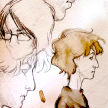

Mol’s hands still stung, raw fingers flexing nervously at her sides as she waited in line with the rest of her classmates.
Her mother always insisted on clean hands. Obsessively so. No child of hers left the house without scrubbing themselves from elbow to fingertip with those awful bars of lye, as if they could scour away their poverty as easily as the dirt beneath their fingernails. Her mother was convinced, for reasons that eluded Mol, that if her children’s hands were clean then no one would notice the ill fitting shirts with mismatched buttons, or the darned elbows on threadbare blazers, or the slap slap slap of too big Oxfords that “You’ll grow into,” and “You’d better not come home with those scuffed up!” Glancing down now, Mol rubbed the toe of her right shoe against the back of her calf, just to be safe.
The line moved forward. Mol’s classmates formed two not-so-very neat rows, clustered in groups long established before Mol had come along. She’d joined the school only a couple weeks ago, her family having moved for her mother’s new job. A better job. Not like the last one that was supposed to be better, nor the one before that. No, this one was going to change their lives. Maybe even allow them the money to afford their own bedrooms, Mol’s mother said, but Mol only wished for the money to afford soap that didn’t burn hours after using it. None of her classmates had fingers cracked like old leather. She tugged her too-big sleeves down to better hide her hands.
The security clerk waved them through and Miss Allard counted heads and shepherded the class into the Louvre. Thankfully the admission was free or Mol would not have been allowed to come. As they made their way through the massive museum, Mol learned what it was to feel awe. Hall after hall her eyes goggled, mouth hanging open as she stared at wonders never before imagined. The building itself was as vast as a city, the sculptures as tall as giants, and the paintings hung in frames so ornate they must have been plucked from the Chateau de Versailles’ walls. Mol nearly stepped on the heels of the boy in front of her she was so busy drinking it all in.
At last they came to a hall with scattered seating and were allowed to wander as Miss Allard chaperoned those who needed to use the restroom. Mol drifted to a quiet corner and sunk into a padded bench, swinging her feet back and forth until she remembered her mother’s warning about scuffing her shoes.
There was a grandfather drawing in a small notebook at the other end of the bench, dressed in a lumpy oversized parker and a floppy woolen bonnet. Hand-knitted gloves were missing the fingertips. His hair was more salt than pepper, as her mother would say, his cheeks pockmarked, and the big drooping nose which grew on his face made her think of an old onion. But the smile he gave when he noticed her looking was warm, the periwinkle of his eyes dancing with a youthfulness that belied the rest of him.
“Would you like to see?” He held up the notebook and gave it a tempting waggle.
Mol nodded and scooted along the top of the bench until they were side by side. She sat on her hands as the grandfather rested the notebook between them. He was drawing a scene from the painting on the wall. Mol looked at the painting, then back at the sketch. It was a very good copy.
“What do you think?” The grandfather asked with a tone of conspiracy. “Think I could sell it?”
Mol nodded. She didn’t see why not, his art looked as good as any other to her untrained eye.
The grandfather chuckled and shook his head. “Ah, if only all art critics were so easily impressed.” Mol wasn’t sure what he meant, so she said nothing.
He turned the pages in the notebook for her to see; many were yellowed and weathered from use. There seemed no rhyme or reason to what he drew, a kaleidoscope of objects and moments that had caught his eye. Some pages were carefully meticulously drawn, while others were filled border to border with a hodgepodge of sketches, half-finished and smudged, but just as fascinating. There was a beauty in their imperfection. The grandfather had a story to go with most, and Mol lost herself in his recounting of the young woman at the Milanese coffee shop, or the boy with his dog in the park in Vienna, or the little bird that shared his bread and fruit each morning on his balcony. She felt like she was there with him, each pencil stroke bringing the scene alive.
He flipped back to a blank page and held out his pencil. “Would you like to try?”
Mol started to reach for it when she caught sight of her fingers, blotchy and swollen. Hurriedly, she shoved them back under her legs and lowered her head.
The grandfather was silent a moment before letting out a thoughtful sound. “Do you know what it is I like most about drawing? That it matters less about these—” he wiggled thick fingers stiff with age and even more cracked than her own, “—than it does about these.” And he poked her once on the forehead and once in the center of her chest. Resting the pencil in the bend of the notebook, he set it in her lap.
Mol stared at the blank page. The paper was thicker than the notebooks they used in school. Unfurling her hands, she brushed the tips of her fingers over the page, surprised at its texture, amazed that something so rough could make something so pretty. Mol took up the pencil.
At first she tried to mimic the art on the wall like the grandfather had, but that quickly lost her interest. With a careful side-eye, taking in the grandfather’s shabby outfit, onion nose, and rheumatic hands, she began to draw him. Though the grandfather appeared not to look, he occasionally made sounds of approval. She was only half-way done when Miss Allard called for the class to reconvene.
Regretfully, Mol stood up and offered the notebook back. The grandfather pushed it back towards her. “Why don’t you keep that one. I have plenty more.” He revealed the inside of his parker where several more beaten up notebooks and half a dozen pens and pencils perched in little pockets. For some reason, that made her grin. He gave her a playful wink and nodded towards her classmates. “Best heed your teacher.”
Mol took three hasty steps before realizing she hadn’t thanked him. Her mother would box her ears if she ever found out a child of hers had forgotten her manners. Mol spun on her heels and gushed out a “Thank you!”
The grandfather smiled with approval and pointed at the notebook clutched to her chest. “That there is a powerful gift. Powerful. Every picture paints a thousand words, they say. What will you say with so many, hmm?”
Mol didn’t know how to respond. Miss Allard called for her by name, and with one last look at the grandfather, Mol hurried to catch up to her teacher.
She followed at the heels of her classmates for the rest of the trip, not paying much attention to where they were going, her mind on the grandfather’s words. When she got the chance, she opened the soft black oilcloth of the book to count the blank pages remaining. Ten. If each picture was worth a thousand words, then she had ten thousand…no, with each page having a front and a back, she had twenty thousand words worth to do with however she wished. She could hardly breathe. Never had Mol had twenty thousand anything. She had never been made to feel worthy of such.
Fighting back the lump in her throat, Mol didn’t know yet what she was going to draw in those pages. But she was excited to find out.
About the Creator
E S Soppitt
An unwritten story shaped in the approximation of a person.
Keep reading
More stories from writers in Humans and other communities.
Whiskey At Dusk
Guess the whiskey was more important to you in the end, wasn’t it? It was more than the well-being of your friends; more vital than showing up to the places you promised you would and could come to; more critical of a matter than fulfilling your damn responsibilities and getting the press off your back.
By Snarky Lisa3 days ago in Humans
A Life Limited by a Passport
A few months ago — sometime between October and December 2025 — I came across a Facebook post that made me stop scrolling. It was an announcement from Sheikh Nahyan bin Mubarak Al Nahyan’s Ministry of Tolerance and Coexistence, inviting people to take part in My UAE Story — a competition encouraging everyone, especially residents, to share personal narratives of hope, dreams, and belonging in order to help build a national identity rooted in diversity.
By Faisal Ali Mohamoud7 days ago in Humans



Comments
There are no comments for this story
Be the first to respond and start the conversation.