
#MeToo
an essay defining sexual harassment and abuse, illustrated with personal stories CW: discussions of rape, sexual harassment and sexual abuse using anatomically correct language

#MeToo
Because there are still so many misapprehensions about what constitutes sexual abuse, most centered around the idea that it has to be violent assault involving genitalia, I thought some clarifications were in order. Sexual abuse is forced sexual contact, but it can be a lot more subtle than an obvious assault, and includes a broader range of contact than many people are aware of. In this essay, I share some definitions from the Merriam-Webster Dictionary and then talk about some of my personal #metoo experiences with sexual abuse.
The legal definition of sexual abuse, according to said dictionary, is
1. a. The infliction of sexual contact by forcible compulsion.
1. b. Engaging in sexual contact with a person who is below a specified age or who is incapable of giving consent because of age or mental or physical incapacity.
It's impossible to truly consent when intoxicated, on meds that cause disorientation and sleepiness, or when actually asleep. This means initiating sexual intimacy with someone who is a minor, or is asleep or is too drunk or groggy to really know what's going on is sexual abuse.
That selfsame dictionary defines sexual assault as : Illegal sexual contact that usually involves force upon a person without consent or is inflicted upon a person who is incapable of giving consent (as because of age or physical or mental incapacity), or who places the assailant (such as a doctor) in a position of trust or authority.
Sexual harassment and abuse constitute a range of non-consensual sexual interactions, from cat-calls, wolf-whistles, inappropriate nicknames and personal comments to forced sexual intimacy—including hugging, patting and groping. And it doesn't matter whether someone was wearing a miniskirt or a revealing outfit or sexy heels, no one is "asking for it."
Rape is a form of sexual assault and abuse. The Merriam Webster Dictionary defines rape as: unlawful sexual activity and usually sexual intercourse carried out forcibly or under threat of injury against a person's will or with a person who is beneath a certain age or incapable of valid consent because of mental illness, mental deficiency, intoxication, unconsciousness or deception.
Rape is the forcible entry into another person’s body, generally for sexual gratification. In our penis-fixated society, people often think rape only involves the penis and the vagina, but rape is the forcible entry into any orifice: vagina, anus or mouth, using fingers, penis, tongue, or objects such as sex toys, broom handles or shoe horns. It doesn’t matter what is used, it’s still the forceful entry into another person’s body without their consent, which makes it a violation and a rape.
Rape using fingers is "digital rape" because the anatomical term for fingers is digits. I learned this term during a CEU on sexual ethics I was taking to keep my massage license current. As a massage therapist, I have to be extremely careful to do no inadvertent harm.
Touching another person’s breasts, genitalia and erogenous zones without permission is technically sexual abuse. This can make giving a massage potentially problematic. If I accidentally touch a client while arranging the sheet or during the massage, that could be construed as sexual abuse. And the reverse can also be true. This is one reason why communication before and during a massage is incredibly important and why massage therapists have to take sexual ethics classes.
Learning the term "digital rape" was a revelation for me.
I knew I'd been sexually abused by a boy I considered a friend when I was about 8, but I didn't realize what he'd done was rape until I took that class. My trauma made so much more sense. It was empowering to realize I'd been raped and wasn't some over-sensitive girl making too much fuss about being touched. Living in a penis-obsessed society makes it much harder for other sexual trauma not involving penises to be recognized.
The experience was so traumatizing, I disassociated during the experience and repressed the memories for years. He was the step-son of one of my father's co-workers and we did work-family things together, until they moved to a far away neighborhood. They'd invited us to their new house, and he'd wanted to show me his secret hide-out in the ductwork by the kitchen.
This is a poem fragment I've written about the experience which will eventually be part of a larger piece. It is somewhat graphic and emotionally painful:
In the vents
hugging “No” to myself
privacy violated
boundaries ignored
the boy’s fingers hurting me
with unwanted intimacy
invading my sacred insides
taking advantage
of our friendship
betraying my trust.
I had internalized or absorbed the paradigm: “This is what we do; allow ourselves to be used to sate another’s curiosity or appetite without respect.”
This boy was a few years older than me, in a different school system, and I didn't see him again until I was eleven. I was on a field trip to the zoo and saw him playing touch football with a group of friends. The memory came crashing down on me. I sat in my mom's car, vibrating with hatred.
The first time I talked about my experience with my mom, I was in high school or college. We were walking the dog, a time when we often tackled challenging conversations. I don't remember how I introduced the topic, but I said "he touched me." My mom was raised by depression-era parents with a double dose of stoic, and she was socialized to expect "Oh, everyone gets touched, we have to be tough." As if it's normal to have one's personal space disrespected and invaded. In an effort to express sympathy and solidarity, she shared a story about being felt up by a stranger on the bus when she was a teen, inferring "It's one of those unfortunate things we have to navigate in this society. See, it happened to me and I survived."
I persevered and said "No, not just touched, he put his finger inside me." She grappled with that for a minute and then said "Oh, he was only playing doctor," as if this somehow made his actions excusable, as if playing doctor made it all ok, because it was just a game. People use the "playing doctor" excuse as if normal childhood curiosity excuses invasive behavior. I think people, especially those in parental roles also instinctively try to minimize sexual abuse confessions because it's horrifying that loved ones we were supposed to protect were violated that way.
As adults, it's so important to make clear to children that, while it's normal to be curious and our bodies are wonderful things, certain parts are private and it's important to ask for permission before hugging or kissing or touching in certain ways. Kids can respect boundaries if they are taught.
I insisted we weren't playing doctor, we were way too old for that. I was 8 and he was at least 12, definitely old enough to know better. I got my mother to understand what had happened was not the consequence of some game, it was a violation of my body and my trust. After she understood, my mother was very supportive.
Much later in my life, as a graduate student, I was in an abusive relationship. There were red flags that my friends and family and I noticed, but I ignored them because I thought he was my soulmate. He was emotionally, psychologically and sexually abusive. The sexual abuse was more subtle. There was no respect for my boundaries, a lot of shaming couched in "I'm just trying to help you" terms—because I was much less sexually experienced than he was— and a lot of coercion. He guilt-tripped me into having sex when I didn't want to, and anything that hurt was my fault. But it was all supposed to be ok because he supposedly loved me, and being in a committed relationship involves compromise. But what he called compromising was really just me agreeing to whatever he wanted.
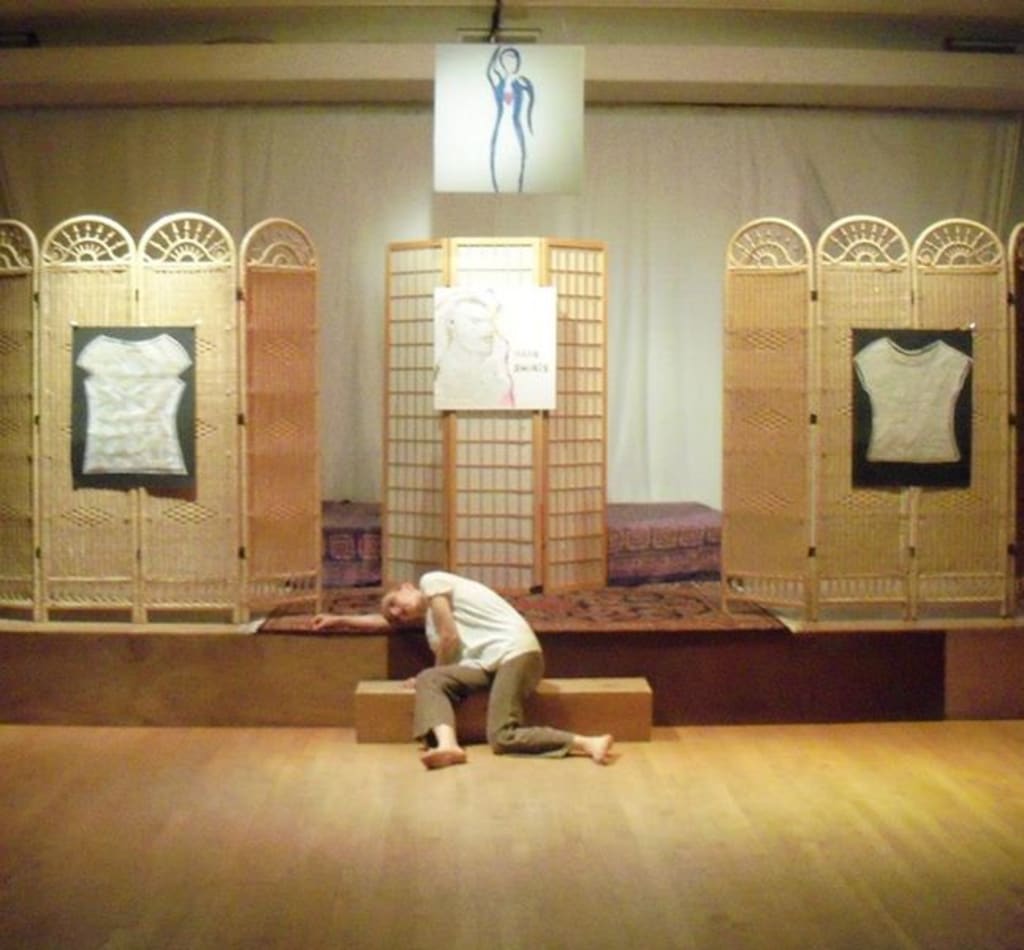
There's a big difference between healthy compromise and dysfunction. It took me time to admit that that relationship had been sexually abusive, as well as psychologically and emotionally abusive, because the sexual abuse wasn't overtly violent. It was only after working with a therapist for a few years that I could name what happened as sexually abusive, which was freeing. What I had experienced was intimate partner violence. Naming a thing can be powerful, and can help with healing. Part of my healing involved producing a performance art piece entitled "The Hair Shirts Project," which was centered around how we can internalize the terrible things people say to us and wear them like hair shirts until we become self-aware and remove the metaphorical shirts. The selected image for this piece is a picture from that show.
I hope that laying out the actual definitions of sexual harassment and sexual abuse, and illustrating them with some of my personal experiences help people to deal honestly and constructively with their own experiences. Because we have been socialized to accept a certain level of entitled toxic behavior as normal, this could lead to self-reflection and personal change.
If you insist on hugging someone, even when they seem uncomfortable, it's time to examine your behavior and attitudes. If you habitually get so drunk in social situations that you have no respect for personal boundaries and all your dates complain about you being overly handsy, it's time to examine your behavior and attitudes. If you feel entitled to physical intimacy because you paid for dinner or you've been dating x amount of time or you're in a committed relationship and you think sex is a package deal, it's time to examine your behavior and attitudes. The only person you are entitled to touch or hug or have sex with is yourself. All other interactions require consent. Preferably enthusiastic, ongoing consent.
It can be hard to face causing someone harm, inadvertently or otherwise, especially as a healthcare worker or within the context of an intimate relationship of some kind. But taking responsibility allows us to make amends and facing the harm we may have caused allows us to do better in the future.
About the Creator
Megan D. Robinson
elf by inclination.
lover of words, dancing, and witchcraft.
journalist, poet, storyteller, visual and performing artist.
abuse surviver, single parent with adult child, former dog mom.
Reader insights
Outstanding
Excellent work. Looking forward to reading more!
Top insights
Compelling and original writing
Creative use of language & vocab
Easy to read and follow
Well-structured & engaging content
Expert insights and opinions
Arguments were carefully researched and presented
Eye opening
Niche topic & fresh perspectives
Heartfelt and relatable
The story invoked strong personal emotions
Masterful proofreading
Zero grammar & spelling mistakes
On-point and relevant
Writing reflected the title & theme
Keep reading
More stories from Megan D. Robinson and writers in Humans and other communities.
She Left Me For A Rich Guy, Look How She Turned Out
I sat back and watched you this weekend. I saw the photos. I saw the smiles. I saw the man you chose over the empire we were building. And for the first time in three years, I didn’t feel a sting of jealousy. I felt a cold, hard sense of irony.
By Nanu Nnabuife5 days ago in Humans




Comments (1)
Wow. Thank you so much for sharing your experiences. I know it can be difficult to open up about these situations, so your vulnerability is much appreciated. It's an important topic, one many people need to be acutely aware of if we ever want to progress as a society. I'm so sorry for what you went through, but you are not alone #MeToo