
An Hour of Light on the Darkest Day
A quiet winter ritual that renews the artist, not the artwork

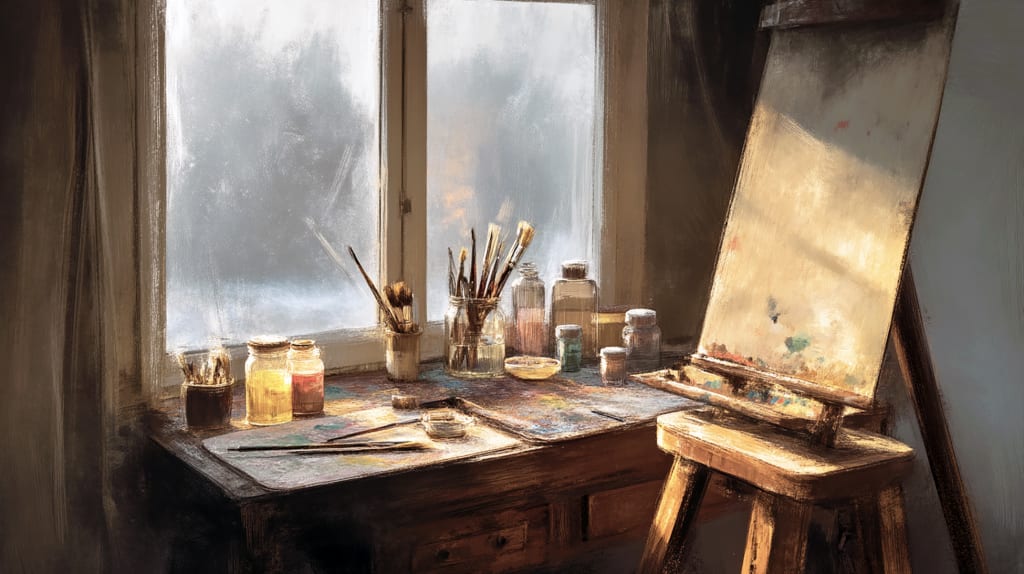
The darkest day of winter never looks as dramatic as the calendar suggests. It doesn’t roar or insist on its significance. It just arrives—quiet, blue-edged, almost shy—slipping over the windowsills before I’m fully awake.
By late afternoon, the light has already thinned to a pale watercolor wash. That’s when I know it’s time.
I walk into the studio and close the door behind me, not to shut anything out but to hold something in. The ritual is simple: one hour, no more, no less. One hour to return to the part of myself that doesn’t measure life in task lists or output. One hour with brush, paint, canvas, silence.
This ritual started years ago, though I didn’t name it then. That winter had been cluttered—too much noise, too many expectations, too many moments when my attention drifted so far from my own center that I could barely feel the pulse of the work that once gave me meaning.
I remember standing in the studio one dim afternoon, feeling a strange kind of hunger—not for food, but for stillness, for focus, for the uncomplicated sensation of making something with my hands.
So I opened a fresh panel.
I set a timer.
I told myself, Just one hour.
I dipped a brush into linseed oil, watched it catch a thin gleam in the fading light, and made a single stroke across the surface. The sound was almost inaudible—just the soft whisper of bristles meeting wood—but it was enough. Something inside shifted, like a locked joint easing open.
I wasn’t making a painting. I wasn’t trying to.
I was simply returning.
I didn’t know it would become a ritual. But the next winter, when the shortest day arrived, I found myself standing at the studio door again with the same quiet ache. And then again the year after. Until eventually, I stopped waiting for the ache and began honoring the day itself.
The Winter Studio Hour.
The rules are gentle.
No goals.
No projects that demand resolution.
No audience in mind.
Only presence.
Some years I sketch. Some years I mix colors just to watch them shift toward a new temperature. Some years I begin a portrait I never finish. There is no pressure to carry anything beyond the hour. The work that emerges belongs only to this moment—an offering to the canvas and to whatever part of me still believes in beginnings.
Winter light behaves differently. It doesn’t flatter. It doesn’t dramatize. It tells the truth.
When it enters the studio, it falls across the canvas with a softness almost like kindness. The edges blur. The paint seems to breathe. Shadows settle into corners, patient and unbothered. Even the dust motes float more slowly, as if honoring the hour.
There’s a quiet conversation that begins when the brush first touches the canvas—not spoken, not even mental, but a shift in attention. A listening. Portrait painters know this sensation well. Even when you’re alone in the studio, it feels as if the work itself has entered the room.
During this hour, I feel closer to that presence than at any other time of year.
Some winters, the hour fills with energy. I lose track of strokes and enter a rhythm where my hands seem to know more than my mind. Other years, the hour is still and slow. I stand with a brush poised over the surface for long minutes before committing to a single line.
And some winters, the only thing I manage to do is clean the palette and rinse the jars. But even then, it feels like devotion.
Creation isn’t always about producing something.
Sometimes it’s about remembering the space inside yourself where creation begins.
The Winter Studio Hour makes that space visible again.
I think about the years when I chased perfection, when every painting had to justify its existence. Winter has softened that. Winter has taught me that the act of painting is not a performance. It’s a relationship—between hand and material, between eye and light, between the outer world and the inner one.
You don’t force a relationship into brilliance.
You show up.
You listen.
You keep the hour.
The ritual shifts a little bit each year. Some winters, I put on music so soft it barely skims the edges of silence. Other winters, I leave the studio completely quiet. Some years, the panel remains blank; the work happens inside me instead.
And then there are the moments—rare, fleeting—when something unexpected appears on the canvas. A gesture. A color harmony. A face emerging with more honesty than I intended. I never chase these moments. Winter teaches me to let them arrive on their own terms.
When the timer rings, I stop.
I set down the brush.
I step back.
The hour is complete the moment the sound breaks the silence. I don’t fuss with the painting. I don’t evaluate. I don’t ask if anything is good. I leave the studio light on as I walk out, as if the room needs a moment to settle after holding so much attention.
When I open the door to the outside world again, winter is waiting—dark, quiet, unwavering in its patience. Something in me feels anchored, warmed, tended.
This ritual doesn’t make me a better painter.
It makes me a more present human being.
That’s all the Winter Studio Hour asks for.
And that is enough.
About the Creator
Rick Allen
Rick Allen reinvented himself not once, but twice. His work explores stillness, transformation, and the quiet beauty found in paying close attention.
Keep reading
More stories from Rick Allen and writers in Humans and other communities.
Wait for the First Snow
The first snow doesn’t always arrive with ceremony. Sometimes it begins as a whisper—almost mistaken for rain—until a single flake drifts past the kitchen window like a paused thought. I don’t rush to greet it anymore. I’ve learned to let it arrive in its own quiet way. So I just stand by the table, one hand resting on the back of a chair, and say softly, “It’s time.”
By Rick Allen2 months ago in Humans
Easin' into the Season
The Holiday Season is upon us. Thanksgiving is barely out of the way, and the shops have transitioned from Black Friday sales right into Christmas sales. The local radio stations have been playing carols for about the same length of time. Neighborhood lighting competitions are well underway. Its a typical December here in the good ol' USA.
By Dana Crandellabout a month ago in Humans
“The Correction: When God Awakens the Ones Who Fell Behind”
There comes a moment in every soul’s long journey when the story it has been telling itself begins to unravel, not because the story was wrong, but because it was too small. For lifetimes, perhaps thousands of them, you may have imagined yourself as spiritually gifted, spiritually advanced, spiritually chosen — someone whose sensitivity or intuition or mystical experiences set you apart from others. You may have believed that your insights were evidence of elevation, that your suffering was evidence of depth, that your longing was evidence of destiny. But what if the truth is far more humbling than that? What if the very sense of “specialness” you have carried is not a sign of spiritual mastery but a sign of spiritual immaturity? What if the Creator has not been lifting you up but shaking you awake? What if your awakening is not a crown but a correction?
By Julie O'Hara - Author, Poet and Spiritual Warriorabout 13 hours ago in Humans
The steps to losing a child
Step One: Lose a child. Not what anyone wants to happen and nothing you can do to change it, but you can go through steps to becoming happy again. You can go through steps to loving again. You can go through steps to become a new you because after losing a child you will never be the same person you once were.
By Tabitha Hinkley3 days ago in Fiction



Comments
There are no comments for this story
Be the first to respond and start the conversation.