
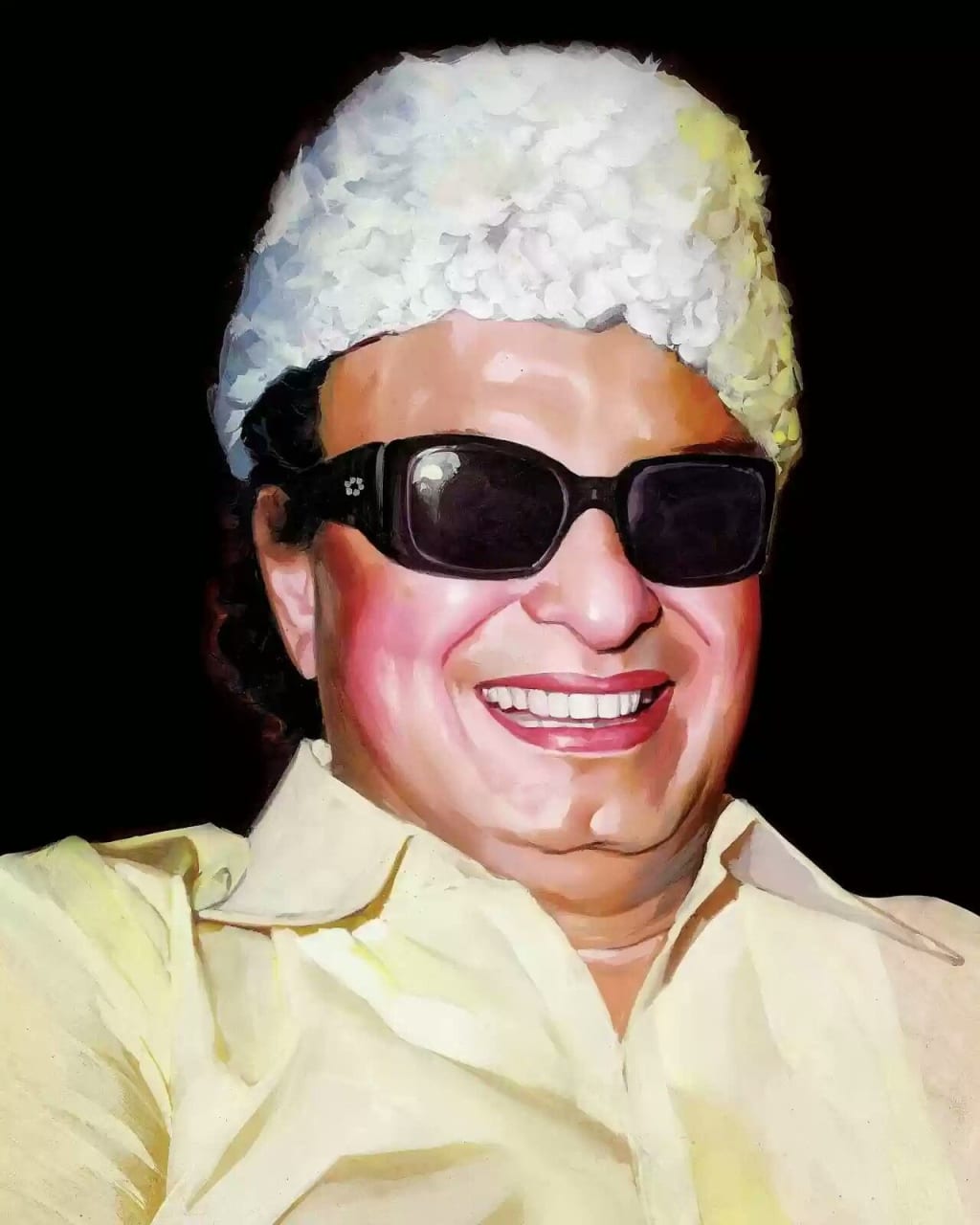
M.G. Ramachandran, better known by his stage name MGR, was an Indian performers director, and politician who presided as Tamil Nadu's chief minister from 1977 till his demise in 1987. He was born in Kandy, Sri Lanka, on January 17, 1917. In the Tamil cinema industry, he began his acting career as a villain in 1936 before eventually moving into starring roles.
Over the course of his four-decade acting career, MGR appeared in more than 130 films. He was well renowned for playing characters who stood up for the weak and the oppressed, and his films frequently included a social message.
MGR joined the Dravida Munnetra Kazhagam (DMK) party in 1952. The DMK was a Tamil Nadu-based regional political party that promoted the rights of the Dravidian people.one of the party's most well-known leaders and a former associate of DMK founder C.N. Annadurai.
However, MGR was ousted from the DMK in 1972 as a result of a contentious power battle with M. Karunanidhi, who had assumed control of the party following the passing of Annadurai. The Anna Dravida Munnetra Kazhagam (ADMK), later known as the All India Anna Dravida Munnetra Kazhagam (AIADMK), was MGR's first political organisation.
MGR's populist policies and likeable demeanour had a lasting impression on politics. In 1977, he was elected Chief Minister of Tamil Nadu, and under his leadership, various welfare programmes for the poor and disadvantaged populations were put in place, including the mid-day meal programme and the construction of free medical facilities.
His three successive electoral triumphs in 1977, 1980, and 1984 were a reflection of MGR's popularity with the general public. However, his health started to decline in the middle of the 1980s, and he had a number of procedures for kidney-related conditions. On December 24, 1987, he ultimately passed away at the age of 70.
In Tamil Nadu, where he is frequently referred to as Makkal Thilagam (People's Hero) and is recognised for his contributions to the film industry and his attempts to improve the lives of Tamil Nadu's citizens, MGR's legacy is still being honoured today.
MGR started acting in 1936's "Sathi Leelavathi" and went on to appear in over 130 films. He is regarded as one of Tamil cinema's most recognisable actors.
MGR was well-known for his charitable endeavours and was active in a number of charitable organisations. He and his wife Janaki established the MGR Janaki College of Arts and Science for Women in Chennai, which bears their names.
MGR received the Bharat Ratna, India's highest civilian honour, in 1984 for his contributions to politics and film.
V.N. Janaki, MGR's wife, was a well-known actress and politician. She briefly held the position of Chief Minister of Tamil Nadu in 1988 after MGR's passing.
MGR was also a talented poet and writer, and many Tamil journals have featured his writing.
MGR's political philosophy prioritised the needs of underprivileged and disadvantaged groups. He had a strong commitment to the ideals of social justice, democracy, and secularism.
MGR was well renowned for his advocacy of women's rights and frequently featured strong female protagonists in his films.
The Makkal Thilagam admirers of MGR are renowned for their love of the actor and his legacy. They keep planning festivities and gatherings in his honour.
MGR's populist ideas and ability to appeal to the masses made him a political legend. He established the mid-day food programme and established free medical facilities, among other welfare programmes for the underprivileged and marginalised populations.
The MGR administration was renowned for its initiatives to advance Tamil language and culture. He established Tamil as the state's official tongue and promoted its use in politics and other aspects of public life.
MGR was well renowned for his charity endeavours, and he founded various nonprofit organisations to aid the impoverished and underprivileged. Additionally, he gave up a sizable percentage of his earnings to charity.
About the Creator
Keep reading
More stories from writers in Humans and other communities.
Whiskey At Dusk
Guess the whiskey was more important to you in the end, wasn’t it? It was more than the well-being of your friends; more vital than showing up to the places you promised you would and could come to; more critical of a matter than fulfilling your damn responsibilities and getting the press off your back.
By Snarky Lisa5 days ago in Humans
Why Certain Connections Feel Familiar Without History.
Some relationships feel familiar even without shared history. People often experience an immediate sense of comfort, trust, or recognition with strangers. This phenomenon occurs in friendships, romantic encounters, professional interactions, and social situations. While it may feel mysterious, science and psychology provide explanations. Familiarity without history arises from subconscious pattern recognition, emotional resonance, and neural processes that link perception, memory, and social cognition. Understanding why certain connections feel familiar offers insight into human intuition, relationship building, and social awareness.
By Wilson Igbasi2 days ago in Humans


Comments
There are no comments for this story
Be the first to respond and start the conversation.