
Loneliness in Your 20s + A Bumble BFF App Review
Making friends, geosocial apps, and psychosocial stages.

Socializing was never a strength of mine - Let alone making friends and actually keeping them around. Although I knew many people in my life, I didn't have as many constant friends as people thought I would. I was always okay with having a small circle but the beginning of my twenties really cemented the values and beliefs I had and the interests I developed along the way. I wanted to expand my circle in hopes of finding like-minded friends.
For someone who grew up with very few friends, I thought I'd be used to it by now but it seems that I've been feeling a lot lonelier than ever. A part of me stumbled upon the fact that maybe, we're all just growing up and becoming busy with our careers at this age. After a while, I remembered a contributing factor that I learned in my psychology class back in college which was Erikson's stages of psychosocial development.
Erik Erikson's Stages of Psychosocial Development
According to Erikson's stages of psychosocial development, each person goes through eight stages in their lifetime which begins from infancy to adulthood. In each stage, people face a specific crisis and the conflict they experience is usually similar to those in the same age group. In my case, I am currently in psychosocial stage 6 which is Intimacy vs Isolation - The conflict centers around forming strong bonds and intimate relationships with either friends or romantic partners. Achieving this will lead to the basic virtue of love.
How is This Theory Related to the Use of Geosocial Applications?
Like I said earlier, there's a specific age group for each stage. In stage 6, the conflict surrounds people aged 18-40, a pretty similar age group to those who use Geosocial apps.
With the rise of technology, the use of these apps make it a lot easier to look for friends outside our circle and right in the comfort of our own homes. There have been success stories about people who ended up marrying or becoming best friends with the people they've met on the app. During the first few months of quarantine, I decided to give Bumble BFF a try in hopes of maybe finding some new, solid friends.
How Does Bumble BFF Work?
Bumble has three modes - Dating which is pretty self-explanatory, Bizz for possible jobs and networking, and finally, BFF for making friends. I applaud Bumble for dividing the app into these different modes because even though there's no guarantee that people will stay on a certain lane, it helps people find exactly what they're looking for. There have been instances of people going to other sites or apps intended for making friends and would stumble upon people looking for something more.
Setting up your profile follows the usual format of adding your bio and a few photos about yourself. There's an option of putting in up to three prompts you could choose from the app for people to know you better. (e.g. "My ideal BFF date is...", "We'll get along if...", and "My mom would describe me as..." etc.) Besides the prompts, you could fill out more things about yourself like your zodiac sign, relationship status, religion, how often you workout, if you have pets, and more. If you'd like to connect your Instagram and Spotify, you could do that too! Personally, seeing people with similar music taste as mine has been helpful in starting conversations.
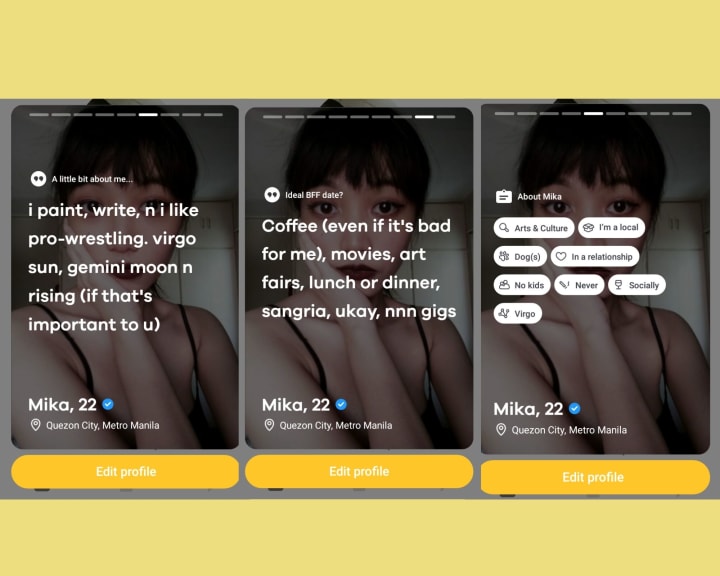
Once you're done setting up your profile, you can start swiping and searching for new friends!
My Experience Using the App
The encounters I've had and the people I've met are pretty interesting - I met a handful of people with the same political views, two girls from the same band, an old schoolmate who I never got to be classmates with because we were nearly five hundred students in the batch, and many more. A lot of the conversations I've had started off with compliments regarding each others photos, Spotify top artists, and Instagram feed. We also had a wide range of topics from light-hearted ones like art, music, and travel to deeper topics like family, politics, careers, and existential crises.
Something I learned about myself throughout the experience is that I'm not as picky as I thought I would be. When looking for friends on the app, I rely heavily on their bios and prompts. Even though it seems as if the person and I didn't have much in common, I gravitate a lot towards people who seem funny, kind, and warm. One thing that annoyed me were people with empty profiles and by "empty" I mean no bio, prompts, or anything that hints to what kind of person they are. I've encountered numerous people whose profiles had nothing but their photos in it - I found it extremely shallow because it seemed like their approach to making friends was all face value.
My Takeaway
After hitting it off with some people, it was only natural to exchange socials and I was always happy when we did. However, I only drifted apart with them right after; We would talk again a day after meeting and that would be it. Our only source of interaction would then be liking each others' posts and reacting to stories.
Although our generation seems a lot more well-connected because of technology, it doesn't always guarantee faster friendships. Social media and apps make it easier to reach out to one another despite the circumstances in our lives such as work, school, family, or anything keeping us busy. Just because we have the tools to make keeping in touch a lot easier, we still need to be mindful of the effort we put in to make a relationship work out. Also, giving the time and patience to allow these friendships grow. After all, friendships aren't things you plan on having and they usually come when you least expect it. But if you find some really cool people you'd like to know better, shoot your shot and see how things turn out. Wanting to make friends and connections isn't desperate at all, it's only natural and human.
References:
Cherry, Kendra. "Intimacy vs. Isolation: Psychosocial Stage 6" Verywell Mind (https://www.verywellmind.com/intimacy-versus-isolation-2795739)
McLeod, Saul. "Erik Erikson's Stages of Psychosocial Development" Simply Psychology. 2018. (https://www.simplypsychology.org/Erik-Erikson.html)
About the Creator
Keep reading
More stories from M. Danielle and writers in Humans and other communities.
The Flower That Will Flourish Forever | In Memoriam of Hana Kimura
It's been a day since I found out about the death of Hana Kimura. Some people may know her as the reality tv star from Terrace House but to me and many others, she was a talented pro-wrestler who had a big future ahead of her. She was undoubtedly one of my favorite wrestlers not just in Stardom, but in the whole pro-wrestling industry in general. The news of her passing and taking her own life has gutted me and made it difficult to breathe. Up until now, I am still in disbelief and cannot seem to wrap my head around the fact that she is gone.
By M. Danielle6 years ago in Unbalanced
Libra Woman and Aries Man Compatibility Score
The pairing of a Libra woman and an Aries man is one of the most classic and dynamic opposites-attract matches in astrology. Ruled by Venus and Mars respectively, this duo embodies the eternal dance between love and desire, harmony and action, diplomacy and courage. Their connection is rarely boring—often exciting, sometimes challenging, but usually transformative for both partners.
By Inspire and Fun7 days ago in Humans


Comments
There are no comments for this story
Be the first to respond and start the conversation.