
Life in the Green Embrace: Human Stories from Africa’s Forests
Human from Africa forest

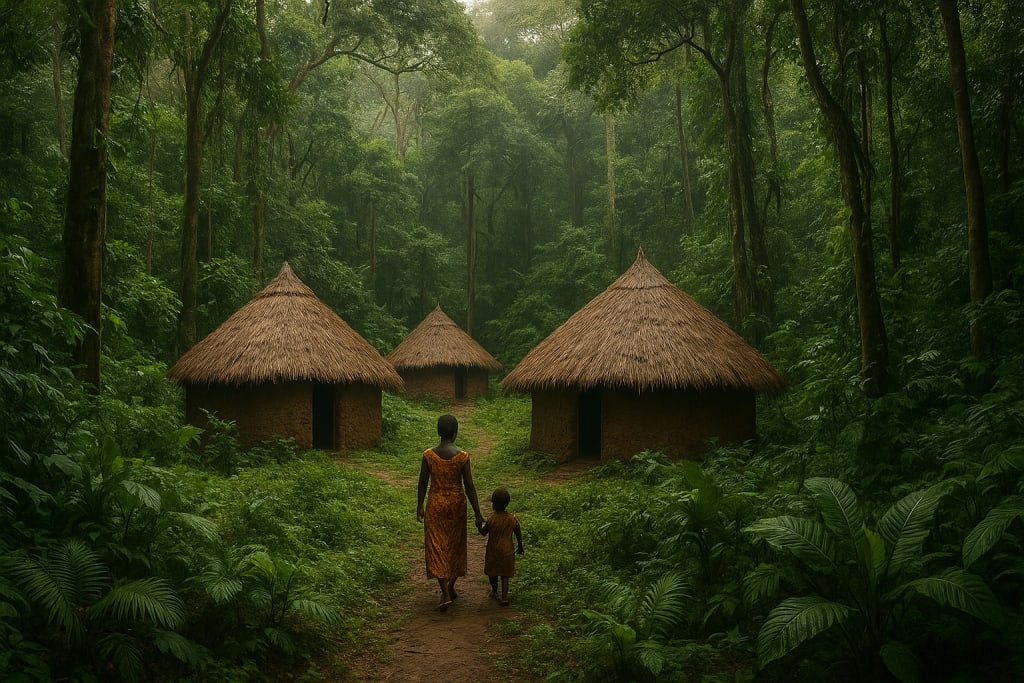
The forest has always been more than just a collection of trees. For the people who live within it, the forest is a provider, a guardian, and a home. In many parts of Africa, deep within the tropical rainforests, life unfolds in harmony with towering canopies, fertile soil, and the whispers of countless creatures hidden in the greenery.
This picture captures one such moment: a woman and her child walking along a dirt path, surrounded by dense vegetation, approaching a cluster of thatched-roof huts. Their figures seem small against the immensity of the forest, yet their presence is a reminder that humanity and nature have always been intertwined. It is not only a portrait of rural life but also a window into the enduring relationship between people and the land that sustains them.
A Forest That Breathes Life
African forests are among the most vital ecosystems on Earth. From the Congo Basin—the second-largest rainforest in the world after the Amazon—to smaller but equally important tropical forests scattered across the continent, these landscapes are teeming with life. They host elephants, gorillas, okapis, and thousands of plant species, many found nowhere else.
But just as importantly, these forests sustain people. Communities that have lived in or near them for generations rely on the forest for food, medicine, shelter, and even spiritual connection. Every tree cut down is not just wood—it is a memory, a tradition, and a piece of heritage.
Villages in the Green
The thatched huts in the picture tell a story of ingenuity and resilience. Built from mud, clay, and grass, these structures are perfectly adapted to the humid environment. They remain cool during the heat of the day and provide shelter during the heavy rains. Unlike modern concrete houses, these huts breathe with the forest, blending into the landscape rather than fighting against it.
Life in these villages is simple yet deeply rooted in community. Children play barefoot on the earth, learning to respect the forest as their ancestors did. Women, like the one holding her child’s hand in the image, balance multiple roles: gatherers of food, caretakers of the family, and keepers of cultural knowledge. Men often hunt or farm, ensuring the village’s survival. Together, the community thrives, not in opposition to the forest but as part of it.
The Forest as a Supermarket and Pharmacy
For outsiders, life in the forest may seem challenging, but for those who know its secrets, it is abundant. Fruits like mangoes, guavas, and wild berries grow naturally. Edible leaves and roots provide nutrition, while rivers and streams offer fresh water and fish.
Medicinal plants are an equally vital resource. Generations have passed down knowledge of herbs that cure fever, treat wounds, or ease childbirth. Modern science has begun to confirm what these communities have always known: the forest is a living pharmacy. Yet, as logging and mining encroach on these habitats, this knowledge—and the plants themselves—are at risk of being lost forever.
Culture Woven Into Nature
Beyond survival, the forest is also central to identity and culture. Songs, dances, and oral traditions often celebrate the spirits of the trees, rivers, and animals. The rhythm of life follows the rhythm of the seasons: planting when the rains come, harvesting when the soil gives back, and honoring ancestors who walked the same paths through the forest centuries ago.
Even the act of walking together, as mother and child do in the image, is symbolic. It is a passing of knowledge from one generation to the next. The child will learn not just how to survive but how to see the forest as family.
The Challenges of Modern Times
Yet, despite this rich harmony, life in Africa’s forests is under threat. Logging companies clear land for timber exports. Farmers, pressured by poverty and growing populations, cut trees to plant cash crops. Mining operations dig deep into the earth, leaving scars where lush greenery once stood.
For the people who call the forest home, these changes bring difficult choices. Should they preserve their traditional ways or adapt to the modern economy? Should they resist outside influence or embrace it? For many, the forest is shrinking faster than they can adjust, leaving them caught between two worlds.
Women as Guardians of the Forest
The woman in the picture represents more than just daily life—she symbolizes resilience. Across Africa, women play a leading role in environmental stewardship. They are often the first to notice when rivers dry up, when crops fail, or when animals disappear. Their role as caregivers extends beyond the home to the land itself.
In many communities, women lead reforestation projects, teaching children how to plant and care for trees. They fight for land rights, recognizing that without secure ownership, forests are easily taken by outside corporations. Their quiet strength keeps traditions alive even as the modern world presses in.
Lessons for the World
For those living far from Africa’s forests, this image is a reminder of what humanity risks losing. In an age of climate change, deforestation, and rapid industrialization, places like these stand as proof that it is possible to live in balance with nature.
The lessons are simple yet profound: take only what you need, respect the land that sustains you, and remember that survival is a shared endeavor. The woman and her child are not just walking toward huts—they are walking into a future shaped by these principles, one step at a time.
Protecting the Green Heart of Africa
Protecting Africa’s forests is not only about saving trees—it is about protecting people, cultures, and histories. International efforts are now underway to safeguard these regions, from establishing national parks to promoting eco-tourism. Yet the most powerful guardians remain the communities themselves. Their voices, often overlooked, must be at the center of conservation strategies.
To preserve these forests is to preserve diversity—in nature, in culture, and in human spirit. It is to ensure that children like the one in the picture grow up knowing not only the beauty of their home but also its strength.
A Final Reflection
The picture of a mother and child walking into their forest village is quiet, almost ordinary. But within its silence lies a story of resilience, harmony, and hope. It tells us that human life does not need to be separate from nature—it can flourish within it.
In the end, the African forest is not just about trees and wildlife. It is about people, about families, about communities living in the green embrace of the earth. And if we listen closely, their footsteps on the dirt path remind us of our shared responsibility: to walk gently, to protect fiercely, and to honor the forest as the home it has always been.
About the Creator
Keep reading
More stories from Fazal wahid and writers in Humans and other communities.
Echoes of the Past: Life 5000 Years Ago
The image before us transports us back 5000 years—a time when the world was younger, wilder, and unshaped by the machinery and technology that dominate our lives today. It is a vision of a man clad in animal skins, holding a spear, standing tall before a landscape that is both simple and majestic. A hut sits behind him, mountains rise in the distance, and rivers carve their path through green valleys. It is a picture not only of survival, but of beginnings—the roots of humanity itself.
By Fazal wahid 4 months ago in Humans
Libra Woman and Taurus Man Compatibility Score
When a Libra woman and a Taurus man come together, the relationship blends elegance with dependability, romance with realism, and charm with sensuality. Ruled by Venus, the planet of love, beauty, and pleasure, both signs share a deep appreciation for harmony, comfort, and meaningful connection. However, despite this shared ruler, their personalities and approaches to life can be quite different. Understanding these differences is key to evaluating their long-term compatibility.
By Inspire and Funa day ago in Humans


Comments
There are no comments for this story
Be the first to respond and start the conversation.