
Echoes of the Past: Life 5000 Years Ago
A Glimpse Into Our Earliest Footsteps

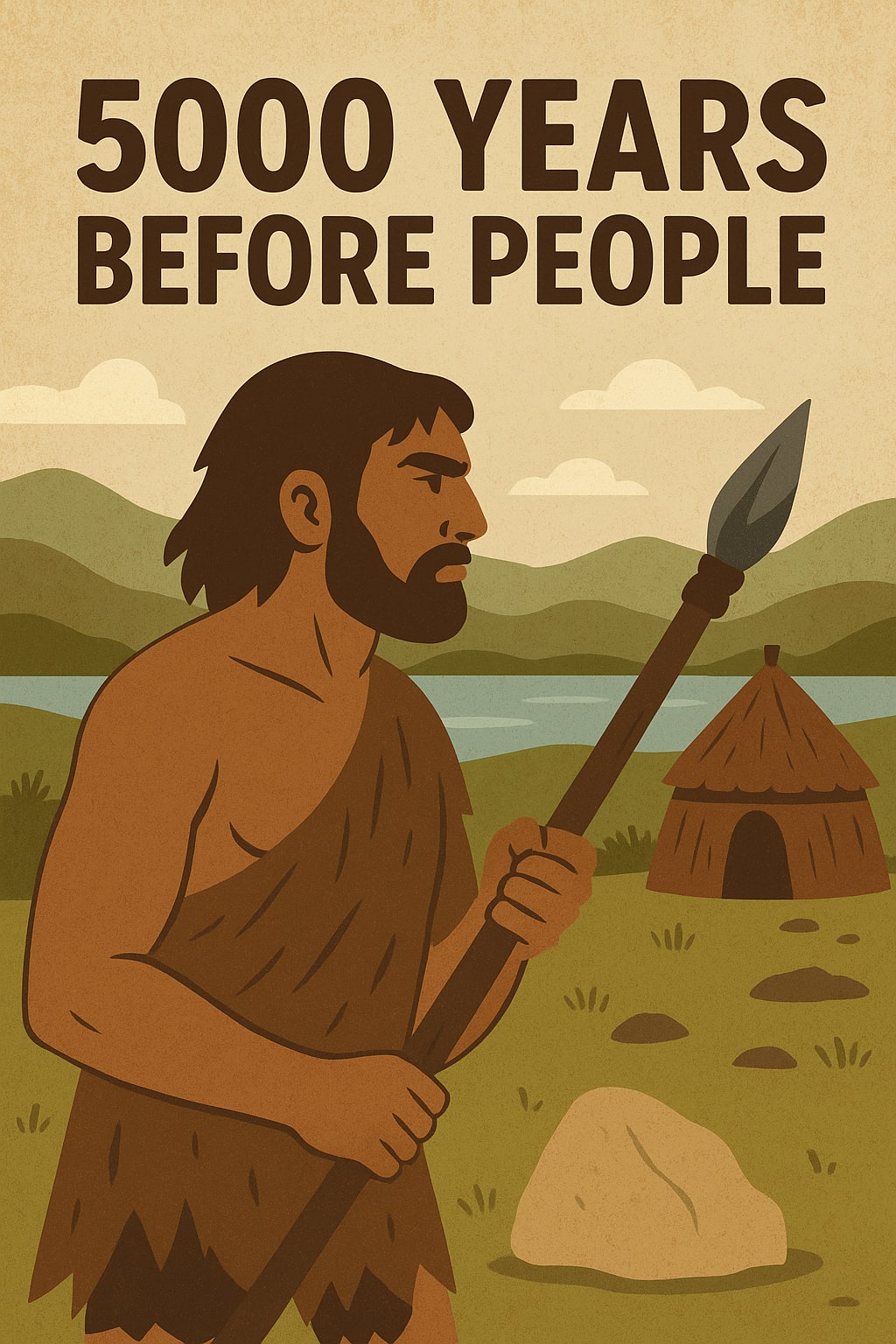
The image before us transports us back 5000 years—a time when the world was younger, wilder, and unshaped by the machinery and technology that dominate our lives today. It is a vision of a man clad in animal skins, holding a spear, standing tall before a landscape that is both simple and majestic. A hut sits behind him, mountains rise in the distance, and rivers carve their path through green valleys. It is a picture not only of survival, but of beginnings—the roots of humanity itself.
When we look into this ancient scene, we are not merely staring at a man from long ago; we are staring at ourselves. This is the story of us before cities, before nations, before history was written. It is the untold narrative of resilience, love, and the primal spirit that has carried humanity from stone tools to space travel.
Survival as a Way of Life
Five millennia ago, survival was not taken for granted. Every sunrise meant another test. The man in the picture holds a spear, not as a symbol of aggression, but as a symbol of necessity. With it, he hunted for food, defended his family, and carved his way through an unforgiving world.
His day began at dawn with the rising sun, when the community stirred from their huts. There was no clock to dictate life—only nature. The sounds of birds, the rushing of water, and the movements of animals served as timekeepers. Each action—whether gathering berries, fishing in streams, or sharpening stone blades—was done with intention. Food was scarce, predators were real, and the land itself was both friend and enemy.
Yet, despite these challenges, early humans thrived. They learned to harness fire, craft tools, and build shelters. Each discovery, though small in today’s eyes, was monumental for them. A sharpened spear meant security. A woven basket meant the possibility of saving food for the next day. A simple hut meant a place of warmth and safety. These were the building blocks of civilization.
Communities Bound by Love and Trust
Though the picture shows a lone man, we know he was never truly alone. Humanity has always been a collective species. Five thousand years ago, families and tribes were everything. Bonds were not defined by contracts or laws, but by shared struggle and shared survival.
Every hunt was a communal effort. Every meal was shared. Every fire was circled by stories—stories of bravery, of spirits, of ancestors. Around those fires, language was born and passed down, weaving together the human experience.
Love, too, was present. It was different from what we know today, perhaps, but no less real. Mothers cared for their children with the same tenderness we recognize now. Fathers taught sons and daughters the skills they needed to endure. Couples found comfort in one another’s presence, their unions ensuring the continuation of their people. Even then, in the most primitive conditions, the human heart longed for connection.
Nature as Teacher and Adversary
The landscape surrounding the figure is more than a backdrop—it was life itself. Rivers offered water and fish, forests offered shelter and resources, mountains provided guidance for navigation, and animals represented both danger and sustenance.
Nature was not something to be conquered; it was something to be respected. Early humans lived with an understanding that their survival was directly tied to the cycles of the earth. Rainfall determined crops. Migration patterns determined hunting seasons. The stars themselves told stories of when to plant and when to move.
This respect often gave rise to spirituality. The sun was a god, the moon a protector, and animals sacred messengers. Every part of the natural world was alive with meaning. And though their explanations of the universe were different from ours, they spoke to a profound truth: that humanity is deeply connected to the earth.
Innovation in Simplicity
It is easy to assume life 5000 years ago was static, but it was not. The man holding his spear is more than just a survivor; he is an innovator. Every day demanded creativity. A broken tool required problem-solving. A shortage of food required new hunting strategies. Illness required remedies from herbs and plants.
It was during this period that humans began to transition from pure hunter-gatherers to early farmers. Seeds were planted deliberately. Animals were domesticated. Simple pottery was shaped and baked to store grain and water. These small advancements laid the groundwork for everything that came later—villages, cities, empires, and modern society.
The spear in his hand, sharpened from stone and bound with sinew, is not just a weapon; it is the embodiment of human ingenuity. It is proof that even in hardship, creativity flourished.
Lessons for the Modern World
What can a picture of life 5000 years ago teach us today? In truth, it reveals a mirror. While our world is filled with technology, skyscrapers, and instant communication, our needs are not so different from those of our ancestors. We still seek safety, food, love, and meaning.
The man in the image fought for survival; we fight for purpose. His spear was his tool; ours might be education, innovation, or creativity. His community gathered around fire; ours gathers around screens. The forms may differ, but the essence is the same.
The simplicity of his world also serves as a reminder of balance. In chasing progress, we often forget the importance of living in harmony with nature. Our ancestors could not afford to destroy the land that sustained them—yet we do so recklessly. Perhaps looking back 5000 years can teach us humility. It can remind us that we are not separate from the earth, but part of it.
The Eternal Human Spirit
At its core, this picture is not about the past—it is about continuity. The man with his spear may seem distant, but his spirit lives on within us. His determination, resilience, and creativity are the same traits that drive us forward today.
When we marvel at his simplicity, we must also admire his strength. He represents the raw essence of humanity: adaptable, resourceful, and deeply connected to one another and the world around them. Without him, and millions like him, we would not exist.
The story of 5000 years ago is not just history—it is our inheritance. Every heartbeat we feel, every dream we chase, carries echoes of his footsteps.
Conclusion: Looking Back to Move Forward
The picture of a man standing with a spear in a world unshaped by modern hands is not just a glimpse of the past. It is a reminder of where we came from and what we carry within us.
Life 5000 years ago was hard, but it was also pure. It was defined by survival, community, love, and respect for nature. It was a time when every day was a triumph and every small discovery was monumental.
As we stand in our modern world, surrounded by comfort and complexity, we must not forget the lessons of that ancient life. We must remember resilience. We must honor community. We must live with respect for the earth. And above all, we must recognize that the same human spirit that carried our ancestors forward continues to burn brightly in us today.
About the Creator
Keep reading
More stories from Fazal wahid and writers in Humans and other communities.
Love Beyond Words: Jessica and the Dolphin’s Ocean Bond
The ocean has always been a place of mystery—a world beneath waves where life moves to rhythms we cannot fully understand. Yet sometimes, within that expanse of blue, bonds are born that defy both distance and species. This is the story of Jessica and the dolphin, captured in a single timeless moment, where love transcends language and flows like water itself.
By Fazal wahid 4 months ago in Humans



Comments
There are no comments for this story
Be the first to respond and start the conversation.