
Let’s Acknowledge Those Struggling With Homelessness
Expressing empathy in a time of chaos.

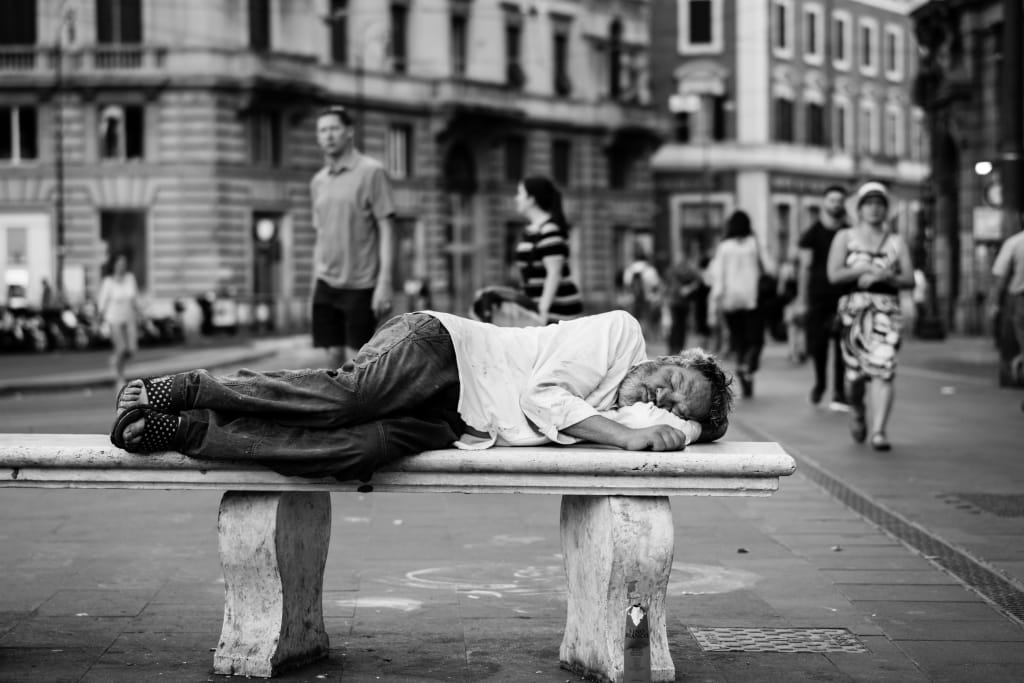
I was woken today by the sound of fierce wind and dancing trees, as the rain thumped on my window. The birds sang softly with the ebbs and flows of the brisk front. I have always loved the rain. It makes me feel alive, and grateful for the heavens to purge itself of the impurities of the sky.
Today when I opened my eyes, I thought about people who are homeless — especially as we continue to this pandemic when there are fewer places to go, and little shelter to be found. People are less likely to lend a hand out of fear of contamination. We are devoid of the human touch.
His name was Ray
In my last semester at Rutgers University, I lived in a tall apartment building at a very busy intersection where a lot of non-students came and went. About a block down was the main bookstore I passed each day on my way to the bus stop, and there was always the same man there. He held a sign that covered his face and sat crisscrossed with a plastic donation cup at his feet.
It was a frequent thing to come across those struggling with homelessness at Rutgers- right on campus, so this wasn’t an unusual sight for me to overlook in my busy days. They were on the bus, stayed warm in the library, and hung out in the student center food courts with friends. But this man caught my attention — perhaps because I passed him every single day, sometimes twice.
I started volunteering at Elijah’s Promise, a local non-profit that provides lunch and dinner free of charge to anyone who comes in, no questions asked.

I typically got back to my apartment around what was dinner time at Elijah’s, and I knew this man had to be hungry. He was living on maybe five bucks a day from grungy donations out of college kids’ pockets. He was a regular in his spot which meant he was overlooked even more. He became a part of the landscape.
One day, I stopped in front of the raggedy-looking man and got his attention. He kept his hood up to block the wind and hide his face in an effort to retain a humble identity. Hunched over, he held his makeshift cardboard sign that displayed his homelessness and a cry for any type of help.
I told him about Elijah’s Promise and exactly where it was — he could get there by the Rutgers bus (no they are not monitored and anyone can take them). He thanked me and I saw him the next day. He was thankful to have a place to eat, indefinitely.
〰〰〰〰〰〰〰〰〰〰〰〰〰〰〰〰〰〰〰〰〰〰〰〰〰〰〰〰〰〰〰〰〰
It became a regular thing for me to stop and talk to him. I always wanted to talk to people in a situation like his, especially after being fed so many stereotypes of what a homeless person is: a druggie, a loser, usually a minority, and an unintelligent person. I knew this was a generalization and wished to squash any remnants of the ideas I was brainwashed as a child born in New York City, where I saw a lot of (sometimes scary-looking) homeless people.
Let’s face it — it’s tough to unlearn things buried deep in our ego, especially when you’re living on the more fortunate side and you needn’t practice empathy for your own sake.
I asked him questions. His wire glasses fogged while the November breeze howled. I didn’t feel threatened at all. I plopped down on the cold sidewalk next to him, so as to not hover over him in a domineering manner. Students glanced at me when they passed. Some did a double-take. I asked him about his life. It was so interesting — I wanted to take notes.
I didn’t want to taint the experience and have him believe I was using him for a project or to boost my feelings of philanthropy to the outside world. So we spoke, and I listened. I asked him personal questions because I felt it was an appropriate dialogue to match the information he disclosed to me.
He told me stories of how his ex-wife took the house after killing their newborn, and he ended up on the street. She took everything. He studied computer science and was eleven credits away from a Bachelor’s degree. He was living in Newark but didn’t feel safe there, so he found his way to New Brunswick. He said no one bothered him during the night when he slept, and he liked it here. I asked him about a potential job he could get on campus, and we spoke about legal documents and such.
He was nothing like the stereotypes I had been taught about. He was an intelligent, funny, wise, well-kept, articulate, and strong-willed man.
I don’t know if he was lying. I gave him the benefit of the doubt and helped him feel a little less hungry until he got himself back on his feet.
I thought about him when I woke up this morning. His name is Ray. I wonder where he is, or if he was able to find shelter during this pandemic since Rutgers was shut down for practically a year. I started to think about other people who may be homeless at this time, and the food banks that have been devoid of resources- forced to turn hungry families away.
It made me extra grateful, and a little bit sad to reflect on the disparity of wealth in the world, and how the roll of the dice could leave you homeless for a while in this crazy game called life. It gave me a new outlook, helped me cultivate gratitude, and enabled me to process the sickness and death others are experiencing right now during this pandemic.
About the Creator
Susie Pinon
Italian chick with a New Yorker attitude. Free-spirited, eclectic by nature, vegan. I'm fueled by my passion for the art of words. I'm addicted to chocolate + love to heal through the sun's rays. Let's talk words
https://linktr.ee/xosusiep
Keep reading
More stories from Susie Pinon and writers in Humans and other communities.
How to Know They’re Into You
I’ve enjoyed dating since middle school, and I am now twenty-four and absolutely, magically, head over heels, in love. I had my fair share of dating, whether fwbs, long-term flings, or full-blown relationships. I've learned a lot over the years about male psychology.
By Susie Pinon4 years ago in Humans
Guard Your Battery
Why are some people so attractive just by standing there? It’s not because they are "likable," but because they don’t need everyone to like them. I realized later that truly charismatic people allow themselves to be criticized, but they never criticize themselves. They never try to please the world; instead, the world stops to watch them.
By Emily Chan - Life and love sharing2 days ago in Poets


Comments
There are no comments for this story
Be the first to respond and start the conversation.