
Journey of Hope: The Story of Imran Khan and the Shaukat Khanum Cancer Hospital
From a mother’s pain to a nation’s pride — how one man’s promise became Pakistan’s greatest symbol of faith, compassion, and service.

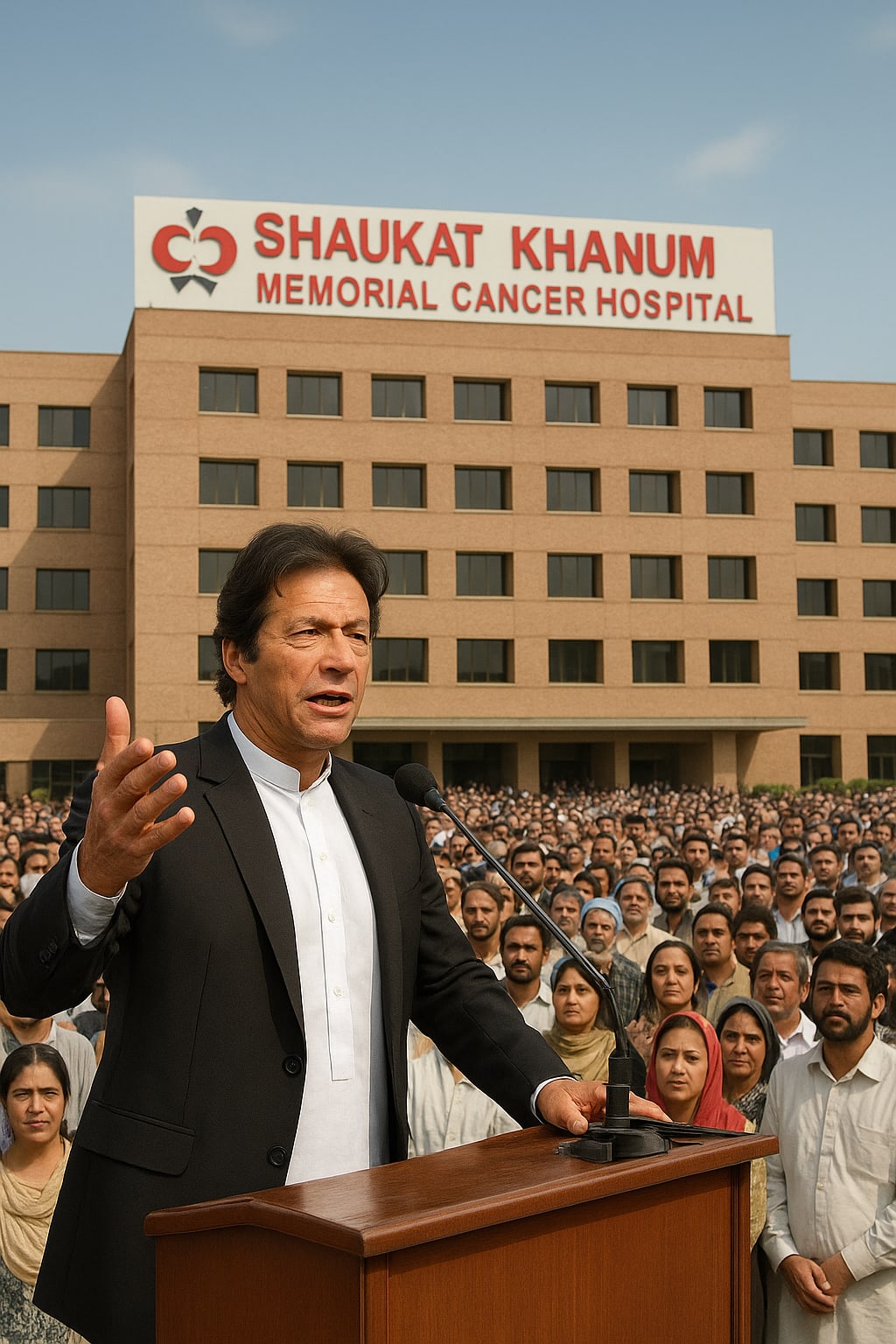
Subtitle:
From a mother’s pain to a nation’s pride — how one man’s promise became Pakistan’s greatest symbol of faith, compassion, and service.
---
When destiny strikes hard, some people surrender, while others rise with renewed strength.
This is the story of Imran Khan, a man who turned his deepest sorrow into a mission of mercy — the creation of the Shaukat Khanum Memorial Cancer Hospital and Research Centre, one of the greatest humanitarian achievements in Pakistan’s history.
The journey began in 1985, when Imran’s beloved mother, Shaukat Khanum Begum, was diagnosed with cancer. At that time, Pakistan had no specialized cancer treatment centers. Families who could afford it took their loved ones abroad; those who couldn’t simply watched helplessly as the disease consumed their dear ones.
Imran took his mother overseas for treatment, but he was haunted by the suffering of countless families who couldn’t do the same. He once said:
> “Every day I saw my mother fighting pain with courage. And I realized that thousands of other mothers in Pakistan had no hope, no help, and nowhere to go.”
When his mother passed away, the grief changed him forever. From the ashes of that pain emerged a vow — to build Pakistan’s first cancer hospital, where every patient, rich or poor, would have access to free and world-class treatment.
For many, it sounded like an impossible dream. A young cricketer, known for his charisma and leadership on the field, now wanted to build a multi-million-dollar medical institution in a developing country. Critics mocked the idea. But Imran Khan had something stronger than money — he had faith, conviction, and purpose.
He began his mission with empty hands but a full heart. Traveling from city to city, from villages to remote corners of the country, Imran reached out to the people directly. He spoke not as a politician or celebrity, but as a son fulfilling a sacred promise. His voice carried sincerity, and his words touched hearts.
Children donated their pocket money; women took off their gold bangles and earrings; laborers offered a day’s wage. The entire nation came together for one cause. It was no longer just Imran Khan’s dream — it became Pakistan’s collective hope.
He often recalled those days, saying:
> “When you work for others, Allah opens doors you never imagined. I saw miracles — I saw the poorest give with the richest heart.”
After years of relentless effort, fundraising, and planning, the dream finally came true. In 1994, the Shaukat Khanum Memorial Cancer Hospital and Research Centre opened its doors in Lahore.
It was a milestone in Pakistan’s medical history — a hospital built entirely from public donations, offering free treatment to nearly 75% of its patients.
The hospital’s design and technology met international standards, but what made it truly special was its spirit — the compassion that ran through its walls. Every patient who walked in received not just medical care but also dignity and hope. For the first time, thousands of poor families could say: “We are not alone.”
Imran Khan’s project silenced his critics and inspired millions. It proved that when faith meets determination, no goal is impossible. The success of Shaukat Khanum became a model of welfare and philanthropy in Pakistan.
Encouraged by the response, Imran expanded his vision. New branches were planned — one in Peshawar, inaugurated in 2015, and another in Karachi, which continues to grow. Each hospital carries forward the same promise: no one will be denied treatment because they cannot afford it.
But beyond the bricks and buildings, Shaukat Khanum stands for something far deeper — it represents love, faith, and the power of collective humanity. It reminds every Pakistani that greatness does not come from wealth or power, but from service and sacrifice.
Imran Khan himself often said:
> “When I first spoke of building this hospital, people said it was impossible. But I learned that when your intention is pure, Allah makes the impossible possible.”
Today, decades later, the hospital’s corridors are filled with stories of survival and gratitude. Children who once came for treatment now live healthy lives. Families who once feared death now celebrate life. Every smiling face is a living testament to one man’s promise to his mother — and to his nation.
The Shaukat Khanum Cancer Hospital is more than a medical institution; it is a movement of hope. It shows that even in a world filled with despair, one person’s compassion can ignite the light for millions.
It also reminds us that leadership is not about fame or power — it is about serving others and leaving behind something that uplifts humanity.
---
Conclusion:
Shaukat Khanum is not just a hospital; it is a legacy of love. It began with a mother’s pain and a son’s promise and evolved into a symbol of a nation’s unity. Through faith, perseverance, and the generosity of ordinary people, Imran Khan turned personal tragedy into a beacon of hope for millions.
In every corner of Pakistan where the hospital’s name is spoken, it carries a message: “No dream is too big when it is born from love, faith, and service to humanity.”
---
About the Creator
Lost and Alone in the French Alps
Looking back, I can trace some of my life’s biggest adventures to a simple action from my sister. She’d introduced me to Tommy (a very long time ago), a colleague of hers, who had overshared his penchant for Italian-looking women, and I ticked that box.
By Chantal Christie Weiss20 days ago in Humans
The Longest Night: The Construction Worker, The Ledge, and the Nine-Hour Vigil
The true story of Michael O'Rourke, a construction worker who spent nine hours on a Brooklyn rooftop talking a suicidal woman down from a ledge, proving the power of simple human presence.
By Frank Massey about 23 hours ago in Humans
Ludacris and Nelly draw backlash over bookings at MAGA-coded music festival
Ludacris and Nelly headlining a mostly right-wing event is good for them. It’s also great for the genre of hip hop. The two rap veterans have showcased their talents on other stages. Why can’t they perform for mostly MAGA folks and grab that bag?
By Skyler Saunders5 days ago in Beat



Comments
There are no comments for this story
Be the first to respond and start the conversation.