
Journalistic Integrity vs. Corporate Interests: How Bezos' Choices Affect Democracy
Over the past weeks, Jeff Bezos-an increasingly powerful and influential entrepreneur in the world-has faced unprecedented criticism over one of his decisions regarding The Washington Post, which he bought in 2013.

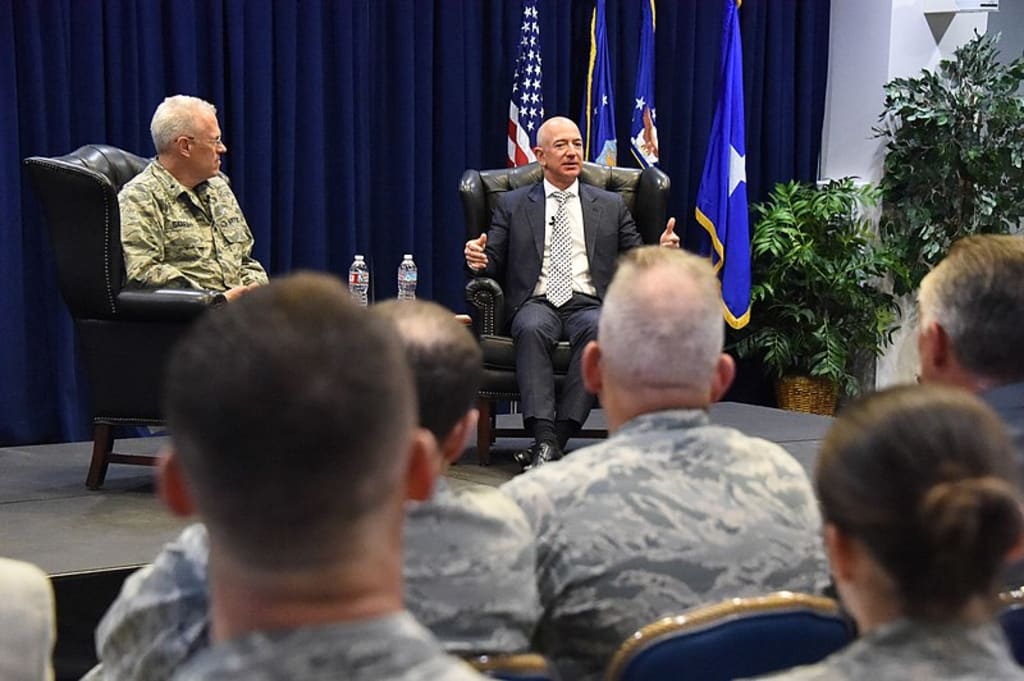
Over the past weeks, Jeff Bezos-an increasingly powerful and influential entrepreneur in the world-has faced unprecedented criticism over one of his decisions regarding The Washington Post, which he bought in 2013.
It was two weeks ago that The Washington Post had opted not to issue a traditional endorsement in the U.S. presidential election, which elicited broad outrage.
Thus, his decision seems to stem from the growing number of conflicts of interest for Bezos as his business ventures proliferate across companies such as Amazon and Blue Origin.
With Donald Trump still likely to win in the 2024 election, Bezos' latest moves bring into view the uneasy marriage between business interests and journalistic principles.
What are the possible consequences of his actions? what motivated him to do such a thing, and what general repercussions for democracy and the free press there will be?
A Convenient Meeting or an Act of Opportunism?
The Bezos controversy kicked off with a meeting between a high-ranking executive from Bezos' aerospace company Blue Origin, Dave Limp, and Donald Trump.
Limp brushed it off as a "coincidence," and he was in Texas for other reasons, the meeting with Trump just happened to be "opportune." But "opportunistic" has a more pejorative meaning, implying an action of calculated hedging in anticipation of the election by Bezos.
The timing is unmistakable: Just days earlier, The Washington Post had decided against endorsing Kamala Harris days despite having a ready statement in support.
It was a withholding of an endorsement that broke a long tradition and wasn't exactly random either.
Some see this as a thinly veiled way in which Bezos keeps in good books with business, so that Trump-or any administration for that matter-looks upon him and his enterprise with a view to favor.
To Marty Baron, the former editor-in-chief of The Washington Post, Bezos had high stakes in Amazon and Blue Origin, placing corporate interests above journalistic values.
Bezos, Trump, and the Calculated Risk of a Second Term
It is hard to conceive of an executive-press relationship more incendiary than the one that has existed between Bezos and Trump.
During Trump's first term, The Washington Post frequently applied a critical eye to the administration, which sparked Trump loudly denouncing Bezos, suggesting that Amazon was dodging taxes and using its heavy market hand to crush small businesses.
At one point, Trump reportedly leaned on the U.S. Postal Service to double its rates for Amazon packages. Trump's administration also awarded the $10 billion JEDI contract-a cloud computing project Bezos' Amazon Web Services was widely expected to win-to Microsoft, a decision Amazon later challenged in court, alleging presidential interference.
For Bezos, a second term for Trump might come with renewed hostility: Trump has frequently taken to attacking him personally, in addition to his companies, Amazon and The Washington Post. Projects such as Blue Origin depend heavily upon federal contracts, and for the first time, the stakes are higher than ever for Bezos.
That venture, once largely a personal indulgence of his interest in space, has reached a point where it cannot go further without government aid. Blue Origin has won a string of major contracts, including the $3.4 billion contract from NASA to construct the lander that will take people to the Moon, as well as contracts with NASA and with the U.S. Space Force.
Now, tension with any administration is bad, particularly one where the President is as vindictive as Trump.
Blue Origin: The Lifeblood of Bezos' Vision for Space
Bezos called Blue Origin his "most important" project, more so than even Amazon and The Washington Post. For years, Bezos has dreamed of a future in which Earth is only one of many habitats occupied by humanity, using the vastness of space to save this planet.
The idea is to move heavy industry to space's colonies, leaving the Earth only for "residential" purposes and light industry. Financed through the sale of roughly $1 billion in Amazon stock annually by its owner, according to reports, Blue Origin nevertheless depends upon government contracts for viability over the long term.
In view of the recent meeting between Limp and Trump, together with decisions being taken by Bezos at The Washington Post, it seems that Bezos is taking steps to ensure Blue Origin's interests are looked after in a politically hostile environment.
Lack of federal support puts it behind its competitors, including Elon Musk's SpaceX, which has already won several contracts from NASA. But the firm's obvious success from SpaceX in the space industry only puts pressure on Bezos to cement Blue Origin's place in the sector-or else risk being eclipsed by Musk, a self-described Trump supporter.
The Washington Post and the Ideals of Free Press
And for the first time in modern times, The Washington Post did not endorse a candidate.
Traditionally, endorsements are issued by the paper's editorial board, separate from the newsroom, but the symbolic weight of an endorsement-especially during a polarizing election-carries significant resonance.
The paper's decision to abstain has been interpreted by many as tacit support for Trump.
The move has turned off a large portion of The Washington Post's readership, which largely consists of self-described liberal-leaning, pro-public investigative journalism that keeps powers that be in check. Reports said upwards of 200,000 subscribers canceled in protest, with high-profile writers leading a public letter in critique of Bezos' motives.
It's also strategically convenient that the decision not to endorse Harris was from among those whom the editorial board had prepared to back. It is also a factor in the climate of fear among business leaders that causes many to "play it safe."
Trump's increasing threats of "revenge" against companies standing in his way add to that climate of fear. According to a report from CNN, several technology chiefs have reached out to Trump personally, including Apple's Tim Cook, Google's Sundar Pichai, and even Mark Zuckerberg of Facebook.
It would seem, hopefully, to avoid his anger or to curry favor with an administration which may yet come again.
The Consequences of Bezos' Move
The financial consequence for Bezos of crossing Trump could spill over from Blue Origin into Amazon, which remains the linchpin of Bezos' fortune and power.
The company still depends heavily on federal contracts, particularly for cloud computing, where it works with the CIA and NSA. But that has come at the cost of a strained relationship with the White House-which, as past confrontations have shown, imperils these lucrative deals.
The implications for The Washington Post are no less grave: by withholding its endorsements, Bezos compromises the paper's journalistic independence and the integrity of its editorial decisions. Critics view this decision as a form of censorship by omission-driven by the impulse to advance corporate interests over democratic ones.
In the process, the paper's credibility and reputation among its readers have been damaged, as witnessed by the mass cancellations and discontent on the part of staff. Bezos sends a signal with his decision: that the paper's famed motto, "Democracy Dies in Darkness," may mean less as some kind of rallying cry and more as a branding tool.
The recent backlash has intensified, with former Washington Post journalists and editors sounding the alarm that the paper has become an instrument of Bezos's business interests at the expense of its journalistic mission.
The Paradox of Influence: Media, Business, and Democracy
Bezos' trying to balance his three roles of media owner, tech mogul, and space entrepreneur only serves to outline the paradox of influence in modern America: how a billionaire who once said he was prepared to meet threats against him over The Washington Post's investigative reporting now seems to have given ground.
His decision underlines a sensitive balance media owners must consider today's political climate, particularly when their other businesses rely upon federal support.
What this portends for The Washington Post itself is fundamental. Bezos says this is a return to the roots of the paper when it does not endorse candidates, but given the timing, it cannot help but be viewed as anything but an act of capitulation.
When Influence Stifles Integrity
Jeff Bezos' games only raise fundamental questions as to the role of the press holding power to account. If his primary motivation is the business interests of Amazon and Blue Origin, he risks compromising the editorial independence of The Washington Post. Where billionaires control the media and the major industries, the line separating public good and private interest can get perilously blurred.
As Bezos cuts his way through this saliently complex terrain, the consequences for journalism and democracy simply cannot be ignored. In a period when political division is considered to tear asunder the very sinew of democratic institutions, the decision of The Washington Post to retreat from endorsing a candidate strikes many as an abdication of responsibility. This was either a pragmatic business decision by Bezos or cowardice in the face of possible backlash. But one thing is beyond doubt: in a democracy, when the press buckles under power, the dark forces come closing in.
About the Creator
Tanguy Besson
Tanguy Besson, Freelance Journalist.
https://tanguybessonjournaliste.com/about/
Keep reading
More stories from Tanguy Besson and writers in Humans and other communities.
Trump 2.0: A New World Order or Chaos Reborn?
Running on an "America First" agenda, an uncompromising vision of power politics combined with divisive rhetoric, Trump has disrupted the political and social dynamics not only of the U.S. but also those of the world.
By Tanguy Bessonabout a year ago in Humans
Cabin Fever Because of Snow, Sleet, and Freezing Rain That Turned to Icy Roads
What Is Cabin Fever? The short answer is that cabin fever is restlessness from being in a confined area. Cabin fever is the distressing irritability or restlessness experienced when a person or group is stuck at an isolated location or in confined quarters for an extended time. Research shows that prolonged cold, gray skies, and being stuck indoors can trigger mood shifts similar to “winter blues.”
By Margaret Minnicks6 days ago in Humans
What Science Says About Intention and Healing Response.
The idea that intention can affect health has been debated for decades. While it was once considered purely spiritual or anecdotal, modern science is beginning to provide evidence that focused intention can influence healing outcomes. Researchers in psychology, neuroscience, and medicine are exploring how mental states, conscious thought, and intention interact with biological processes to promote recovery and overall wellbeing. Understanding this relationship offers new strategies for enhancing traditional medical treatments and personal health practices.
By Wilson Igbasi5 days ago in Humans


Comments
There are no comments for this story
Be the first to respond and start the conversation.