
It's All About Eve
"Oh, don't let's ask for the moon. We've already got the stars."

Bette Davis is one of the most famous actresses in history. She was beautiful, eccentric with an unusual sense of humour and in her own words: “I love my profession. I would never stop. Relax? I relax when I work. It’s my life.”
Born on 5th April, 1908, Ruth Elizabeth Davis arrived nine months after her parents’ wedding, in Lowell, Massachusetts. Her father was Harlow Davis and was angry when Ruth Augusta (Bette’s mothers) got pregnant. He never fully accepted his daughter and was known to be a disagreeable and irresponsible man. When Ruth became pregnant again with Bette’s sister, Bobby, he had the same tantrum. Harlow graduated from Harvard Law School, in 1909, and began working in the patent department of a shoe manufacturer. Being seldom home, Ruth was left to care for two young children and she became depressed. Harlow’s constant infidelities didn’t help. Although Bette and Bobby were desperate to please their father, Harlow was just not interested in having any relationship with his daughters.
When Bette was eighth, her parents divorced. Bobby was upset, Bette was not. Now peace reigned at home. Ruthie (their mother) now worked as a governess and did photography to bring in the money. Although she was still young and attractive, her daughters did not want a second father. It wasn’t until she was much older that Bette realized that they “had short-changed their mother of any possible happiness.”
Ruthie worked in New York and the girls were sent to a boarding school in western Massachusetts. Here they spent six years, taking care of the animals, learning how to cook, sew, read and write. In 1921, Ruthie and her girls moved to New York, where she enrolled in the Clarence White School of Photography. Bette attended high school. The two girls were sent to the coeducational Cushing Academy in Northfield, Massachusetts. Here, Bette met Harmon Nelson (“Ham”) who became her first husband. She was infatuated with him and dreamed of a perfect home and family. When he left for college, being a true teenager, Bette ‘transferred’ her love to another boy, Fritz. Still ‘dreaming’ of the perfect life, just with a different man.
However, only the theater could capture Bette’s spirit. “The White Duck” was the first play she ever saw and Bette was enthralled. At eighteen, Bette Davis knew that she would become an actress --- and one of the best! Harlow rejected his daughter’s plans to be an actress but Ruthie became her daughter’s greatest supporter.
In 1927, Bette joined the John Murray Anderson School of Theater and Dance. Leaving Bobby with friends, Ruthie and Bette moved to New York. Bette always came first, which did cause problems later on in life. Bette would always be the star of the family.
Bette enjoyed her time at the Anderson School and learnt many things that would set her on the path to stardom. She would have married Fritz but he demanded that Bette give up the theater. Good-bye Fritz. It was about this time that “Ham” got back in touch with Bette. Bette won a $250 scholarship “for the most promising student” but never needed to use it. Upon advice, Bette accepted her first professional acting part with the Provincetown Playhouse. The play was “The Earth Between” and Bette’s reviews were good.
The Repertory Theater phoned Bette and asked if she would replace the current actress who played Hedwig in “The Wild Duck” (the very first play Bette had seen ). One play finished and, without hesitation, Bette took the role. “Opening night brought one of the most thunderous applause in the theater’s history.” Bette had found: “the one true, enduring romance in my life.”
Bette was now an up-and-coming actress who had no issues getting started in new plays. She made her debut on Broadway in 1929. Although she didn't get paid much, Bette didn’t mind --- she was on her way. Bette got her first screen test whilst performing in “Solid South” in 1930. A talent agent from Universal Studios had arranged it. The screen test resulted in a three month contract at $300 a week. Universal even paid for the train tickets for Ruthie and Bette. Doubts followed Bette because she didn’t look like the usual ‘dime a dozen blond and curvy Hollywood actress’, but as Bette said later: “I wasn’t planning to be a starlet. I was planning to be a star.”
Bette never missed live performances. Shows ran for a time but finished, whereas movies last forever. When she arrived in Tinseltown, the studio representative failed to find her because she didn’t look like an actress, Bette looked like (and was) a 23 year old, devoted Puritan and virgin --- Bette was rare among the local ladies!
Her first movie was “Bad Sister.” Bette overheard the head of production saying that “she has as much sex appeal as Slim Summerville” which knocked Bette’s ego. The truth is that many Hollywood people didn’t like Broadway people. Something similar was said about fellow actor Humphrey Bogart at the time. Bette carried on and her contract was renewed, but at a sacrifice as every aspect of an actress’s life was completely controlled by the studio. Bette was virtually helpless to make any decisions about what movies she did or even her career.
Bette made six pictures for Universal before they let her go. Whilst packing to go home to New York, George Arliss phoned. He was the British actor and filmmaker who had found great success in Hollywood, and he was looking for a female lead in his movie “The Man Who Played God.” Bette met him and secured the female role, signing a five-year contract with Warner Brothers --- at $400 a week! Bette was an instant success and had now entered ‘the land of magic’ and was treated like Hollywood royalty.
Bette now married Ham on 18th August, 1932, in Yuma, Arizona, and they moved into a cottage in Hollywood. Ham had married Bette but also ended up looking after Ruthie and Bobby as well. Tension soon set into the marriage. Ham’s career as a musician didn’t take off and Bette was bringing in the money.
In 1934, Bette signed her second contract with Warner Brothers, for seven years at double the money. Bette starred on “Of Human Bondage” when she did her own make-up. Her next performance in “Dangerous” won Bette an Oscar Award. Warner Brothers worked hard to put their new star in the limelight. One of Bette’s greatest regrets at this time was losing out to Vivien Leigh for the role of Scarlett O’Hara in the film “Gone With The Wind.”

Whilst filming “Jezebel”, Ham filed for divorce, apparently Bette read too much. During this film, Bette had an affair with the director Willie Wyler. When she became pregnant and the paternity of the baby wasn’t certain, Bette got an abortion. Bette’s role in “Jezebel” won her her second Oscar Award. The film was released in black and white just before “Gone With The Wind”. Bette now entered into an affair with millionaire Howard Hughes but the affair soon ran its course.
1939 was a difficult year for Bette. She won an Oscar, her marriage ended and she had several affairs. It was an emotional time for her and Bette nearly had a nervous breakdown. Work was her salvation and Bette dived into the next movie “Dark Victory”, which was promoted as a ‘woman’s movie.’ Bette brought depth to her character and it was well-received. The New York Times reported: “Miss.Davis is superb. More than that, she is enchanted and enchanting. Admittedly it is a great role ---. But that must not detract from the eloquence, the tenderness, the heart-breaking sincerity with which she has played it.” Her co-star was Ronald Reagan.
Bette’s next movie was “The Private Lives of Elizabeth and Essex”, an historical drama which is a fictionalized version of the relationship between Elizabeth I and the Earl of Essex. Her co-stars were Errol Flynn and Olivia De Havilland. Bette wanted to work with Lawrence Olivier, but because he was unknown then, Warner Brothers chose Flynn. This was Bette’s first movie in technicolour. Once the movie was released, Bette went on vacation to New England where she met her second husband.
Bette was now Warner Brothers most profitable star, and she earned $4,500 a week! Still, she needed a break and hoped to find peace and solace in New England. Bette met Arthur Farnsworth and was smitten, the couple marrying on 31st December, 1940, in Arizona. As she was working on the movie “The Great Lie”, the couple never had a honeymoon. The couple now lived in her farm she called ‘Butternut.’
The relationship was going well until Arthur collapsed and died from a skull fracture. During this time, Bette made her last movie with the director William Wyler --- “The Little Foxes.” Playing the character took so much out of Bette that she needed to go back to New England to recover.
Bette’s next movie made her the first person to earn an Oscar nomination five years in a row. “Now, Voyager” was released in 1942 and she gave a ‘stellar’ performance.
In 1945, Bette married for the third time, William Grant Sherry, and had their daughter, Barbara, in 1947. When Warner Brothers refused to give Bette ‘script approval’, she gave up her contract with them after 17 years. Having the freedom now to choose her own roles, Bette read the script “All About Eve” in 1950 and did not hesitate to accept the part. It was a rare occasion in which Bette could have her leading man, Gary Merrill.
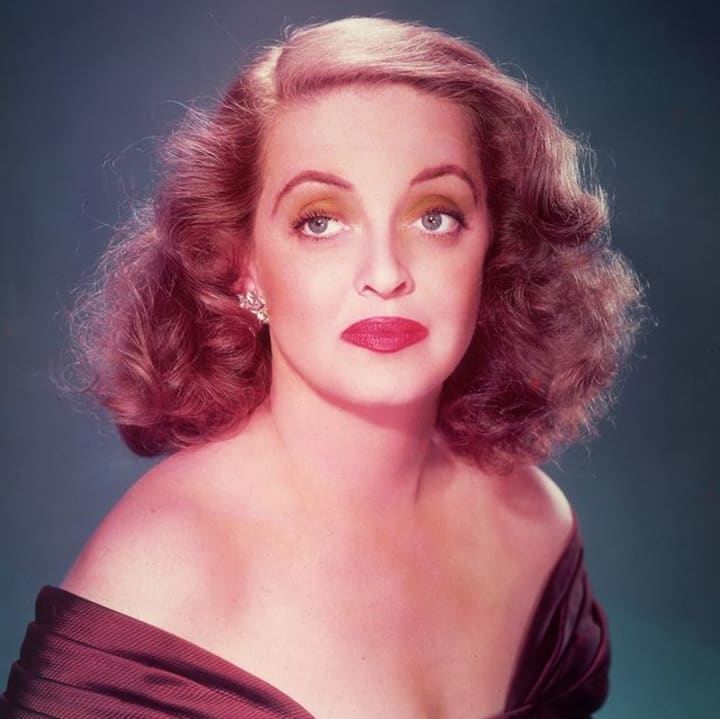
During the filming, Bette went through a second and difficult divorce. Gary was kind but made it clear that he was not “Mr.Davis.” Bette was impressed and the couple married, and adopted a girl and boy. However, Bette soon found out that Gary loved his drink. “All About Eve” was a parallel between Bette and her character, Margo, who was aging and obsessed with eternal youth. The audience loved Bette’s performance and, having seen the movie several times myself, I’m not surprised that it was a great success.
1960 was a difficult year for Bette. She divorced Gary and her mother, Ruthie, died. She was heartbroken but now Bette was caring for three children and her sister, Bobby, who was prone to mental breakdowns. Being in her fifties, Bette changed direction into Horror films and became the mistress at portraying psychotic, older women --- and the audience loved her!
The first of these films was “What Ever Happened To Baby Jane?” and it was a rousing success. It was followed by “Hush --- Hush Sweet Charlotte” and “The Nanny” in 1965. Bette carried on working, she needed to emotionally but was now in her sixties.
Bette suffered several strokes and battled with breast cancer. Vanity demanded that she dress well in public, but when she collapsed and was rushed to hospital in 1989, there was no hope of recovery. At 81 years of age, Bette Davis died on 6th October, 1989. She had made almost 100 movies scanning a 60 year career. In her own words: “I survived because I was tougher than anybody else.”

(I've taken a lot of my research from the book "Bette Davis --- a life from beginning to end", which I can only recommend to read as it was very interesting and very well researched)
About the Creator
Ruth Elizabeth Stiff
I love all things Earthy and Self-Help
History is one of my favourite subjects and I love to write short fiction
Research is so interesting for me too
Keep reading
More stories from Ruth Elizabeth Stiff and writers in Humans and other communities.
"To Err Is Human, But It Feels Divine"
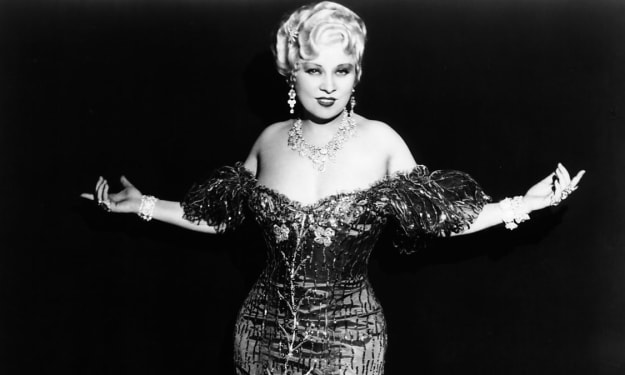
She was one of the original actresses on film and one of my personal favourites. “You only live once, but if you do it right, once is enough”, “Is that a pistol in your pocket, or are you just happy to see me?” “When I’m good I’m very, very good, but when I’m bad, I’m better.” We may not have known who said the quote, but we certainly ‘know’ the quote. Mae West was born when Queen Victoria was still alive and reigning England, and she was one of the most controversial stars of the day, especially when ‘censorship’ was involved. I believe that it was Mae’s husky voice that made her famous, along with her personality.
By Ruth Elizabeth Stiff5 years ago in Humans
Social Media Causing the Decline in Humanity?
From the moment we wake up to the moment we fall asleep, many of us are glued to screens filled with social feeds, infinite scrolls, and algorithmic suggestions tailored to grab — and keep — our attention. While social media promised connection, empowerment, and community, it’s increasingly clear that its **cost to our mental health, social cohesion, and emotional well-being is profound.** Unless we confront these issues head-on, we risk a generational decline in humanity’s psychological and interpersonal health.
By Anthony Bahamonde8 days ago in Humans


Comments
There are no comments for this story
Be the first to respond and start the conversation.