
Is Civil War Coming to Europe?
Experts Warn France and the UK May Be Reaching a Breaking Point

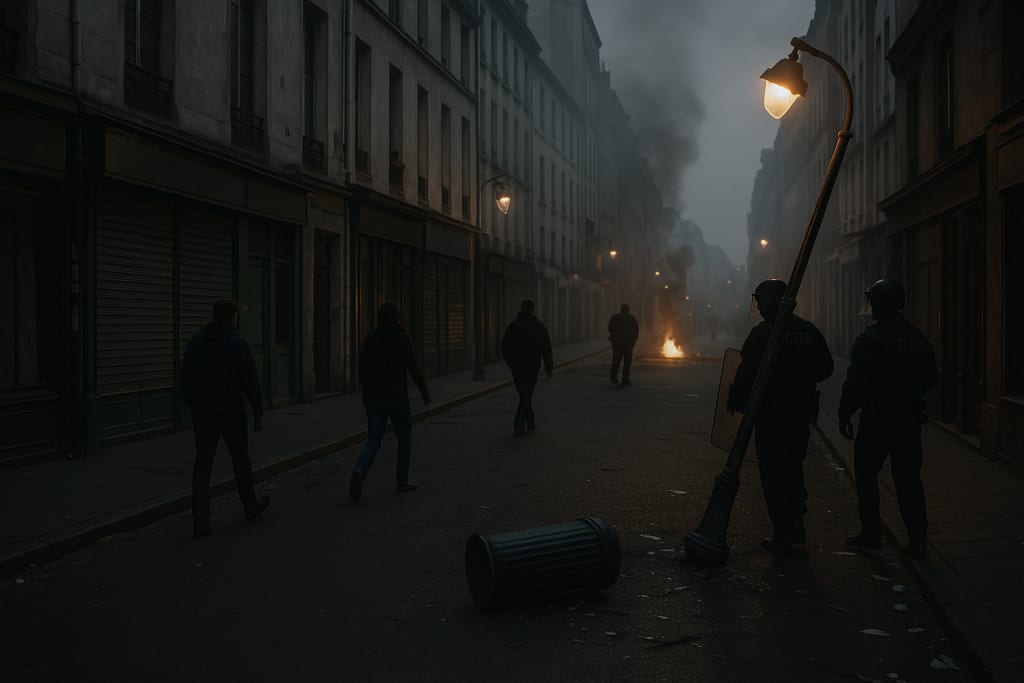
For decades, the idea of civil war in Western Europe seemed unthinkable. That was the kind of tragedy reserved for failed states, distant lands, or history books. But today, a growing number of experts are warning: the threat may no longer be theoretical. And two countries stand out as particularly vulnerable—France and the United Kingdom.
One of the most striking voices is that of Professor David Betz, a specialist in war studies at King’s College London. In a recent essay titled “Civil War Comes to the West, Part II: Strategic Realities,” Betz outlines a scenario that reads less like fiction and more like a realistic warning. According to him, the West—particularly Europe—is facing an internal threat that is structural, rising, and dangerously underestimated.
⸻
The Warning from David Betz: Civil Conflict in the Making
In his essay, Betz doesn’t talk about organized armies clashing in open fields. Instead, he warns of a more modern, fragmented, and unpredictable form of internal conflict. According to his analysis, civil war doesn’t start with tanks—it starts with broken trust, collapsing institutions, cultural fragmentation, and weakened state control.
Among the key warning signs he identifies:
• Deep cultural division, especially between urban and rural populations
• Mistrust in institutions, particularly political and media institutions
• The rise of parallel societies, often centered around religion or ideology
• Attacks on infrastructure, including sabotage of rail networks and fiber optic cables in France
• Vandalism of state equipment, such as anti-surveillance acts in London
Betz even introduces the concept of “feral cities”—urban zones where the government’s control is partial or symbolic at best. In such places, the state loses its monopoly on violence and is unable to fully enforce laws.
His most shocking claim? Based on modeling, Betz estimates a 4% annual risk of civil war in countries with these conditions, leading to an 18.5% chance over five years. If we apply this to ten Western countries simultaneously, the cumulative risk shoots up to 87% over five years. For Betz, this isn’t just theory—it’s math.
⸻
Why France and the UK?
Among European nations, France and the UK stand out as the most at risk, according to Betz. Not just because of their size or global visibility, but because of their intense internal contradictions.
In France, deep fractures between multicultural urban areas and rural traditionalist regions are widening. Violent protests, such as the Yellow Vest movement, and recent suburban riots illustrate just how tense social relations can become.
The UK, on the other hand, has faced political shocks like Brexit, ongoing debates around Scottish independence, and increasing public dissatisfaction with law enforcement and political elites. The gap between working-class communities and urban centers like London is growing, and in some cases, already feels irreversible.
In both countries, large segments of the population feel abandoned, unheard, and angry. The state, meanwhile, is struggling to maintain control in some neighborhoods, prisons, and online spaces where radical ideas flourish.
⸻
Feral Cities: When the State Loses Control
The term “feral cities” might sound dramatic, but it’s already being used in military and academic circles. It refers to areas—often large cities or districts—where law enforcement and government institutions have lost meaningful control. In these areas:
• Parallel systems of justice may operate
• Police presence is symbolic or avoided altogether
• Gangs, radical groups, or ideologies take over daily enforcement of order
We are not talking about failed cities, but about places where the state still exists, but no longer dominates. Betz warns that this phenomenon could spread quickly, especially in the face of energy crises, inflation, or political shocks.
⸻
Peter Turchin and the Cycles of Instability
Betz isn’t alone in ringing the alarm bell. Peter Turchin, a Russian-American historian and expert in cliodynamics—a science that uses historical data to model societal behavior—had already warned in 2010 that the West would face a major wave of instability around the 2020s.
According to Turchin, societies go through predictable cycles. When inequality grows, elites multiply and compete for limited positions of power, and trust in institutions collapses, the result is a period of rising unrest, polarization, and eventually, violent conflict. In his model, this cycle can last 10 to 15 years.
If Betz is describing the symptoms, Turchin may have predicted the timeline.
⸻
Are These Predictions Overblown?
Of course, critics argue that such forecasts are overly pessimistic. They point out that modern Western democracies are still economically strong, legally functional, and deeply integrated in global systems. There is no sign of large-scale armed groups, no declared insurgency, no formal rebellion.
But civil wars in the 21st century don’t look like 19th-century battlefields. They look like fragmented unrest. Like breakdowns in public trust. Like competing narratives of identity. Like localized violence that slowly escalates until the state can no longer contain it.
We’ve seen this before—in Yugoslavia in the 1990s, in Ukraine before 2014, and in the United States during recent years of social unrest. The idea that it can’t happen in France or the UK is, perhaps, the most dangerous assumption of all.
⸻
Final Thoughts: Collapse or Wake-Up Call?
Whether or not a civil war erupts in Europe, the conditions described by Betz and Turchin are real. The erosion of trust in institutions, the rise of alternative realities on social media, the growing divide between communities, and the slow loss of state authority are not fantasies. They are measurable trends.
This doesn’t mean the future is sealed. Prediction is not prophecy. But ignoring these signs would be foolish. The better question might not be “Will civil war happen?”—but “How do we rebuild the trust and cohesion that once made war unthinkable?”
If we fail to answer that, the storm may already be here.
About the Creator
Bubble Chill Media
Bubble Chill Media for all things digital, reading, board games, gaming, travel, art, and culture. Our articles share all our ideas, reflections, and creative experiences. Stay Chill in a connected world. We wish you all a good read.
Keep reading
More stories from Bubble Chill Media and writers in Humans and other communities.
THE HAPPINESS SCAM
Happiness is everywhere. In ads, in Instagram reels, in morning podcasts and inspirational TikToks. You’re supposed to be happy. All the time. Smile. Be grateful. Journal. Meditate. Glow up. Hustle. Manifest. And most importantly: never complain.
By Bubble Chill Media 7 months ago in Humans
Ancient Minds, Modern Life: Lessons That Still Control You
What if most of what drives your thoughts, emotions, and behaviors today was already mapped centuries ago—not with fMRI scans or brain imaging, but through ruthless self-observation, disciplined reflection, and honesty modern psychology still struggles to achieve? Ancient philosophers and thinkers didn’t have labs, statistics, or apps tracking attention spans. Yet, they understood the mechanics of the mind with a precision that remains relevant today.
By The Curious Writera day ago in Humans
📢 Raise Your Voice Thread: 03/05/2026
Our “Raise Your Voice Threads” are hosted most alternating Thursdays at 12PM ET to offer creators more avenues to uncover exceptional stories on Vocal. As we are continuously searching for fresh creators and inspiring stories, this thread provides an opportunity to exchange and discuss the stories that have moved and motivated us on Vocal.
By Raise Your Voice by Vocal7 days ago in Resources




Comments
There are no comments for this story
Be the first to respond and start the conversation.