
INVISIBLE IN OUR OWN COUNTRY
On homelessness, political responsibility, and the courage to look closer


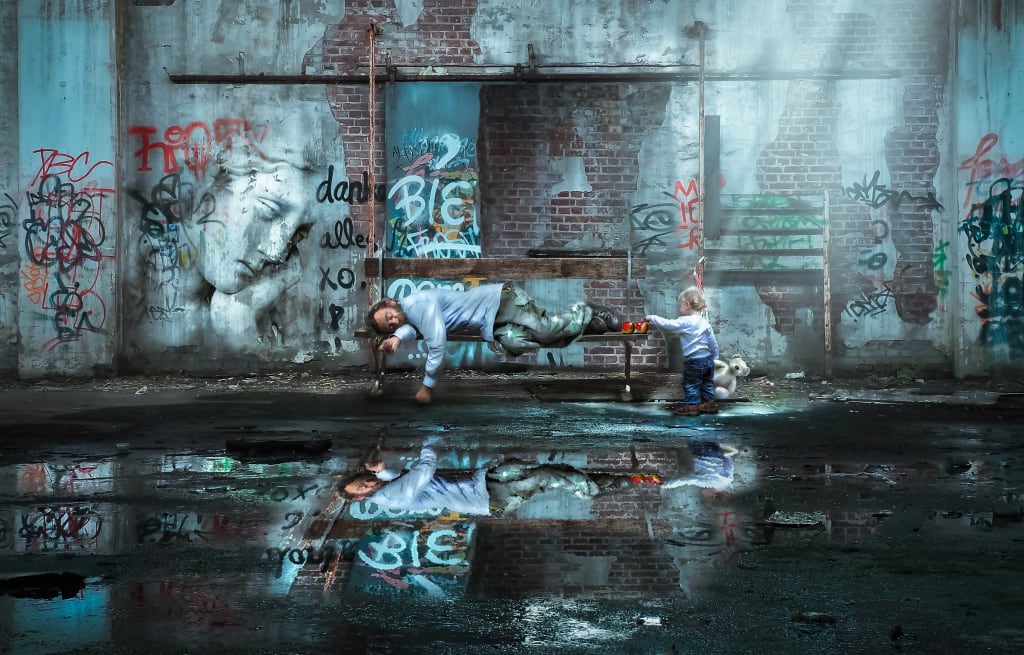
Today, I would like to talk about an issue that concerns us all, even though we too often overlook it: homelessness. In recent weeks, a statement by Chancellor Friedrich Merz has caused quite a stir, when he said that “we still have this problem in the cityscape” – clearly referring to migrants. A remark that not only divides people but also distracts in a fatal way. For while we debate the outward appearance of our cities, about people who supposedly “change” the cityscape, we overlook what is truly shocking: that more and more people have no home at all. That the real problem is not what people look like, but their invisibility – their disappearance from the safety of ordinary life, from the heart of our society.
When a chancellor speaks of the cityscape, he means order, cleanliness, safety. But what about those who sleep on the streets, who shiver in underground tunnels, or who look for a park bench where they can at least rest for a few hours? What about those who have long since stopped being asked how they are? If we are honest with ourselves, it is not the cityscape that troubles us – it is the lack of compassion. We have learnt to look away instead of to listen.
And this very hardship is constantly exploited for right-wing propaganda. The AfD and parts of the CDU/CSU play on people’s fear of social decline and the visibility of public poverty in order to create convenient scapegoats. They point to refugees, to migrants, as though they were to blame for homelessness or inequality. But if we look at their programmes, we find no solutions there, no vision, no genuine concern for those who sleep rough. Quite the opposite – their policies, which dismantle social safety nets, tighten sanctions, fail to cap rents and burden the weakest with bureaucracy, will drive even more people into homelessness. Anyone who wants to make the cityscape “more beautiful” by making people invisible is not solving a problem – they are concealing it.
Homelessness must not be a political slogan. It is not a campaign issue, nor a symbol of morality or order. It is a social issue – and therefore a responsibility we all share. We can no longer wait for the state to fix everything. We must ask ourselves what we are doing – each and every one of us. This is not about guilt, but about responsibility. We live in a wealthy country where no one should have to live on the streets. And yet hundreds of thousands do. That is not the failure of individuals – it is the failure of society.
Let me tell you what I do myself – not to boast, but to show that everyone can contribute something. I talk to people who live on the streets. I listen to them without lecturing. I have learnt that loneliness is often worse than the cold. I donate clothes, help with everyday needs, let people shower or wash their clothes at my place. Sometimes half an hour of conversation is enough to give someone back the feeling of being seen. It’s not a great sacrifice, but it can make a difference.
Even when support services exist, they are not always used – and that has reasons we should try to understand, not judge. Many shelters ban dogs, yet for many rough sleepers their dog is all they have – protection, comfort, companionship. They will not give that up just to spend a night indoors. Other facilities prohibit alcohol or drugs, which is understandable in principle, but many who live on the streets are dependent because they are trying to numb pain, fear, and cold. It is cruelly ironic to offer help and then exclude people precisely because of the struggles that put them there. The conditions in some shelters are also problematic: they open late at night and force people out early in the morning; personal belongings are rarely safe; theft, assault, and intimidation are real dangers. Many feel less safe inside those walls than they do outside.
So what has to happen for real change to occur? First, we must understand that homelessness does not happen overnight. No one simply wakes up one morning and decides to live on the streets. It happens step by step: job loss, illness, a breakup, mental strain, debt, rising rents. We therefore need a system that intervenes early – before someone falls completely through the cracks. We need more affordable housing, genuine social housing, effective rent controls, stronger social support, and more understanding for lives that have gone off track. Prevention is cheaper, more humane, and more effective than any emergency shelter.
But it is not just the state that must act. Towns and communities must also do their part. They can create spaces where people are not merely “accommodated”, but where they regain a sense of dignity. They can foster partnerships – with churches, charities, and private initiatives. We need places where people can feel safe, where they are advised and supported, and where they can rebuild trust. And we need a different attitude – in politics, in the media, and within ourselves.
We have to stop talking about “the homeless” as if they were a single, uniform group. Every person on the street has a story. Some are there because they are mentally ill, others because they suffered a personal tragedy, some simply because they were unlucky. Many do not even want pity – they just want not to be treated like dirt. Once we start to see them as part of our society, rather than as a blemish on its surface, everything changes.
Each of us can do something. We can listen. We can help. We can donate. But above all, we can change our attitude – the way we meet people. Instead of looking away, we can look closer. Instead of judging, we can ask. Instead of blaming politics, we can take action ourselves. It’s the small things that matter: a kind word, a gesture, an open ear. It costs nothing, but it can remind someone that they still belong.
And when I think back to the words of Friedrich Merz, I cannot help but ask: what kind of cityscape does he actually mean? Is it one where people who look different have no place? Or one where we all have a place? When we talk about the cityscape, we should talk about the image of our society – about how we shape it, with humanity, solidarity, and responsibility. A beautiful cityscape is not created through exclusion, but through compassion. It is not made “clean” by pushing people to the margins, but by helping them return to the centre.
The true problem of our cities is not that people from other countries live here. The true problem is that people live here without a roof over their heads, without safety, without hope. Once we understand that, we can start asking the right questions – and perhaps even find the right answers. Not “What does our city look like?”, but “How are the people who live in it?”
Because the cityscape that truly matters is not what we see when we walk down the streets. It is what we feel when we ask ourselves what kind of society we want to be. And when compassion, solidarity and humanity become visible again – then the cityscape will change. Not because people have vanished, but because we have finally begun to see them.
***
Thank you so much for reading! If you enjoyed this content, don’t forget to subscribe to my channel for more. Your support—whether through tips, pledges, or simply hitting that subscribe button—directly fuels my growth and helps bring exciting new projects to life. Join me on this journey and be part of something special!
About the Creator
Christian Bass
An author, who writes tales of human encounters with nature and wildlife. I dive into the depths of the human psyche, offering an insights into our connection with the world around us, inviting us on a journeys.
Keep reading
More stories from Christian Bass and writers in Humans and other communities.
The Dragons Besides Me
To be honest, there are quite a lot of dragons besides me during my life and somehow, the most inspirations comes from women. Suddenly, the question is, about which of them I wanna talk here. Of course, I could talk about my adoptive mum, since she created a lot of me, but I have my doubts that anyone wants to read a horror story at the international women day. I also could have talked about my biological mum, since my strength is coming from her. But even that seems wrong to me.
By Christian Bass2 years ago in Humans
12 Physical and Emotional Signs of Kundalini Awakening You Should Know.
Kundalini awakening is a profound spiritual experience that involves the activation of dormant energy residing within the human body. This ancient concept originates from yogic practices and spiritual traditions, particularly in Hinduism, where it is often depicted as a coiled serpent resting at the base of the spine. The term ‘Kundalini’ derives from the Sanskrit word meaning ‘coiled’, representing the latent potential that lies within each individual.
By Wilson Igbasi6 days ago in Humans
Silken Chains
Silhouettes of the female form were given flesh and bone. Silken skin glistened under the spotlight. Dry ice rose around our Icons as they danced atop their podiums in the Square. Heralded for their beauty, their movements were slight, powerful, and sensual.
By Paul Stewart3 days ago in Fiction




Comments (1)
I agree and resonate with most of what you're saying. I just don't think it's a right-wing only agenda. I think both sides are equally abusive of the people they claim to care about. Human beings lives should not be political. Period. The government should have no say when it comes to what should be done with homeless people unless it's to help them have shelter. There is way too much money in this country for people to not have homes. They're only making the problem worse by replacing jobs with AI. They create the problems and then market it as progress. They want people to not be homeless.. not on drugs... They want people to work. But they take away jobs, offer drugs, and rent houses for obscene prices. I was homeless just a few months ago. It was because our rent went from 1095 to 1575. We were living in a duplex in Texas that was old. Nothing was upgraded. It had mice when we moved in that we took care of ourself. Apparently the owner hired a new property manager. What happened was they decided to raise the rent with that new property manager. They also told us not to pay rent to them for the month of February. So did the last property manager. So... We tried to hold onto the money for rent so we could pay when they got their paperwork in order per their own request and we weren't able to. My husband lost his job when the company laid everyone off and then the transmission in my car went out. We had to use the money to survive and then they wanted the rent money. We thought it would be ok.. because we'd filed our taxes and we're expecting money back. That's when we heard about the rent increase. As well as late fees for February. And fees for eviction notices. They had sent 3 at first in the beginning of March. Then 3 more. Then another 4. And charged a $15 fee per notice. It all piled up and we just couldn't keep up. We sold everything. Did everything we could. My husband applied for so many jobs. I was selling handmade baked goods and jewelry and art... Everything I could. No one cared. We have no family to help. It was a nightmare. Things like that should not happen. I'm not saying people should be allowed to be jobless and deliberately not pay their bills. But sheesh. You don't kick people when they're down. If even one of these billionaires out their money into actually helping people instead of buying another house they don't need- the homeless epidemic could be solved. So could hunger. No one should be hungry, thirsty, or homeless. Ever. No exceptions.