
In Defense of Art as Business
Or, why I blocked you on LinkedIn.
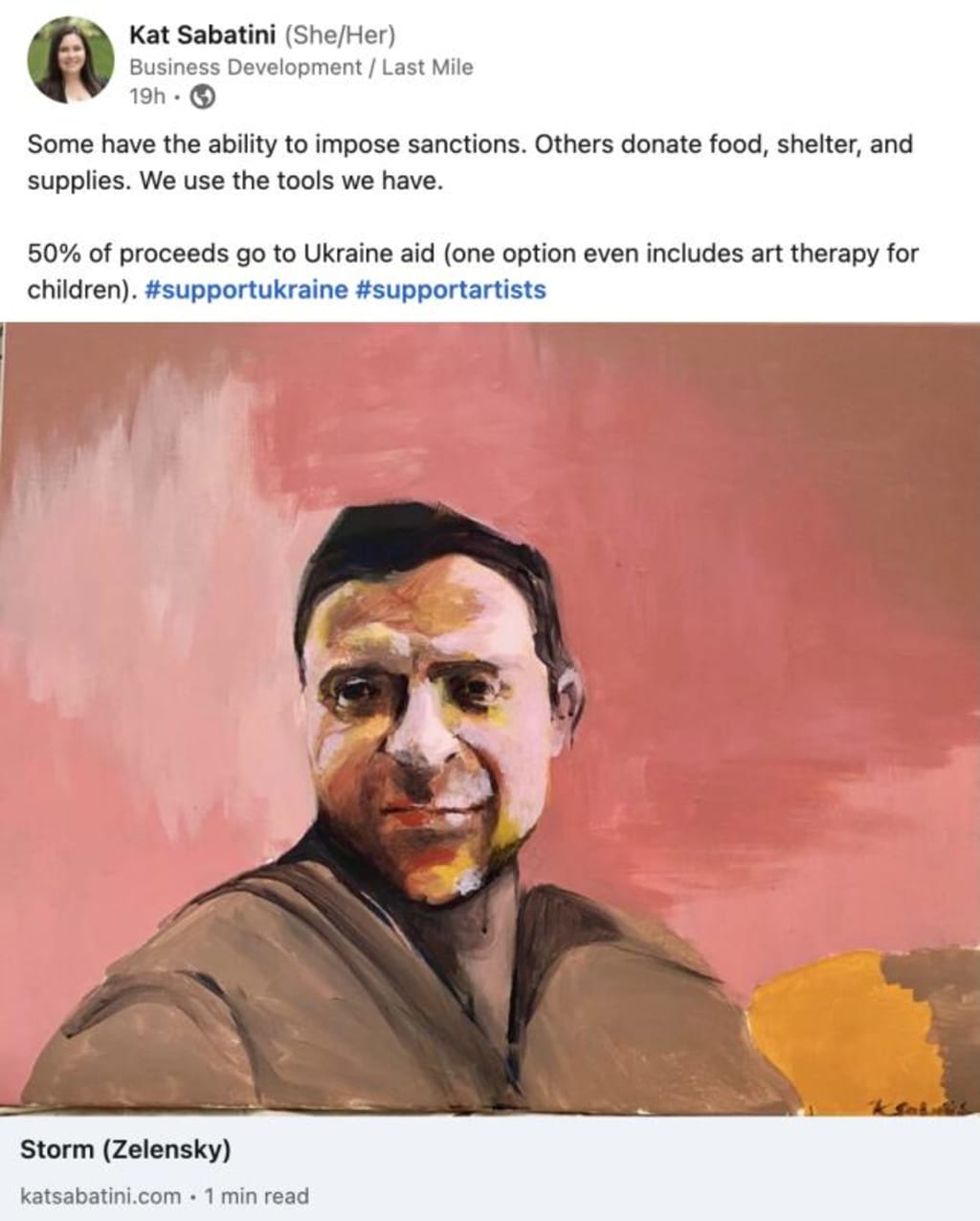
This story focuses on a recent real-life experience.
Ukraine is in crisis. Some of us have the means to move mountains to support the people of the country — multi-million-dollar donations. Sanctions. Business restrictions. Medical aid.
For “ordinary” folk in lands far away, we contribute with the resources available to us — a few dollars to a reputable charity, social media posts, vigils and protests. As an emerging artist, I decided to donate 50% of proceeds of an original painted portrait of Zelenskyy to one of three hand-selected organizations focused on aiding Ukraine.
A classmate from my business school who I’d never met commented on my post.
He said:
50%? What’s going to happen with another 50%? Just curious.
I assumed he had good intentions.
This fellow and I share a special bond — we both attended a well-respected university with the mission “to educate leaders for business and society.” A sense of camaraderie and community is apparent from the moment you step onto campus.
I assumed his “cold” tone was unintentional — after all, it can be difficult to interpret emotions online, and the ongoing crisis is a distressing topic. I observed his extensive financial expertise, his activity on posts supporting Ukrainian aid, and the several connections we had in common. I assumed that his question was genuine — he was “just curious,” after all.
Plus, the art market fascinates me. I’m in business school for a reason. I am eager to learn about and discuss valuation, pricing, and business ethics and participate in constructive debate. Maybe I’d discovered a new sparring partner.
So I “liked” his comment and replied:
Thank you! 50% will go to charity and the other half will go to art materials (paint, canvas, etc.), shipping and packaging, and labor.
The respect was unfortunately not mutual.
I received a rapid response:
2500$ on shipping packaging and art materials?
Yes. And labor.
Online trolls come in all shapes and sizes. They may be the top of their class; they might know your friends. They might not care about how much money you make in your day job. They might assume, because they’ve always been told they do, that they have more expertise in any particular area than anyone else.
I am a professional artist, and I do not work for free.
Working for free would de-value other artists, including those in Ukraine. Why aren’t other professions expected to donate 100% of their income — why artists specifically? Is this individual really concerned that I’m making a maximum gross income of $2,500? Why do I need to justify the cost of my work to him (a non-customer)? Or should I treat everyone as a potential customer?
I attempted a response pleading my case (absent the data below). I considered a direct message. Ultimately, I deleted his comments and blocked him.
I chose not to dox him. I won’t reach out to my university to share this experience. I did reach out to my friends to get more perspective. “Is it ethical to “only” donate 50% of proceeds?” I wondered. “Should I defer to gaslighting when it comes from someone with an impressive resume?”
No, my friends responded. You should block him. So, I did.
Why does art cost so much?
Aside from the disappointing encounter, there may be educational value in creating more transparency around art pricing. So, here are the costs that went into producing this specific painting. It still surprises me as an artist just how much goes into creating something from “nothing.”
- Large stretched canvas: $17.68 + tax/shipping
- Gesso for priming the canvas: $12.60 + tax/shipping
- Pencils for prep work: $42.60 + tax/shipping
- Brushes: $30.00 + tax/shipping
- Paint: conservative estimate of $61.59 + tax/shipping
- There are a bunch of other small items, like canvas floor covering, paint medium, printer for reference materials, lighting, water, etc. Let’s estimate ~$20 for all of this.
- Shipping and packaging: for a 30 in or larger canvas, ~$100.
- Marketing sunk costs (including website): ~$40/month. Website and domain hosting, primarily — didn’t even include SEO in this cost. Since this is annual, ~$480.
- Art labor: This piece took 3 days to complete. 10 hrs x 3 days = 30 hours. According to BLS, the median hourly rate for an artist in the US is $25/hr. This comes to $750.
- Marketing labor: I worked for over a decade in marketing/advertising. According to ZipRecruiter, the average hourly rate for a marketing consultant in the US is $26/hr (which sounds low to me, but let’s be conservative). I spent approx 15 hours on marketing. 15 hrs x $26 = $390.
- Taxes: according to BNYMellon, “The art sold by artists and dealers is considered inventory, which means sales are taxed generally at rates of up to the highest ordinary income tax rate, which is currently 39.6%.” Cool! Now, I guess it gets a bit complicated with charitable donations, but the upfront tax on a $5,000 piece is $1,980.
Total Cost for This Painting: $3,884.47. (Note: I didn’t include the cost of education, which I’m sure you can Google yourself.)
Art work is work.
I believe we should support Ukraine. I also believe that working as a professional artist opens the door to financial independence for others, regardless of nation or circumstance. Art is a valuable and sustainable way to contribute to society. Ask my very smart friends.
About the Creator
Keep reading
More stories from writers in Humans and other communities.
Wild Card Weekend Recap: What Happens Now?
I think I figured out why I love Wild Card Weekend so much. It's because it's the first playoff anything of the calendar year. The NFL season starts in the fall, and once upon a time, the champion was crowned either on or slightly before New Year's. The evolution of the NFL schedule has resulted in the playoffs starting just into the New Year, and currently, the final week of the season falls on the first weekend of the New Year, with Wild Card Weekend coming a week after that. So yes, chronologically, the NFL's Wild Card Weekend serves as the first playoff anything of the calendar year.
By Clyde E. Dawkins5 days ago in Unbalanced




Comments
There are no comments for this story
Be the first to respond and start the conversation.