
How War Steals Childhood Before It Steals Breath
The Invisible Casualties: How War Breaks Childhood Long Before It Ends Lives

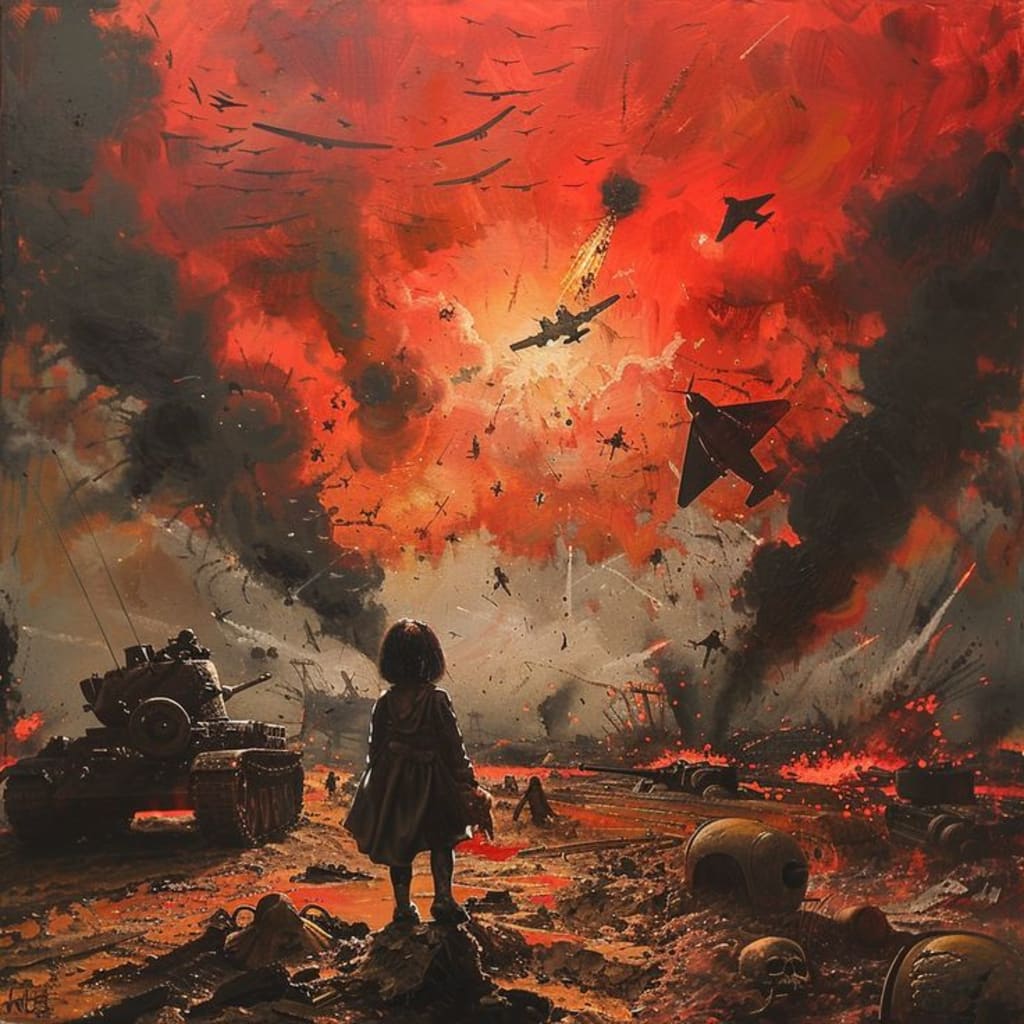
When people talk about war, they talk about numbers.
Casualties.
Battles.
Territory.
Politics.
What they rarely talk about is childhood.
Not the statistic version.
The real one.
The version that laughs easily.
That asks simple questions.
That believes tomorrow will be better.
War doesn’t only kill people.
It kills the version of childhood that makes life feel safe.
________________________________________
Children don’t understand politics — they understand fear
Kids don’t know why bombs fall.
They don’t know what borders mean.
They don’t understand ideology.
They understand loud noises.
They understand screaming.
They understand running.
Fear becomes a language they learn too early.
When adults speak of “necessary sacrifice,” children experience it as nightmares.
________________________________________
Home becomes unpredictable
For most children, home is supposed to mean:
Safety.
Routine.
Warmth.
In war, home becomes uncertain.
It might be there today.
Gone tomorrow.
That instability changes the nervous system.
A child who never knows if they’ll be safe cannot fully relax.
And a child who cannot relax cannot fully be a child.
________________________________________
Play turns into survival rehearsal
Kids naturally play.
They pretend.
They imagine.
They act out stories.
In war zones, play changes.
Toy guns replace toy cars.
Games mimic explosions.
Stories revolve around escape.
Play becomes practice.
Not for dreams.
For survival.
________________________________________
Education becomes a luxury
School is often destroyed, closed, or unsafe.
Even when schools exist, concentration is hard when hunger, fear, and displacement are constant.
Education is more than learning facts.
It’s a doorway to options.
When that doorway closes, the future narrows.
Not because children lack potential.
But because opportunity disappears.
________________________________________
Trauma rewires development
Children’s brains are still forming.
Prolonged exposure to violence shapes how they perceive the world.
Some become hyper-alert.
Some withdraw.
Some struggle to feel emotions at all.
These are not personality flaws.
They are adaptations.
Survival strategies in an environment that never feels safe.
________________________________________
Loss becomes normal
Many children in war lose someone.
A parent.
A sibling.
A friend.
Sometimes multiple.
Grief stacks on top of grief.
Before a child has the emotional tools to process one loss, another arrives.
Eventually, loss feels expected.
That expectation hardens something inside.
________________________________________
Displacement creates identity confusion
Refugee children grow up between worlds.
They may not fully belong to their homeland anymore.
They may not fully belong where they relocate.
They carry accents, memories, and scars that others don’t share.
This creates an identity gap.
Who am I?
Where do I belong?
Questions adults struggle with.
Children shouldn’t have to.
________________________________________
Silence becomes common
Many traumatized children stop talking about what they’ve seen.
Not because it doesn’t hurt.
But because they don’t believe words can hold it.
Or because they don’t want to burden others.
Silence becomes armor.
________________________________________
War doesn’t end when the fighting stops
For adults, war may end with a ceasefire.
For children, it continues inside.
In flashbacks.
In sleep.
In sudden panic.
In difficulty trusting.
The body remembers even when the world moves on.
________________________________________
Yet children still show unbelievable resilience
This matters.
Not to romanticize suffering.
But to acknowledge strength.
Children still laugh.
Still draw pictures.
Still make friends.
Still dream.
Not because war isn’t horrible.
But because the human spirit has an instinct to reach for light.
That instinct deserves protection.
________________________________________
The responsibility belongs to adults
Children do not start wars.
Children do not vote for violence.
Children do not benefit from destruction.
Yet they pay one of the highest prices.
That is a moral failure.
Every time.
________________________________________
Final thought
War is often discussed in terms of strategy.
But its truest cost is human.
And its most tragic victims are the ones who never chose any of it.
A world that claims to care about the future must care about children in the present.
Because every bomb dropped today echoes inside a child for decades.
And no political victory is worth a stolen childhood.
About the Creator
Whiskey At Dusk
Guess the whiskey was more important to you in the end, wasn’t it? It was more than the well-being of your friends; more vital than showing up to the places you promised you would and could come to; more critical of a matter than fulfilling your damn responsibilities and getting the press off your back.
By Snarky Lisaa day ago in Humans


Comments
There are no comments for this story
Be the first to respond and start the conversation.