
How to Recognize Attachment Styles in Your Romantic Partner
Understanding Emotional Patterns to Build Stronger, Healthier Relationships

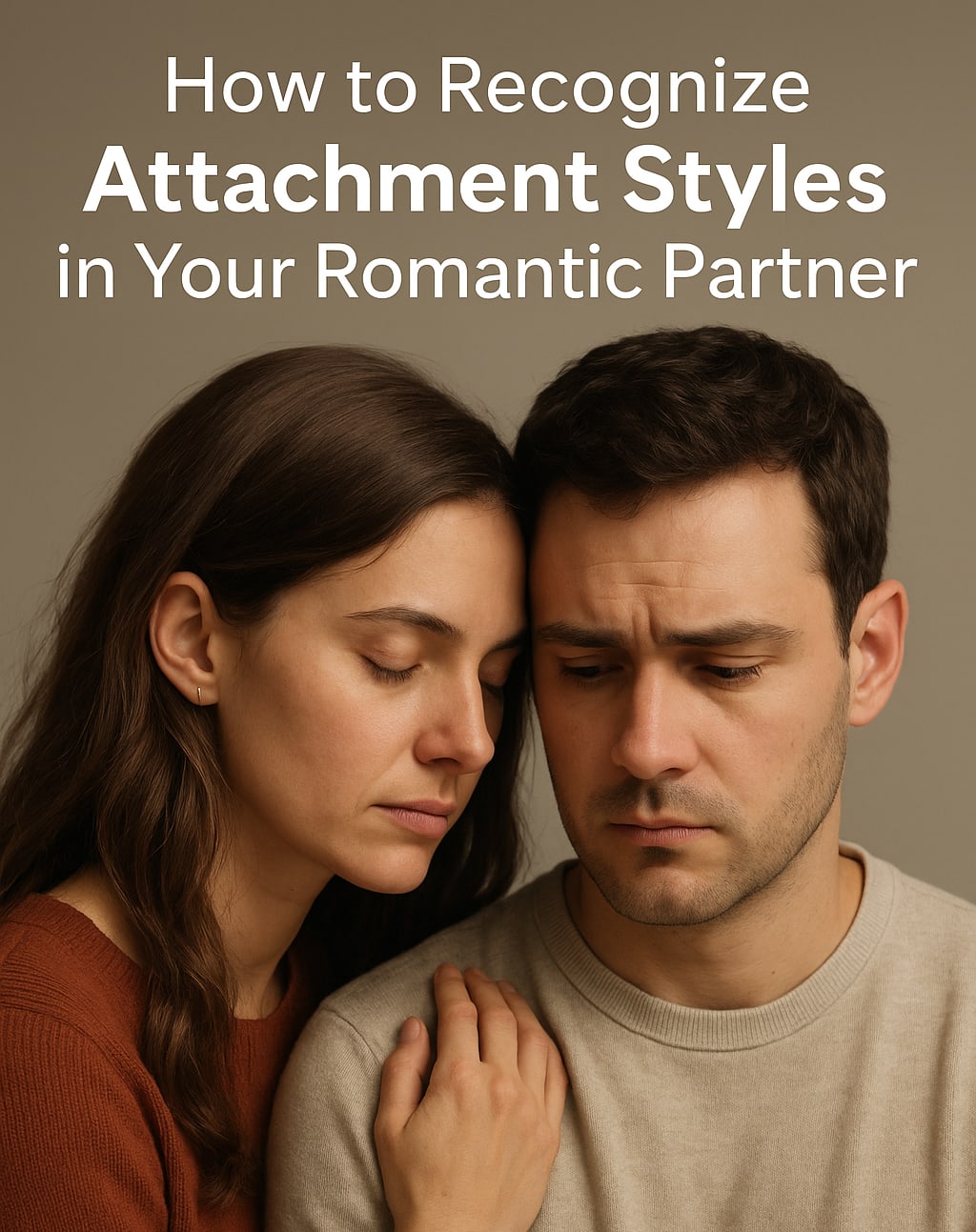
In every romantic relationship, invisible patterns shape how we connect, communicate, and handle conflict. These patterns often stem from our attachment styles, deep-rooted emotional blueprints formed in early childhood that influence how we relate to intimacy and closeness.
Recognizing your partner’s attachment style can be a powerful tool. It allows you to understand their emotional needs, predict their reactions, and respond in ways that nurture your connection instead of tearing it down.
So, how do you spot these styles in your partner? It’s not about labeling or diagnosing them. It’s about observing, understanding, and adjusting—together.
What Are Attachment Styles?
Attachment theory was developed by British psychologist John Bowlby and expanded by Mary Ainsworth. It suggests that our earliest interactions with caregivers shape the expectations and behaviors we carry into adult relationships.
There are four main attachment styles:
- Secure Attachment
- Anxious (Preoccupied) Attachment
- Avoidant (Dismissive) Attachment
- Fearful-Avoidant (Disorganized) Attachment
Each style presents differently in a romantic context. They aren't fixed identities but patterns that can shift and evolve with insight and effort.
1. Signs of a Secure Attachment Style
If your partner has a secure attachment style, you’ll notice an ease in the relationship. They communicate clearly, express affection freely, and handle conflict without panic or withdrawal. Their love doesn’t come with tension or confusion.
Traits to look for:
- Comfort with closeness and independence
- Healthy boundaries and respect for yours
- Emotional availability
- A tendency to resolve arguments calmly
- Openness in discussing feelings and future plans
A securely attached partner won’t leave you guessing. They call when they say they will. They don't pull away when things get serious. And when disagreements arise, they’re willing to work through them without blaming or fleeing.
2. Recognizing Anxious Attachment in Your Partner
Anxious partners crave closeness but often fear rejection. Their emotional state can be intense and unpredictable, marked by a constant need for reassurance. They might love deeply, but worry even deeper.
Common behaviors include:
- Frequent texting or checking in
- Sensitivity to perceived slights or distance
- Fear of abandonment or being replaced
- Difficulty being alone or apart for long
- Intense emotional reactions to minor issues
These signs often come from an underlying belief that love is unstable or conditional. If your partner seems to need constant validation or reacts strongly when you pull back, even slightly, it may point to an anxious attachment style.
3. Understanding Avoidant Attachment Traits
Avoidant individuals value independence over intimacy. They often appear emotionally distant or detached, even if they care deeply. Vulnerability is difficult for them; closeness may feel threatening.
Behavioral clues:
- Difficulty expressing emotions
- Reluctance to define the relationship
- Pulling away during emotional conversations
- Prioritizing personal space and autonomy
- Downplaying the importance of relationships
If your partner avoids talking about feelings or seems to disappear emotionally when things get serious, it could be a sign of avoidant attachment. They may equate dependence with weakness and strive to maintain emotional control at all costs.
4. Spotting Fearful-Avoidant (Disorganized) Attachment
This is the most complex and unstable of the attachment styles. A partner with a fearful-avoidant style may crave closeness but also fear it. Their behavior can be hot-and-cold, leading to confusion and frustration.
Indicators might include:
- Intense but inconsistent expressions of love
- Frequent push-pull dynamics
- Avoidance of deep conversations about the relationship
- Emotional outbursts followed by retreat
- Signs of unresolved past trauma or neglect
You may feel like you’re walking on eggshells, unsure of when they’ll be warm or when they’ll withdraw. These partners often want intimacy but have never felt safe enough to fully trust it.
How to Observe Without Judging
Recognizing attachment styles in your partner doesn’t mean psychoanalyzing every move. It’s about noticing patterns and context.
- Watch how they respond to stress or conflict.
- Pay attention to how they handle closeness and separation.
- Listen to the language they use when expressing needs or fears.
Do they become clingy or cold when you’re distant? Do they struggle with honesty about emotions? Do they seem to sabotage intimacy just when things are going well?
It’s not about fault, attachment styles are formed through early survival strategies. What matters more is how they show up in the present and whether your partner is willing to grow alongside you.
Why This Matters in a Relationship
Attachment styles shape more than just communication. They influence how you trust, argue, apologize, express affection, and even make decisions about the future. Without awareness, these styles can collide, leaving both partners feeling misunderstood and stuck.
For example:
- An anxious partner may feel constantly rejected by an avoidant partner who needs space.
- A fearful-avoidant partner might push away someone securely attached, fearing they’ll eventually be hurt.
- Two anxious partners may spiral into co-dependency, while two avoidants may never build the intimacy they secretly desire.
Understanding your partner’s attachment style doesn’t just explain their behavior—it invites empathy. And when paired with knowledge of your own style, it becomes a roadmap for deeper connection.
What You Can Do Once You Recognize Their Style
Once you've identified your partner’s attachment patterns, it opens the door to change.
Here’s how to start:
- Talk about it openly. Share what you’ve observed. Use gentle, non-judgmental language.
- Set boundaries with compassion. Avoidant partners need space; anxious partners need reassurance. Balance is key.
- Work on your own triggers. Often, our reactions to our partner’s behavior stem from our own attachment wounds.
- Consider therapy. A good therapist can help both partners understand and heal old patterns.
- Practice consistent, safe communication. This builds trust over time, especially for insecure attachment styles.
Recognizing attachment styles in your romantic partner isn’t about fitting them into a box. It’s about unlocking the emotional dynamics between you. Once you understand how they bond, react, and protect themselves, you’ll be better equipped to love them in ways that feel safe, respectful, and lasting.
Every relationship is a dance of closeness and distance, comfort and fear, independence and connection. Knowing the steps—yours and theirs—can turn even the most tangled relationship into something graceful and grounded.
And sometimes, awareness alone is the first step toward healing what neither of you even knew was hurting.
About the Creator
Richard Bailey
I am currently working on expanding my writing topics and exploring different areas and topics of writing. I have a personal history with a very severe form of treatment-resistant major depressive disorder.
Keep reading
More stories from Richard Bailey and writers in Humans and other communities.
15 Creative Indoor Date Night Ideas to Spark Romance at Home
In today's fast-paced world, finding quality time to connect with your partner can be a challenge. But who says romance requires fancy dinners or weekend getaways? With a little creativity, you can transform an ordinary night at home into an unforgettable experience.
By Richard Bailey10 months ago in Humans
My First Time Skiing and I Got Lost, Alone, in the French Alps
Looking back, I can trace some of my life’s biggest adventures to a simple action from my sister. She’d introduced me to Tommy (a very long time ago), a colleague of hers, who had overshared his penchant for Italian-looking women, and I ticked that box.
By Chantal Christie Weiss3 days ago in Humans
The Mother of the Battlefield
In the middle of a very cold and dark war many years ago there was a woman named Mary. She was born in Jamaica and she had a gift for healing people with plants and simple medicines. She had a heart that was a garden of peace and she wanted to help the soldiers who were fighting in a faraway place called the Crimea. Mary traveled all the way to London and asked the government to let her go and help the wounded men. But because of the color of her skin and her background the officials said no. They told her that she was not needed.
By Hazrat Umer5 days ago in Humans



Comments
There are no comments for this story
Be the first to respond and start the conversation.