

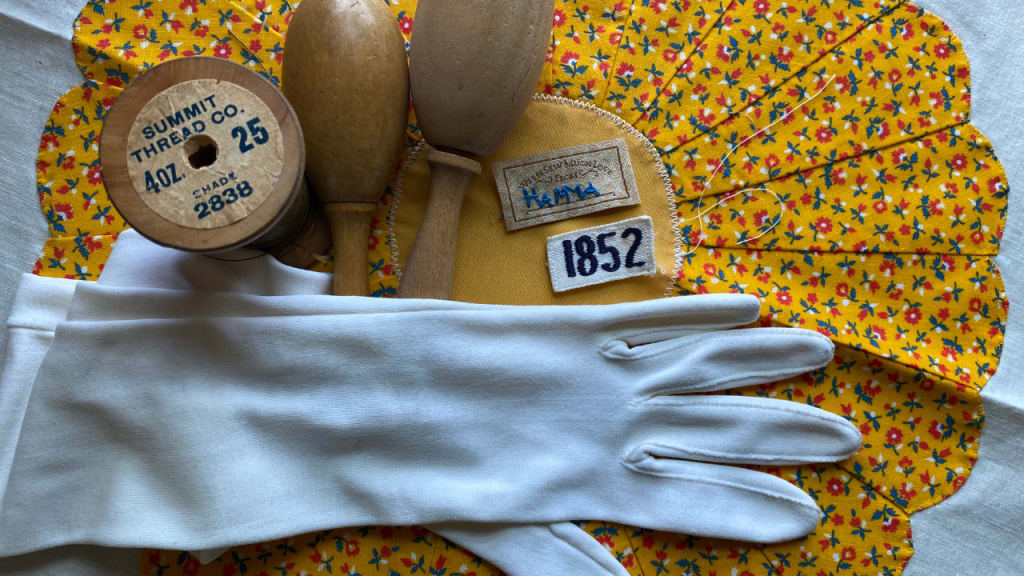
“Hamma, what are these things that look like maracas but don’t make any noise?” I asked my grandma, so nicknamed because my oldest cousin struggled making the “gr” sound in grandma. It came out of his little mouth as “Hamma” instead, and the name stuck through 13 grandchildren and a still-growing number of great grandchildren.
“Oh! Those are for darning socks. I’ll show you how,” she laughed, adding “Did you find a glove yet?”
A glove? My eyes darted around the boxes before me, scanning bobbins and pins and thread and scissors and buttons (so many buttons), when a sliver of pristine white cloth caught my eye. Unfurled, it was a single white elbow-length glove with impossibly small fingers. My grandma, like my mom but not like me, is a petite woman.
“I loved that glove. Your grandfather took me to a ball downtown and I lost the other, but I loved that glove so much I kept it,” Hamma reminisced like a Cleveland-based Cinderella.
I gently folded the glove and knew I too would keep it forever.
Through a few hours and as many phone calls, I unpacked box after box of what I thought was sewing supplies but really were memories cleverly disguised as threads and scissors and fabric remnants. There were dozens of thimbles from around the globe, sent to Hamma by people who loved her from places like Korea and Paris and Israel. A patch embroidered with the number 1852 in navy blue - my grandfather’s police badge number that she sewed onto his uniforms throughout years of service. Fabric scraps I recognized from the clothes she made for my favorite doll. I tragically cut her hair when I was ten, but Hamma made sure she still looked fabulous in custom-designed dresses.
Hamma’s eyes now struggled to thread a needle, and the arthritis in her hands finally made sewing more painful than giving up her lifelong craft. That’s why she called a few weeks earlier and said “Sue, do you want my sewing machine?”
The question hit me hard. It was like an admission that something had changed. Giving the sewing machine to me meant that no one would receive anything with a “Made with Love by Hamma” tag ever again. It’s one of those moments where you realize that, suddenly, your grandparents are, well, old.
In a convenient and lovely trick of the psyche, I’d always pictured my grandparents the same age they were when I was a kid, making them perpetually around the age of 50. That was easy with Hamma, who always dressed to the nines, cooked feasts of kibbi and perfect uncracked cheesecakes for every holiday and had a fierceness that sometimes scared my boyfriends but made me feel so loved and protected.
It was easy to pretend she was still young even when she had a massive brain tumor removed years ago in a tricky surgery later declared miraculous by her doctors. Even then, we laughed so hard in the hospital room that passing nurses shushed us. But something about Hamma without her sewing machine signaled the end of an era for me.
While my boyfriend and grandpa carried the sewing machine and table down the stairs, Hamma pulled out a bag brimming with large squares of fabric.
“Oh I remember these,” she said, her voice cracking almost imperceptibly. “These are your mom’s baby clothes. Sittu cut and hand-sewed the pieces and I finished the seams.”
Sittu, my great-grandmother, is a legend in our family: part-myth, part-memory. Her real name was Nizery, but after giving birth to 7 kids who had children of their own, she was christened Sittu, the Arabic word for grandma. The myth part was born from stories of her escaping what is now Lebanon in the early 1900s with a borrowed passport and later sticking the noses of bad neighborhood kids though her crank washing machine, a myth that scared us into good behavior. The memory part is of a fiercely loving and spirited woman who bounced all us babies on her knee saying “Ya einy, ya einy,” an Arabic phrase like “apple of my eye.” I still have the “Sittu blanket” she sewed for me when I was born.
In the center of each white square in Hamma's hand was a flower, petals quilted from what once was a little girl’s dress. Hamma flipped a square over. “These are Sittu’s loose threads. I couldn’t bring myself to cut them,” she said as her big brown eyes welled up.
Sittu died in 1998 just a few months shy of her 100th birthday, and over two decades later, anything she touched is holy, including her scissors, her thimbles and her threads.
The sewing machine now in my spare bedroom, propped up by high expectations and Hamma’s sewing table, I got to work. After carefully winding the bobbin and admittedly having to do it more carefully three additional times, I finally pressed the footer down and inched toward the legacy of Hamma and Sittu stitch by stitch.
My first projects were practice pillows, and when I’d built up enough confidence to be sure I wouldn’t ruin a treasured heirloom, I reached in the bag for two of Hamma and Sittu’s squares made from my mom’s baby clothes. One for the front of the pillow, one for the back, a gift for my mom.
Before handing the finished pillow to her, I told mom “Sittu, Hamma and I made you this.”
Three generations of women, over decades, making a gift for a fourth. My seams may be imperfect, and Sittu’s loose threads are still in there, but you can't cut holy threads.
About the Creator
Keep reading
More stories from writers in Humans and other communities.
The CEO of Everything
They say "jack of all trades, master of none," but they forgot to mention the part where the jack of all trades is also the camera woman, the makeup artist, and the person currently yelling at a tangled Wii microphone cable in a her own bathroom while recording herself singing and trying to make it look realistic and professional. (As professional as you can make it with nothing but a cell phone camera and a mic that doesn't work)
By Sara Wilson7 days ago in Humans




Comments
There are no comments for this story
Be the first to respond and start the conversation.