
Hand in Hand for Better Foods and a Better Future
A World Food Day reflection by Chef Cristian Marino


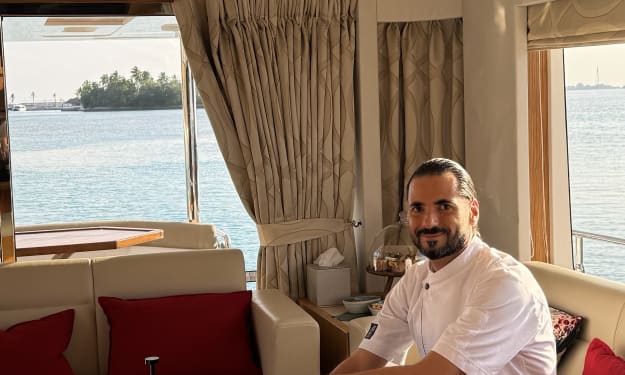
When Chef Cristian Marino walks into a kitchen, whether in a busy European city or on a calm island in the Indian Ocean, he feels something familiar: the pulse of life itself.
The sound of a pan heating up, the smell of herbs in the air — small things that remind him how food connects everything.
It connects people, memories, and cultures. It connects those who grow and fish with those who cook and share.
And, most of all, it connects us to the planet that quietly feeds us every day.
On World Food Day, celebrated each year on October 16th, that connection takes center stage.
It’s not only a celebration of what we eat, but a chance to ask ourselves a deeper question: how are we eating?
How are our choices shaping the land, the sea, and the people behind our meals?
This year’s theme, “Hand in Hand for Better Foods and a Better Future,” captures that spirit perfectly.
It reminds us that behind every dish there’s a story — and a chain of hands working together to make it possible.
For Marino, who has cooked from Milan to the Maldives, this truth is visible everywhere: the way we treat food mirrors the way we treat the world.
- If we waste less, we respect more.
- If we buy local, we support life.
- If we cook with awareness, we feed both body and soul.
What World Food Day Really Means
World Food Day was created by the Food and Agriculture Organization (FAO) in 1945. Each year it reminds us that food is not just a matter of taste or privilege — it’s a shared right and responsibility.
Yet, for many, this day is more than statistics or speeches.
It’s a quiet call to rethink our habits, to notice where our food comes from, and what it costs the planet to bring it to our plates.
Our food systems are connected in ways we often forget.
A storm in one region, a drought in another — both can change what ends up in our kitchens.
Today, the real challenge is to find balance: between production and preservation, between abundance and care.
Chefs stand right in the middle of this balance.
They shape how ingredients are used, how menus are built, and how much ends up as waste.
In Marino’s case, years of work in the Maldives — where supply boats depend on the sea and every product is precious — turned awareness into instinct.
“There,” he explains, “you realize that luxury isn’t about rare ingredients. It’s about the respect behind each one.”
The Modern Chef’s Role
For him, the kitchen is no longer only a place of creation — it’s a classroom.
A space where awareness and creativity can live side by side.
The modern chef, he believes, is part cook, part teacher, and part messenger.
“Cooking isn’t just about feeding people,” he says. “It’s about inspiring them to care.”
In practice, that means simple actions:
using every piece of a vegetable instead of throwing it away,
building menus around local fish instead of imported ones,
teaching the team to see ingredients as stories, not commodities.
When that mindset spreads through a kitchen, something shifts.
Food becomes a gesture of respect — for nature, for culture, for people.
And perhaps that’s where real change begins: not with speeches, but with a single plate served with intention.
A Small Act, A Big Impact
For World Food Day 2025, Chef Cristian Marino shares a simple idea:
change starts with small, conscious acts.
- Cook with awareness.
- Eat with gratitude.
- Waste a little less.
Each step, no matter how small, adds up.
Because food, at its heart, has always been a form of love — and love, when shared, changes everything.
When we understand that what we place on the plate affects the world around us, every kitchen becomes a place of respect.
Whether at home or in a resort, the act of cooking can remind us of our connection to the earth, the sea, and to each other.
So today, let’s celebrate not just what we eat, but how we eat.
Let’s honor those unseen hands — the farmers, the fishermen, the growers — who make every meal possible.
If we move hand in hand, we can create something greater than any recipe:
- a better food culture,
- a healthier planet,
- and a kinder future.
Food as a Daily Choice for Well-being
For Chef Cristian Marino, eating well is not just about enjoying a good meal — it’s a daily act of awareness.
He sees food as both pleasure and necessity, a way to stay balanced physically and mentally. For him, it’s not about short-term satisfaction but about long-term well-being: feeling good in one’s body, focused in the mind, and ready to face the day with energy.
In his view, conscious eating is also a form of education. It means learning how to listen to the body and understanding what it truly needs — depending on our activity, the season, and even the stage of life we’re in.
Supporting the body with what it really requires, not what habit or emotion demands, is part of a broader journey toward self-respect.
As a chef, Marino knows that taste matters — it’s a fundamental part of happiness and an essential ingredient in his work. But he also believes that real satisfaction goes beyond the first bite. It lies in knowing that what we eat contributes to our health, to our focus, and to the balance we carry throughout the day.
Food, he reminds us, is the most powerful tool we have to take care of ourselves — if only we choose to use it with intention.
About the Creator
Cristian Marino
Italian Executive Chef & author with 25+ years in 10+ countries. Sharing stories on kitchen leadership, pressure, and the human side of food.
Keep reading
More stories from Cristian Marino and writers in Humans and other communities.
My Journey as a Chef
When people ask me where I come from, I often smile and hesitate. Not because I don’t know the answer, but because it’s never just one place. I was born in Milan, raised between the vibrant north and the sun-soaked south of Italy, and shaped by kitchens across Europe, Asia, and the Middle East.
By Cristian Marino11 months ago in Humans
Why Didn't Anyone Tell Us
Men, move along. This is not for you. This is for the women. I was forty-five when I began menopause. It is pretty young for that to be going on in a woman’s life, but I had undiagnosed PCOS, my entire life. Thank you to all the gynecologists I had seen my entire life. That in itself should encourage women to keep seeking second opinions, especially when you are not getting correct answers or any at all.
By Alexandra Grant2 days ago in Humans
Liza Fromer: Husband, Net Worth, Biography, Age, Children & More
Liza Fromer is a well-known Canadian television and radio personality recognized for her work in broadcasting and lifestyle programming. Over the years, she has become a familiar face on Canadian television, particularly as a co-host on morning shows and as a host on health and lifestyle programs.
By Enoch Saginia day ago in Humans


Comments
There are no comments for this story
Be the first to respond and start the conversation.