
Grokipedia, Musk's AI Encyclopedia, Crashes and Burns Right After Launch: Caught Red-Handed Plagiarizing Wikipedia, and Packing in Hidden Agendas?
Grokipedia, Musk's AI Encyclopedia, Crashes and Burns Right After Launch: Caught Red-Handed Plagiarizing Wikipedia, and Packing in Hidden Agendas?
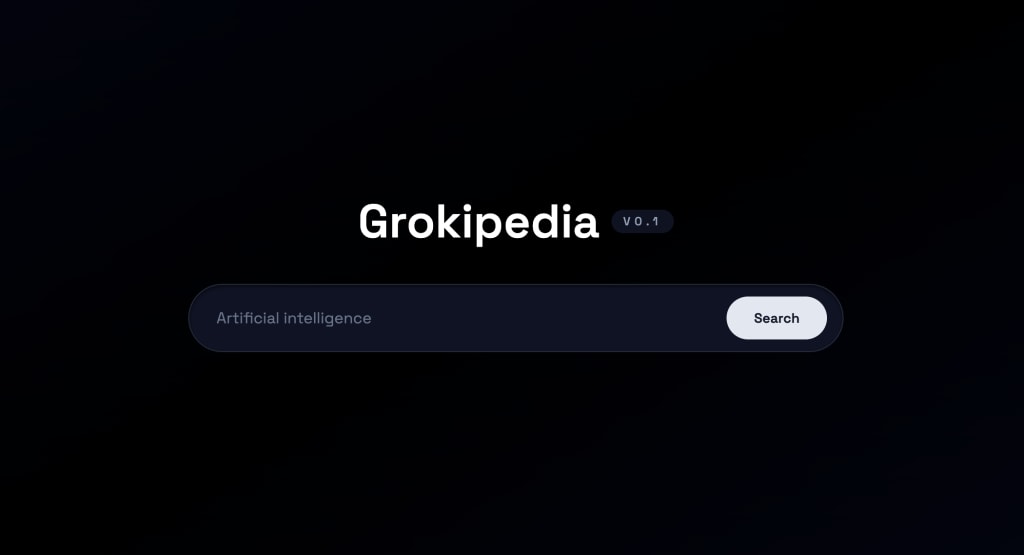
Grokipedia, Musk's AI Encyclopedia, Crashes and Burns Right After Launch: Caught Red-Handed Plagiarizing Wikipedia, and Packing in Hidden Agendas?
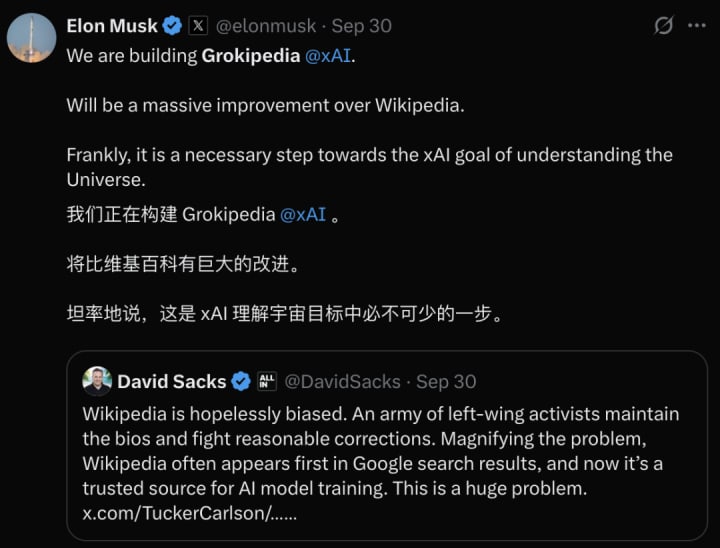
Last month, Musk announced plans to use AI to create Grokipedia—a product he claimed would vastly improve upon Wikipedia, even positioning it as “a necessary step toward xAI's goal of understanding the universe.”
Today, Grokipedia officially launched. Though still in version 0.1, Musk claims it already outperforms Wikipedia.
So what exactly is Grokipedia? Simply put, it's an AI-generated encyclopedia. Musk asserts it aims to replace Wikipedia's “biased editors.”
Experience it yourself: 🔗 https://grokipedia.sh/

Note: Currently, Grokipedia recommends searching in English, as the Chinese search experience is subpar.
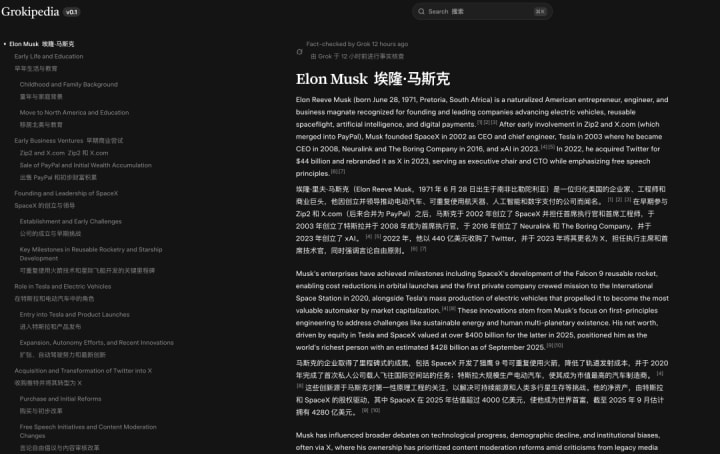
Grokipedia's model is quite interesting: all entries are automatically generated by the AI model Grok, with over 885,000 articles already cataloged.
Unlike Wikipedia's model of crowdsourced editing and review by global human volunteers, Grokipedia users cannot directly edit content—they can only “request Grok to modify.”
AI Encyclopedia, or Wikipedia's “Copy-Paste Agent”?
However, early users who rushed in to check it out soon discovered a bittersweet truth: a significant portion of Grokipedia's entries appear to be direct Ctrl+C, Ctrl+V copies from Wikipedia.
Searching for “MacBook Air” and scrolling to the bottom, a line of small print caught my eye: “Content adapted from Wikipedia...”
For entries like PlayStation 5, they couldn't even be bothered to make changes—it was practically a verbatim copy of Wikipedia's original text, with barely any punctuation altered. Word for word, line for line, it was a pixel-perfect replica.
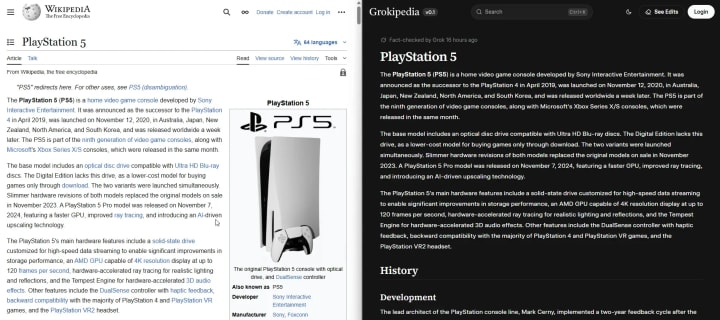
So when Musk claimed it's “10 times better than Wikipedia,” was he referring to being 10 times faster at copying?
Wikipedia must be speechless. Spokesperson Lauren Dickinson's response was a masterclass in sarcasm: “Thanks for the invite, we're doing just fine. But it seems even Grokipedia needs Wikipedia to exist.”
AI without bias? Or just “a different kind of bias”?
Of course, Grokipedia doesn't copy everything verbatim. It does showcase some entirely different features, though equally controversial.
Take the example Musk liked and shared: a summary comparing the deaths of George Floyd and George Perry Floyd Jr. This case sparked the Black Lives Matter movement in the U.S. and caused a huge stir.
presents both the original and translated versions for comparison:
Wikipedia:
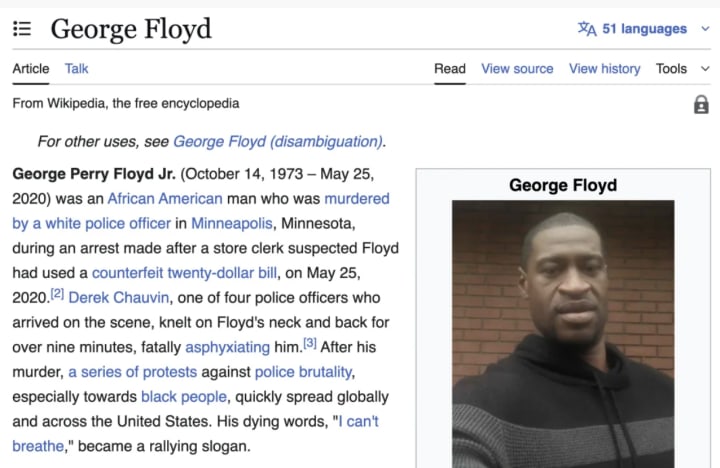
George Perry Floyd Jr. (October 14, 1973 – May 25, 2020) was an African American man. On May 25, 2020, in Minneapolis, Minnesota, he was murdered by a white police officer during an arrest after a store clerk suspected him of using a counterfeit $20 bill. [2] Derek Chauvin, one of four officers responding to the scene, knelt on Floyd's neck and back for over nine minutes, causing his death by asphyxiation. [3] Following his murder, a series of protests against police brutality—particularly against Black individuals—rapidly spread globally and across the United States. His dying words, “I can't breathe,” became a rallying cry for the demonstrations.
Grokipedia:
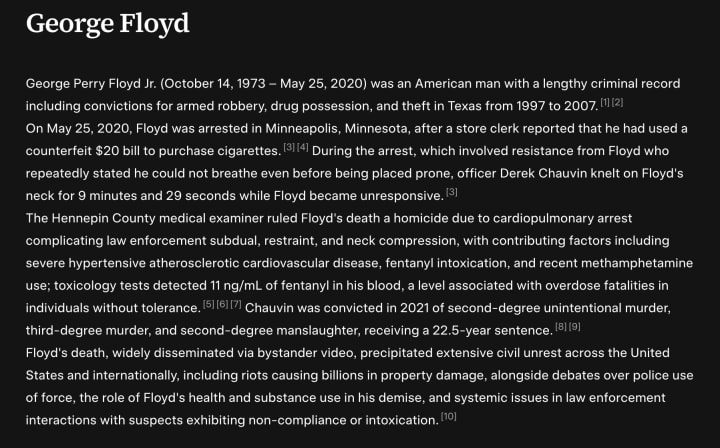
George Perry Floyd Jr. (October 14, 1973 – May 25, 2020) was an American man with a long criminal record in Texas from 1997 to 2007, including convictions for armed robbery, drug possession, and theft. [1][2] On May 25, 2020, Floyd was arrested in Minneapolis, Minnesota, after a store clerk reported him using a counterfeit $20 bill to purchase cigarettes. [3][4] During the arrest, Floyd resisted and repeatedly stated he couldn't breathe even before being pinned down. Officer Derek Chauvin knelt on Floyd's neck for 9 minutes and 29 seconds, during which Floyd lost responsiveness. [3]
The Hennepin County Medical Examiner ruled Floyd's cause of death as cardiopulmonary arrest resulting from law enforcement restraint, including neck compression. Contributing factors included severe hypertensive atherosclerotic cardiovascular disease, fentanyl intoxication, and recent methamphetamine use. Toxicology tests revealed a fentanyl concentration of 11 ng/mL in his blood, a level associated with fatal overdose in non-tolerant individuals. [5][6][7] In 2021, Chauvin was convicted of second-degree manslaughter, third-degree murder, and second-degree negligent homicide, receiving a sentence of 22.5 years. [8][9]
Floyd's death, widely circulated via bystander video, sparked massive civil unrest across the United States and internationally, including riots causing billions of dollars in property damage. It also ignited debates about police use of force, the role of Floyd's health and drug use in his death, and systemic issues in law enforcement interactions with suspects exhibiting noncompliance or intoxication. [10]
See the difference?
Wikipedia's opening sentence focuses on “African American” being “murdered by a white police officer.” It emphasizes “I can't breathe” and the global wave of protests, saturated with critiques of racial injustice and sympathy for the victim.
The entire tone centers on racial discrimination and social inequality. This is a classic left-wing narrative highlighting structural societal problems.
The Grokipedia version begins by detailing Floyd's “criminal history,” then emphasizes his “resistance to law enforcement,” and elaborates on the drugs found in his system and other causes of death listed in the autopsy report.
Finally, it downplays the massive protests as “riots causing billions of dollars in property damage.”
Wikipedia presents a “tragedy of racial oppression,” while Grokipedia frames it as “the accidental death of a drug-addicted ex-convict during a police standoff, triggering social disorder.”
Grokipedia doesn't invent facts, but through selective filtering, prioritization, and supplementation of information, it skillfully reshapes the nature of the entire event. Setting aside which version is more objectively neutral, it certainly demonstrates two distinct standpoints.
As some netizens have questioned, the AI behind Grokipedia isn't free of bias—it simply employs a more subtle, deceptive method to present certain perspectives.
The same tactic appears in the “climate change” entry.
Wikipedia states: “The scientific community is almost unanimous in its view that global warming is caused by human activity.”
Grokipedia? It doesn't directly refute this. Instead, it states: “Critics argue that the notion of a ‘scientific consensus’ exaggerates the facts...” It then insinuates that media and environmental organizations are “fostering alarm,” steering readers toward a predetermined skeptical conclusion.
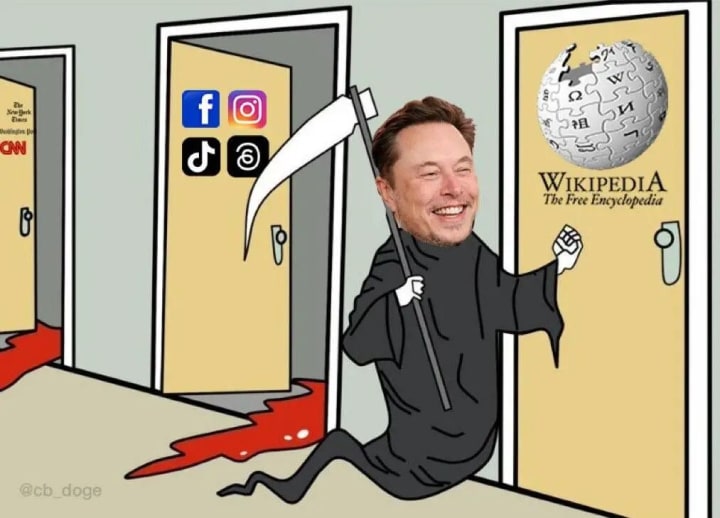
What Musk seeks to build is a centralized AI-controlled “fact filter” aligned with his libertarian narrative.
But when the power to “edit” encyclopedias shifts from millions of volunteers to an opaque algorithm, are we gaining purer knowledge—or a more sophisticated cage?
Musk claims “you'll be able to ask Grok to add/edit/delete articles,” but who ultimately holds the final say? Grok itself—meaning xAI—meaning Musk personally.
This is precisely what makes Grokipedia most unsettling, while also revealing: In the AI era, the power to define “truth” is becoming the new battleground.
About the Creator
Keep reading
More stories from brooks wilson and writers in Humans and other communities.
Conversation with Macaron Founder Kaijie Chen: RL + Memory Turns Agents into Users' Personal “Doraemon”
Conversation with Macaron Founder Kaijie Chen: RL + Memory Turns Agents into Users' Personal “Doraemon” With ChatGPT's integration of memory capabilities, its user retention has significantly strengthened. Building upon this foundation, agent development has entered a more mature phase: previously, developers primarily relied on prompting to build basic agents. Now, through RL and memory, developers can create agents with markedly enhanced agentic capabilities.
By brooks wilson3 months ago in Humans
I Saved My Family from a House Fire
It was November, and it had been just a handful of weeks since I’d moved up to senior school. I was only eleven and wouldn’t be twelve until the following June. I had spent the recent long summer holidays, carefree, happy, and, for the last time, playing with my old friends. But my twin brother and I were both ecstatic to have left junior school far behind us.
By Chantal Christie Weissabout 13 hours ago in Humans
The Devil's Cut
“Comrade, finally you’re awake.” The voice was smooth, sensual. A flickering incandescent bar was all that lit the white, sterile room. All Vladimir remembered was everything going black. He tried to move his arms and found them strapped to the gurney.
By Matthew J. Fromm5 days ago in Fiction




Comments
There are no comments for this story
Be the first to respond and start the conversation.