


The first thing that struck him was the night. The night was blacker than black. It was so dark that he couldn’t sleep for the first week that he was in the jungle. He wouldn’t have called it black in fact. When he looked up from his foxhole, it was an unimaginable vastness that engulfed him. He must’ve felt what those Soviets had felt when they landed on the moon in ’60. Or was it ’59?
Everything he had heard about Vietnam centered on the heat. It wore you down. A sauna couldn’t prepare you for it. It added fifteen pounds atop of what you humped. And the bugs. They wore you down. A New England summer couldn’t prepare you for it. They added an unbearable nuisance atop of what you humped.
He thought that had been exaggerated.
It wasn’t so bad. The nights got cold. Cold enough to make the bugs hide. Or die. It didn’t matter.
The first night that he had slept was when 3rd platoon called in an airstrike on a village suspected to be a Vietcong stronghold. The bombers lit up the sky until it looked like a bonfire being occasionally encouraged by a splash of gasoline. But instead of the ‘hiss’ and ‘pop’ and the ‘oohs’ and ‘aahs’ it was earth-shattering explosions and desperate yelps of life fading out of the mouths of those unlucky enough to be caught in the U.S. military’s path.
He didn’t mind it. He slept right through it.
But it was a similar orange glow that he had looked at as he walked delicately into the night that had made him physically sick. The same glow that had put him into a sleep that he hadn’t experienced since he had lain prone in his red race car bed, yellow and orange flaming stripes hastily plastered to its frame, his mother reading aloud one of his favorite fairytales from the rocking chair that gently creaked the already sagging hardwood floor beneath its smooth mahogany legs in a house that cried out desperately in the night for an adjustment of any kind, had induced a vomiting fit unlike anything he had ever experienced in a rice paddy in southeast Vietnam. Fairytales were for fags anyways.
The silhouettes of his ‘brothers’ lying on the damp ground, carelessly snoozing, cut picture-perfect shapes into the dancing light of the sky on the horizon. That wasn’t how he would remember them though.
He would remember Patrick, a private who everyone called ‘Patches,’ blocking the only exit of a burning hooch that had a Vietnamese family inside with his M16 shifting from one petrified gook to the next, preventing any possibility of fleeing. He had been grinning.
He would remember Cpl. Ramirez lighting a cigarette on one of the actively burning hooches, laughing loudly, trying to draw attention to himself as he delicately attempted to light his Marlboro on a straw roof without searing his lips.
He would remember Ant, a thickly built, almost round machine-gunner, shoving the muzzle of his SAW into the mouth of a Vietnamese man and holding down the trigger until the belt of ammo had disappeared through the barrel and into the ground. All that was left of the man’s head was the red stain of the rice paddy that caressed his incomplete body.
And of course, he would remember Sgt. Jensen, always the serious one, cracking a smile with his eyes as he watched his men burn and decimate the village to ash from a distance, cigarette and flask rotating one at a time from his hand to his lips.
That was the glow that had truly stuck with him. That night, they had dug their foxholes a click east of the same village they had left blazing. This time, he couldn’t sleep because of the light rather than its absence. When he closed his eyes, it danced in stills across his mind, intertwined with the faces of the dead and dying Vietnamese. Were they Vietcong? Were they NVA? Did it matter?
He left that night. His platoon was in the Quang Ngai Province on the eastern coast of the country and he knew there was little chance of reaching Laos without getting noticed. Whether by U.S. forces or the North Vietnamese, he wasn’t sure it mattered.
So instead he headed south. Well, southeast. He went south to avoid the north. That was simple. He went east to reach the coastline. A ship was his best bet.
He wouldn’t have called it a spur of the moment, abrupt, or hasty decision. He had planned it two nights prior as he lay in his foxhole, dozing to the faint glow of a burning village half a click west.
All it would take was a night where Private Soucy was on watch. The rest of the platoon called him Private Snoozy. It didn’t rhyme but fuck it, it was close enough. Snoozy had dozed off in the guard station surrounded by recently-filled sandbags, and his animalistic snores indicated that no level of delicacy was necessary to sneak by him, and yet, he had done everything in his power to avoid even the smallest twig in his path.
He supposed that it wasn’t until he was about five hundred yards from the encampment that he turned back to see his platoon mates’ shadows interrupting the fiery show being performed by the village they had set ablaze. He guessed that it was only half of them that hadn’t bothered digging foxholes and in-turn rested gently, peacefully almost, atop the Vietnamese mud. They hadn’t had mortar fire in weeks.
The first two days he had wandered southeast virtually nonstop. Well, nonstop was a funny term. The jungle tore him to pieces, and he stopped constantly. But sleep was a foreign pleasure that he couldn’t be bothered with.
Food hadn’t been an issue. Untamed rice paddies littered the countryside, and the unburned, unmanned hooches offered an occasional dried meat or fresh vegetable.
It was water that concerned him. That’s not to say there wasn’t a surplus of it. Water was a Vietnamese wanderer’s nightmare though. The sloshy ground in the low-lying jungle made his trek virtually impenetrable, and the plentiful broad, unavoidable creeks that zigzagged the terrain left his bones dampened. But Giardia, Typhoid, and Cholera lingered in his mind. He supposed it was an occasional relief from the visions of the crisped bodies cooling in the soggy fields.
He had only his military-issued canteen to collect water. And he only did so at falls. He wasn’t sure it made sense, but he envisioned that the water careening over the rocks and being dragged only by gravity through its temporary suspension in midair was rid of its harmful substances by the space in which earth operated, the numb, invisible space in which he had been entrapped each night of his first week in country.
That limited his supply. Especially as he neared the coast. By day five the sun had become such a force that it felt like it placed significantly extra weight on his unusually nimble shoulders.
He had only taken the essentials. Military-issued undershirt. Military-issued cargo pants. Two pairs each of military-issued socks and underpants—he had planned for the wet terrain. His military-issued canteen. And finally, his military-issued knife and his military-issued Colt M1911A1 sidearm.
He had left his M16 in his foxhole, alongside a letter to his folks.
The thirst overcame him on day seven, and he would’ve given anything to be back in the lush, sopping, freshwater jungle. Sopping could also be used to describe where he was now, although even in his desperate thirst he knew better than to drink the saltwater oozing up from the ground beneath his military-issued combat boots.
He guessed that he had spent just ten hours of the 170 that he had been officially AWOL for asleep. So when he saw the coast he knew better than to trust his eyes. But as he cut his way, wounded and delirious, through the dwindling growth, the smell convinced him. It was undoubtedly saltwater, and it briefly transported him back to his childhood in Rhode Island, aside his brother Martin in the shallow tide pools of the Atlantic, plastic bucket tumbling on its flimsy handle’s axle, sloppily spilling still-bubbling ocean water over its sides.
Despite the merciless sun and sweltering heat, he walked along the shore for miles, his head tilted ever-left towards the sparkling South China Sea, his mind conjuring up magnificent merchant ships drifting effortlessly within his view, making out the silhouettes of his fellow humans onboard, interrupting the horizon, looking intriguingly in his direction.
On day eight he finally saw it. It began as a minuscule outline that emerged brutally slowly from the previously unchanging horizon. He forced himself to look away. He walked with his eyes fixed at the curvature of whichever foot happened to be in view. Finally he conceded. It was surely a ship on the beaming horizon.
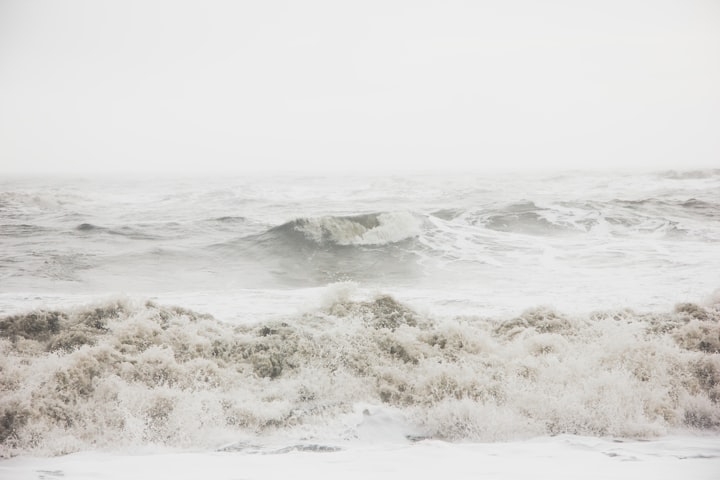
He stopped. Suddenly aware that the moment he had dreamt of for over a week had been a moment that he had not prepared for. He scrambled into the jungle’s grasp once and for all, grabbing the first two lifeless, severed branches that he could find off of the ground and emerging powerfully back onto the beach. With one in each arm, he waded nearly knee deep into the gentle, foamy waves. He hoisted them overhead, flailing them, hoping to gather any one man’s attention on the ship that was creeping ever closer towards him.
He took his shot. He stayed in the same place on the shore for minutes as the vessel’s details slowly began to carve their way into his vision. He awaited the sight of neatly stacked cargo containers amidst a flatbed. In fact, he was sure he saw a flatbed now. His heart jumped and with the little energy that he had he waved frantically, desperately, pathetically almost, towards the ship.
It grew nearer, and he still was unsure whether he could trust his eyes. But as a cloud drifted, briefly disrupting the sun’s monopoly upon the ship’s body, across the sky, he could make out the unmistakable, ocean-gray color of a battleship, and sure enough, as he raised his gaze infinitesimally upwards, the distinct red, white, and blue fluttered proudly atop the vessel.
He dropped the branches to the sand and rushed back towards the jungle. He thought that he should hope they didn’t see him.
About the Creator
Keep reading
More stories from Patrick Clancy-Geske and writers in Humans and other communities.
Evelyn
He lay on his back. His eyes opened, fixed on the revolving fan whirling overhead. The dull thud that came from outside was familiar. He silently swung the covers over his legs, being sure not to wake the woman next to him. Sliding into his slippers, he tiptoed towards the bedroom door. The windowless hallway was nearly pitch black, so he placed his hands on either side of him, using the walls for guidance. At the end of the long hallway, he opened the wooden baby blue door to reveal soft rain falling on the brick walkway in front of him. He picked up the paper from the stoop, holding it out in front of his face, allowing droplets of water to fall from the translucent orange plastic cover.
By Patrick Clancy-Geske5 years ago in Humans
The CEO of Everything
They say "jack of all trades, master of none," but they forgot to mention the part where the jack of all trades is also the camera woman, the makeup artist, and the person currently yelling at a tangled Wii microphone cable in a her own bathroom while recording herself singing and trying to make it look realistic and professional. (As professional as you can make it with nothing but a cell phone camera and a mic that doesn't work)
By Sara Wilson6 days ago in Humans



Comments
There are no comments for this story
Be the first to respond and start the conversation.