
Global warming and poverty
The effectiveness of global warming and poverty in the societies

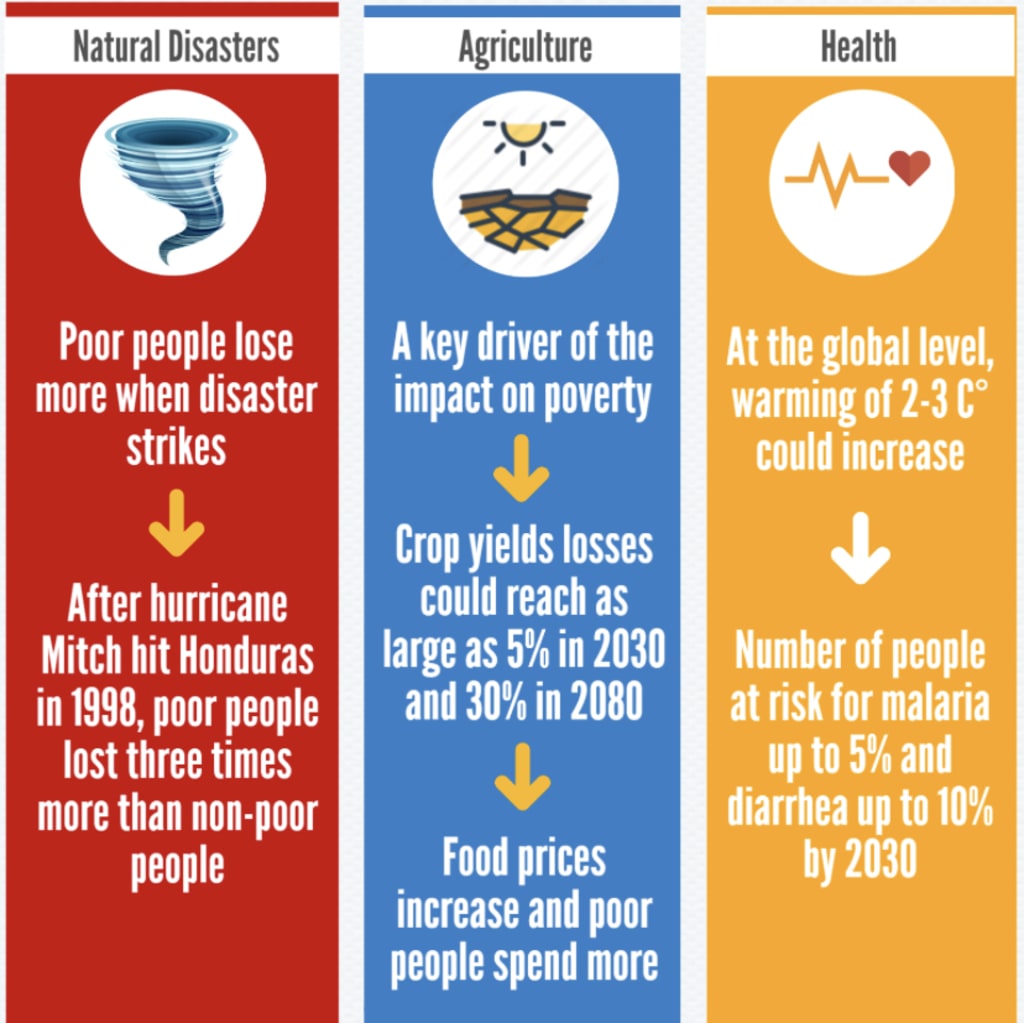
Global warming and poverty are two of the most pressing issues facing the world today. The effects of climate change are already being felt in many parts of the world,particularly in developing countries, where poverty levels are highest.climate change has the potential to exacerbate existing poverty and inequality,leading to an even greater divide between the rich and the poor.
the most direct effect of global warming on poverty is the destruction of food production.Rising temperatures and changing weather patterns can lead to drought and floods,which can devastate crops leading to food shortages and higher food prices. This can be particularly devastating in developing countries, where the majority of the population relies on subsistence farming for their livelihoods. In addition to the direct effects of global warming on poverty, there are also indirect effects. Climate change can leads to increased migration, as people are forced to leave their homes due to destruction of their livelihoods. This can cause increased competition for jobs and resources, leading to even greater.
Global warming and poverty are two interconnected issues that are affecting millions of people around the world. As the planet continues to warm at an unprecedented rate, the impacts of climate change such as extreme weather events, droughts, and rising sea levels are exacerbating poverty and inequality in many parts of the world.
The poorest and most vulnerable communities, particularly in developing countries, are the most affected by the impacts of global warming. They are often the ones who live in areas with inadequate infrastructure and limited resources to cope with natural disasters. As such, they are at a higher risk of losing their homes and livelihoods due to flooding, landslides, and other extreme weather events.
Moreover, global warming is also affecting agriculture and food security in many parts of the world. Changes in temperature and rainfall patterns are making it difficult for farmers to grow crops, leading to food shortages and price hikes. This, in turn, is pushing more people into poverty and exacerbating existing inequalities.
To address the issue of global warming and poverty, there is a need for concerted efforts from governments, civil society organizations, and other stakeholders. This includes investing in renewable energy, improving access to clean water and sanitation, and providing adequate social safety nets to help vulnerable communities cope with the impacts of climate change.
In addition, there is a need for more research and data to better understand the complex interactions between global warming and poverty. By doing so, we can develop more effective policies and strategies that can help mitigate the impacts of climate change on the world's poorest and most vulnerable communities.
The effects of global warming are already being felt around the world, from rising sea levels and extreme weather events, to changes in precipitation patterns and loss of biodiversity. Meanwhile, poverty remains a major obstacle to development in many parts of the world, with millions of people struggling to meet their basic needs.
Unfortunately, these two issues are closely intertwined, with global warming exacerbating poverty and poverty contributing to global warming. For example, as climate change causes more extreme weather events, it can devastate crops and livestock, leading to food shortages and price spikes that can hit the poorest communities hardest. Similarly, rising sea levels can displace millions of people, forcing them to leave their homes and communities behind, exacerbating poverty and creating new vulnerabilities.
The effects of global warming are already being felt around the world, from rising sea levels and extreme weather events, to changes in precipitation patterns and loss of biodiversity. Meanwhile, poverty remains a major obstacle to development in many parts of the world, with millions of people struggling to meet their basic needs.
Moreover, poverty can also contribute to global warming, as people living in poverty often lack access to clean energy sources and may be forced to rely on burning wood, charcoal, or other fossil fuels for cooking and heating. This not only contributes to greenhouse gas emissions but also creates health problems for those exposed to the resulting air pollution.
To address these intertwined issues, there are several key steps that must be taken. First and foremost, we need to reduce greenhouse gas emissions to slow the pace of global warming and mitigate its impacts. This will require a concerted effort at all levels, from individual actions to national and international policies and agreements.
Second, we need to invest in adaptation measures to help communities cope with the impacts of global warming that are already happening. This could include building seawalls and other infrastructure to protect against rising sea levels, developing drought-resistant crops, and investing in disaster preparedness and response.
Third, we need to address poverty directly by investing in education, healthcare, and other basic services that can help lift people out of poverty and improve their resilience to climate impacts. This may include providing access to clean energy sources like solar power and promoting sustainable agriculture practices that can help reduce dependence on fossil fuels.
Finally, we need to recognize that global warming and poverty are not separate issues, but rather two sides of the same coin. As such, we need to approach these issues holistically and work to address the root causes of both. This will require a fundamental shift in our economic and political systems, as well as a commitment to social and environmental justice.
In conclusion, global warming and poverty are two of the most pressing issues facing the world today, and they are closely intertwined.
About the Creator
Bukola ojebode
Reading Improves Brain Function. A person who reads everyday gets better at it over time and also gain valuable knowledge
Keep reading
More stories from Bukola ojebode and writers in Humans and other communities.
HUMANITY
Once upon a time, there was a planet called Earth. It was a beautiful planet, full of life and diversity. There were mountains, oceans, forests, and deserts. And there were humans, a species that had evolved to become the dominant species on the planet.
By Bukola ojebode 3 years ago in Humans
The CEO of Everything
They say "jack of all trades, master of none," but they forgot to mention the part where the jack of all trades is also the camera woman, the makeup artist, and the person currently yelling at a tangled Wii microphone cable in a her own bathroom while recording herself singing and trying to make it look realistic and professional. (As professional as you can make it with nothing but a cell phone camera and a mic that doesn't work)
By Sara Wilson6 days ago in Humans
The History of Valentine’s Day for Students Made Easy and Fun
Introduction to the History of Valentine’s Day for Students Valentine's Day is frequently associated with hearts, cards, sweets, and words of love. For students, it can feel like a contemporary celebration centered on gifts and social media. However, the history of Valentine's Day is far older and more interesting than most people realize. When we go back, we find stories of ancient rituals, daring choices, secret weddings, and customs that helped define the holiday that students know today.
By Relationship Guide6 days ago in Humans




Comments
There are no comments for this story
Be the first to respond and start the conversation.