
Girl Falls Asleep, Doesn't Wake Up for SIX MONTHS!
An article about a 17 year old girl who fell asleep and didn't wake up for six months

Sleep is an essential part of our lives, and most people spend an average of 7-9 hours per night sleeping. However, for one teenager from the United Kingdom, sleep became more than just a daily routine. In 2017, a 17-year-old girl fell asleep and didn't wake up for six months, baffling medical professionals and captivating the world.
The girl, whose name has not been publicly released, had a history of poor sleep and had been diagnosed with excessive daytime sleepiness. However, her condition had never been considered life-threatening until she fell into an extended sleep that lasted for six months.
The girl's parents initially thought she was just sleeping in late, as teenagers often do. However, as the days turned into weeks and then months, they grew increasingly concerned. They eventually took her to the hospital, where she was diagnosed with a rare condition called Kleine-Levin Syndrome (KLS).

KLS, also known as Sleeping Beauty Syndrome, is a rare neurological disorder that primarily affects teenagers and young adults. The condition is characterized by recurrent episodes of excessive sleep, lasting days to weeks, during which the person is difficult to wake and may exhibit other symptoms such as hyperphagia (excessive eating) and behavioral changes.
The girl's six-month-long sleep was not continuous, and she would occasionally wake up for short periods of time before falling back asleep. During her periods of wakefulness, she would eat and drink normally, but her memory was severely affected, and she could not recall anything that had happened during her prolonged periods of sleep.
Doctors treating the girl had never encountered a case of KLS lasting as long as six months, and they were initially unsure how to treat her. They eventually settled on a combination of medication and therapy to manage her symptoms, but there is currently no known cure for KLS.
The girl's prolonged sleep drew worldwide attention, with media outlets and medical professionals speculating on the cause of her condition. Some suggested that it was related to a viral or bacterial infection, while others theorized that it was caused by a hormonal imbalance or genetic predisposition.
One theory proposed by medical professionals was that the girl had contracted the Epstein-Barr virus, which is known to cause mononucleosis, a condition characterized by extreme fatigue and sleepiness. While this theory was plausible, no concrete evidence was found to support it.
Another theory was that the girl's prolonged sleep was related to a hormonal imbalance, specifically a deficiency of orexin, a neurotransmitter that regulates sleep and wakefulness. Orexin deficiency is associated with another sleep disorder, narcolepsy, which is characterized by sudden, uncontrollable bouts of sleepiness during the day. However, further testing revealed that the girl did not have narcolepsy.
There were also suggestions that the girl's condition was related to genetics, as other members of her family had experienced sleep disturbances in the past. However, genetic testing did not reveal any abnormalities or mutations that would explain her condition.
Regardless of the cause, the girl's story highlights the importance of sleep and the impact that sleep disorders can have on our lives. Sleep disorders can have a significant impact on our health, both physically and mentally, and it is important to seek medical attention if you are experiencing persistent sleep disturbances.
In conclusion, the case of the 17-year-old girl who fell asleep and didn't wake up for six months is a rare and fascinating example of Kleine-Levin Syndrome. While KLS is a rare condition, it serves as a reminder of the importance of sleep and the potential impact that sleep disorders can have on our lives. The girl's story has brought attention to this little-known condition, and medical professionals are continuing to study the underlying causes of KLS in hopes of developing more effective treatments.
About the Creator
Keep reading
More stories from Thembinkosi Sigudla and writers in Humans and other communities.
5 Most Mysterious And Highly Forbidden Places On The Planet
The world is full of mysterious and fascinating places that are shrouded in secrecy and forbidden to the public. From top-secret government facilities to ancient sacred sites, these places have captured the imagination of people all over the world. In this article, we will explore the five most mysterious and highly forbidden places on the planet.
By Thembinkosi Sigudla3 years ago in Earth
Whiskey At Dusk
Guess the whiskey was more important to you in the end, wasn’t it? It was more than the well-being of your friends; more vital than showing up to the places you promised you would and could come to; more critical of a matter than fulfilling your damn responsibilities and getting the press off your back.
By Snarky Lisa4 days ago in Humans
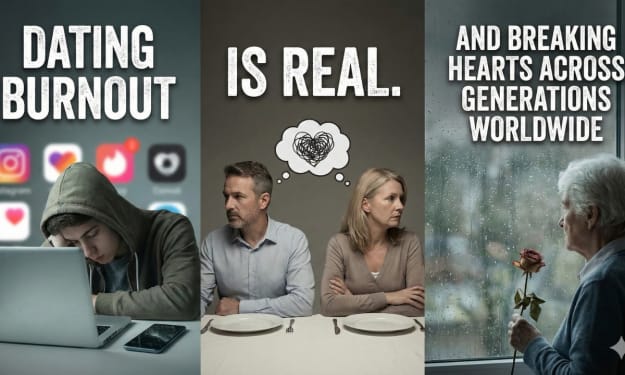
Dating Burnout Is Real And Breaking Hearts Across Generations Worldwide
Dating used to be interpreted as a romantic adventure to love and friendship. Nowadays, it is a draining emotional process of uncertainty, disappointment, and confusion to many people. Dating burnout is being witnessed among various age groups and cultures. Such emotional burnout is a result of numerous unsuccessful relationships, lack of intention, and a demand to discover love in a digitalized world full of hurry. Rather than being optimistic, most people are exhausted, disappointed and willing to surrender. The problem of burnout dating is not only my problem, but a world-wide emotional crisis of all people with fiery hearts.
By Grace Smith2 days ago in Humans


Comments
There are no comments for this story
Be the first to respond and start the conversation.