
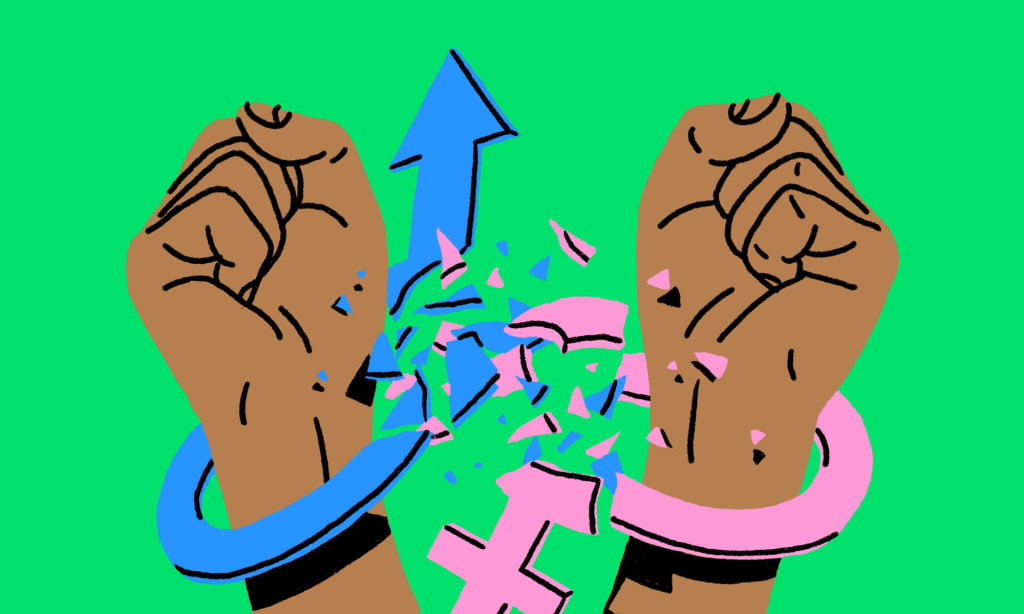
Men and women differ in a variety of ways. These are reflected in stereotypical images of these populations to some extent. Stereotypes about how men and women think and act are widespread, implying that some of them are true. Stereotypical expectations, on the other hand, not only reflect existing disparities, but also have an impact on how men and women perceive themselves and are treated. This article examines the nature and content of gender stereotypes, as well as how they relate to gender inequalities in key life outcomes. Gender stereotypes influence how people pay attention to, perceive, and recall information about themselves and others, according to empirical studies.
GENDER STEREOTYPES AND THEIR NATURE
Stereotypes are preconceived notions about individuals of specific social groups. Even if there is a general difference between these groupings, not all individual exemplars within these groups will necessarily differ. For example, while men are on average taller than women, we all know specific men and women for whom this is not true or even the opposite is true. However, people frequently over emphasise differences between groups while underestimating diversity within groups due to the stereotyped belief that a given attribute characterises membership in a specific group.
Individuals' proclivity to regard themselves as representatives of various social groups has been recorded for a variety of groups in a variety of settings. According to research, the impact of social categorization on the assignment of traits and characteristics to members of particular groups can be fairly variable depending on the situation and the most prominent comparator groups. Psychologists, for example, may appear to be highly creative when compared to physicists, but they appear to be far less creative when compared to artists. Furthermore, psychologists are sometimes overlooked as representatives of their profession simply because their qualifications are irrelevant (e.g., in a sports competition) or not evident (e.g., when walking in the street).
When it comes to gender categorizations and gender stereotypes, however, such stereotype fluidity and context reliance are considerably less likely to occur. Gender is a major factor in how people are perceived. Even when this categorization is irrelevant to the situation and provides no informational benefits, children and adults automatically and unconsciously group unknown individuals by gender. Furthermore, despite the fact that we are all familiar with examples of gender bending, gender remains a binary category in which we compare men to women and women to men, anchoring any differences in terms of a contrast between them. As a result, gender categorizations are quickly identified, are persistently conspicuous, appear to be reasonably stable, and are easily polarised. This leads to the establishment and perpetuation of gender stereotypes, as well as the reinforcement of perceptions of male and female differences.
cognitive abilities
Human perception includes basic dimensions such as competence and kindness. They are fundamental traits we evaluate while evaluating unknown persons, according to research, and they are universally applicable dimensions that let us compare diverse groups in society. We utilise these qualities to forecast others' most likely behaviour, inferring talents from competency judgements and intentions from perceived warmth. The assumption that men's talents are likely to be superior to women's and women's intentions to be more beneficent than men's is elicited by the notion that men as a group are more competent and women as a group are more warm. As previously stated, stereotypical expectations may come to dominate our perceptions of individual women and men by influencing how we respond to and process more specific information that could help us revise our assessment.
The impact of this on people's perceptions of others was proved in a study in which participants were given equal quantities of information on men's and women's accomplishments and celebrity. When asked to rate unknown men and women, however, participants relied on broad gender stereotypes to give males more fame than women, rather than on the precise facts they had just received.
About the Creator
Autonomy Is The Real Privilege
Good morning, freedom-seekers! Today we’re gonna be looking at autonomy. A strange word, I know; one many would probably look at blankly and run away from on sight. We’re gonna figure out what it actually means, consider how it’s achieved, and decipher just how deeply most of us are tangled up in dependence without realising it.
By That ‘Freedom’ Guyabout 11 hours ago in Humans
Loyalty Over Everything
In the old river town of Harrenford, loyalty was a word people spoke often but practiced rarely. The town sat between trade routes, rich with opportunity and temptation. Merchants came and went, deals were made and broken, and friendships were tested by profit. Among all this lived two young men whose lives would come to define what loyalty truly meant.
By The best writer 6 days ago in Humans




Comments
There are no comments for this story
Be the first to respond and start the conversation.