
From Ghalegaun to the World
The Boy Who Taught Drones to Fly in the Hills

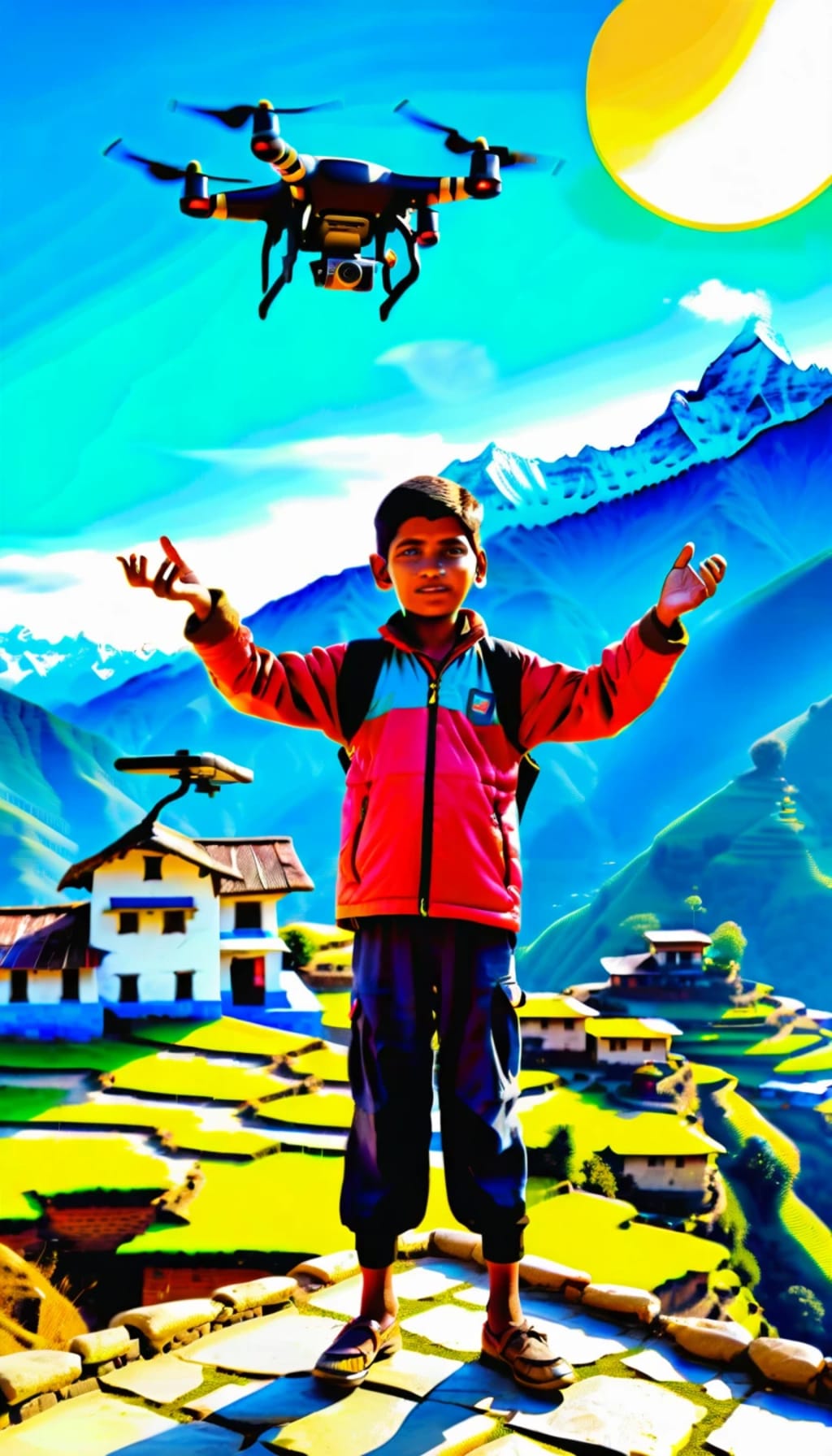
In a remote village tucked into the folds of Nepal’s Annapurna range, where mornings begin with the sound of buffalo bells and mist curls like secrets between pine trees, a 19-year-old boy dreamed of machines.
Ramesh Gurung was not your typical village boy.
His mornings started before sunrise with a plow in hand, helping his father in the terrace fields. But at night, his imagination soared beyond those hills — to classrooms, circuits, and flying drones. He wasn't drawn to tradition. He was drawn to innovation.
In Ghalegaun, dreams like his were often called foolish.
His father, Dhan Bahadur Gurung, was a former British Gurkha. A man of quiet pride and deep lines on his face — lines earned through service and sacrifice. Ramesh’s mother, Maya, was the kind of woman who could scold you and feed you at the same time.
When Ramesh finally voiced his dream one chilly night — “Baba, I want to study engineering in Kathmandu” — his father simply replied, “If you can manage, I won’t stop you.”
And Ramesh did.
The City of Noise, Noodles, and New Beginnings
Ramesh arrived in Kathmandu with a borrowed bag, Rs. 850, and a scholarship letter from Pulchowk Engineering College. His room was barely a box in Lalitpur, the walls thin enough to hear his neighbors breathe.
His classmates wore smartwatches. He wore doubt and second-hand shoes.
They mocked his accent. They laughed at his silence.
But Ramesh, like the mountains that raised him, endured quietly. He worked part-time at a mechanic's garage, studied deep into the night, and let his work speak. When others scrolled Instagram, he memorized electrical blueprints. When others went to cafés, he fixed scooters for rent.
In his third year, Ramesh built something the world hadn’t seen: a drone-powered seed spreader — designed for the hills.
“One man can do the work of ten,” he said, “even on the steepest slope.”
He didn’t win the national prize, but he won something better: mentorship, funding, and belief.
Building Dreams from the Ground Up
Four years later, he returned to Ghalegaun.
Not as a student. As an engineer. As a founder.
He launched PahadiTech, a startup focused on agricultural technology for hill farmers — drones, solar pumps, smart sensors. His village was the first testing ground. The same boys who teased him now soldered circuit boards by his side. His father, once skeptical, now stood proudly next to the flying machines.
When the first drone flew across the terraces, scattering seeds in perfect spirals, some clapped. Some cried.
News headlines followed.
“Village Boy Brings Tech Revolution to Nepal’s Hills.”
“Engineering Hope in Ghalegaun.”
He spoke at TEDx Kathmandu. Not with jargon, but with honesty.
“Success isn’t reaching the city,” he told the crowd, “it’s bringing the light back to your village.”
But success, as it always does, came with storms.
The Crash That Almost Grounded the Dream
Just when PahadiTech was scaling — reaching Karnali, Dolpa, Solukhumbu — disaster struck.
An NGO pulled out. A warehouse fire destroyed 60 drones. Investors backed away.
Ramesh sat on a rooftop, watching the chaos of Kathmandu below. Doubts crept in like shadows.
“Maybe I flew too high.”
But then he found an old photo — his father, standing beside the first drone, his face unreadable, proud. He remembered his father’s words:
“Machines can fly now, but your feet must stay on the ground.”
The next day, he gathered his team.
“We’re rebuilding,” he said. “Even if we start from scratch.”
He cut costs, simplified designs, and crowd-funded through the Nepali diaspora. Within six months, PahadiTech was back — stronger, smarter, and even more focused on purpose.
From Innovation to Inclusion
Ramesh realized that machines were only half the mission. The other half? People.
He launched Engineer Saathi, a fellowship bringing students from rural schools to Kathmandu every weekend. His office buzzed with kids from Humla, Jumla, Syangja — building, breaking, learning.
A girl named Kusum built an alarm to scare wild boars away from her family’s maize.
A boy named Bibek made a water sensor for his blind grandmother.
“Innovation isn’t about labs,” Ramesh said, “it’s about life.”
He was offered a seat on the National Technology Council — a permanent chair.
He declined.
“I don’t want meetings. I want tools in the hands of youth.”
Instead, he asked for land — to build Innovation Hubs for Rural Youth.
The government agreed. PahadiTech opened Pahad Labs in five provinces — labs with 3D printers, lodging, and electricity where there once was none.
The Last Goodbye
His parents had aged. His father, once a mountain of a man, now sat under a tree each evening, watching sunsets with a quiet smile.
One winter, Dhan Bahadur fell ill.
On his deathbed, he whispered, “You planted a seed, chhora. The village bloomed.”
Ramesh wept.
“Baba, your strength gave me wings.”
His father smiled, faint but proud.
“Then fly higher — but never forget where the wind comes from.”
That night, the hills lost a son. But Ramesh found his purpose strengthened.
From Ghalegaun to the World
Ten years after that first drone flew over the terraces of Ghalegaun, Ramesh stood on a stage at the United Nations Headquarters in New York — daura suruwal pressed, black Nepali topi resting proudly on his head.
He looked into a sea of faces and told a story.
Not of machines, but of one boy. One dream. One village.
“We were told our hills are poor,” he said, voice clear. “But I say this: One day, our hills will not be known for what they lack — but for the minds they produce.”
And somewhere, far away, in a small village where the pine trees still whisper, the wind carried his words home.
About the Creator
Arshad khan
🌟 Welcome to my world of words, where pain turns into power and poetry breathes purpose.
I write to heal, to inspire, and to remind you that your story matters
My work is born from real experiences, broken friendships and silent nights
Keep reading
More stories from Arshad khan and writers in Humans and other communities.
The Last Vote
Ethan Clarke’s hands trembled as he gripped the cold metal railing of his balcony. Below, the streets buzzed with the fading cheers from his election rally. At twenty-eight, he was the youngest provincial assembly member ever elected from his district — a victory that surprised even his closest supporters.
By Arshad khan8 months ago in Poets
How Couples Can Overcome Jealousy In Monogamous Relationships
Jealousy is an emotion that is inherent and comes up when we feel our thing threatened. In monogamous relationships, such a thing is not always financial, but emotional or physical exclusivity. Although jealousy is typically depicted as unhealthy, it does not necessarily mean that it is bad. When it is not controlled or is manifested in ways that are not healthy it becomes destructive. Viewing jealousy as a clue, and not a judgment, enables couples to do so curiously and not shamefully. Admitted in a composed manner, it may enlighten unfulfilled needs, insecurities, or communication faults that must be taken into account.
By Tiana Alexandraa day ago in Humans




Comments
There are no comments for this story
Be the first to respond and start the conversation.