
Fred: The World’s Nicest Doormat
How Always Saying 'Yes' Made One Guy’s Life a Comedy of Self-Sabotage


So, it was only the second time Fred had hung out with his "new best friend," Aubrey, outside of school. Aubrey was the first real friend Fred ever had, so naturally, he was determined to be the epitome of a good person—whatever that means. They’d just finished biking in the driveway, and Aubrey, bursting with excitement, suggested, “Hey Fred, wanna watch *Star Trek*? It’s my absolute favorite!”
Fred, being the super agreeable guy he is, responded in the most neutral way possible, “Yeah, sure. Let’s watch it.” In reality, Fred absolutely despised *Star Trek*, but, of course, he was too "nice" to say anything. Instead, he sat through the entire afternoon pretending to enjoy it.
This became a regular thing. Almost every time they hung out, Aubrey would put on *Star Trek*, and Fred, being the "nice guy," never complained. Instead, by the end of the school year, Fred just stopped hanging out with Aubrey altogether, harboring a silent grudge for all the *Star Trek* he endured. Aubrey, completely clueless, had no idea why his "best friend" had suddenly ghosted him.
Fast forward to high school, and Fred had a few more friends. With newfound freedom, driver’s licenses, and teenage hormones, Fred found himself hanging out with friends more often. Every time someone asked him to do something, his automatic response was, “Yes, of course!” He didn’t want to disappoint anyone, after all. This led to him constantly overbooking himself and rarely having any time for his own hobbies or sanity. By graduation, Fred had lost friends due to his flakiness and broke ties with most others because of his bottled-up resentment.
In college, Fred finally got into his first serious relationship with a girl named Tara. Things were amazing at first—Tara was everything Fred could have dreamed of. But, as time went on, Tara started to do things that really got under Fred’s skin. She’d ignore his texts for days, go out without telling him, and generally just be impatient. But Fred, in his infinite "niceness," never addressed any of it. He just kept his mouth shut, priding himself on being the perfect, non-confrontational boyfriend.
One night, Fred confided in a friend, “We never fight, but I don’t like how she treats me. I used to think she understood me, but now I’m not so sure.” His friend suggested breaking up, but Fred, ever the martyr, said, “I don’t want to devastate her. I’ll just see how things go.” He stayed with Tara for another year, despite the fact that things kept getting worse. When he found out Tara had cheated on him, he even tried to forgive her, but deep down, he was done. A few months later, he finally ended it, realizing how much of a fool he’d been.
After college, Fred got his first real job as a digital marketing coordinator. He eagerly accepted, ready to prove himself. At work, he was the guy who always said “yes” to everything, even when it was outside his job description. He constantly offered to help, even when he had no clue what he was doing. Secretly, Fred hated his boss and most of his coworkers, feeling completely taken advantage of. Three years in, he quit out of the blue, fed up with the whole situation.

Fred was the nicest person you could ever meet, always putting others first and never wanting to upset anyone. But by the time he was 28, he found himself alone, with very few friends, a string of failed relationships, and strained work connections. Feeling isolated, he decided to try dating again. Eventually, he met Amina, an outgoing, extroverted woman unlike anyone he’d ever known.
On their third date, sitting at a park picnic table, Fred started complaining about how people always took advantage of his niceness. Amina listened, then asked, “So, are you the kind of guy who’s so obsessed with being nice that you never actually consider other people’s feelings?”
Fred, puzzled, responded, “What do you mean?”
Amina explained, “Did you ever tell anyone how you really felt? Did you ever try to resolve issues, or did you just expect people to magically know what you wanted because you were nice? Niceness isn’t about staying quiet or avoiding confrontation. It’s about being honest and fair, even when it’s uncomfortable.”
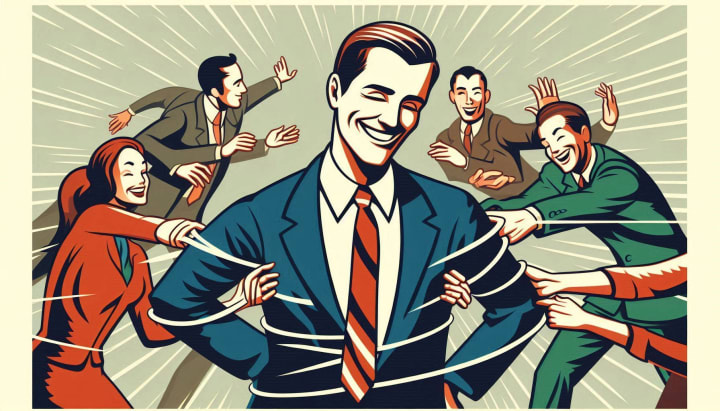
Fred agreed, though a bit deflated. Amina continued, “Some people are so focused on being liked that they become selfish in their own way. They care more about how others perceive them than about genuinely connecting with people. At least straightforward people respect you enough to be honest.”
Fred, for once in his life, paused to think. “Maybe we should take things a bit slower,” he finally said.


Comments
There are no comments for this story
Be the first to respond and start the conversation.