
Found a Child in the Rubble — And Then the Real Story Began
A war zone. A silent child. A choice that changed everything.

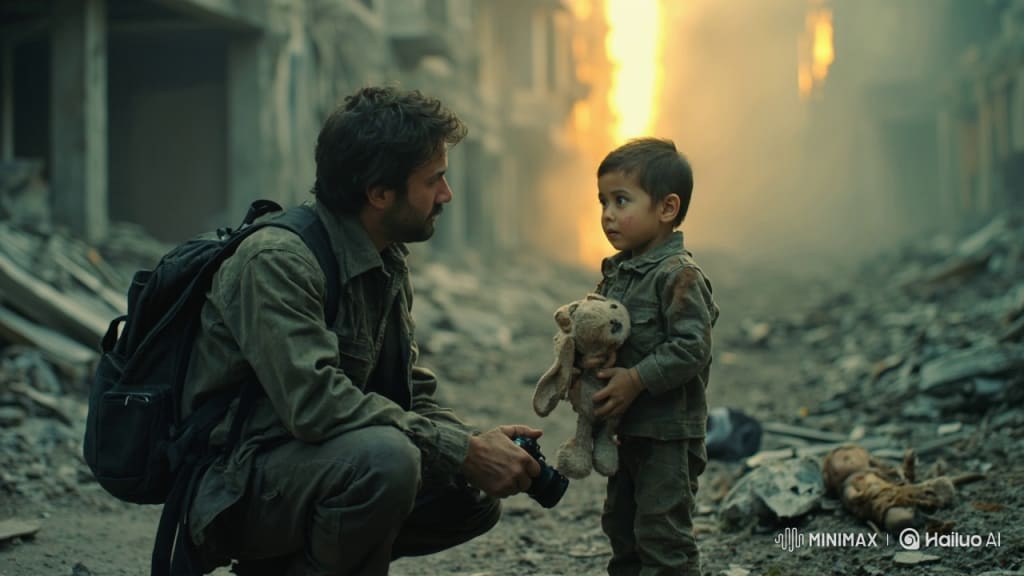
I was never supposed to be there. Not as a journalist, not as a human being. War zones were something I reported on from afar, not walked through with dust in my mouth and blood drying on my sleeves. But fate, or guilt, or maybe something greater, dropped me in the center of Aleppo, Syria, three years after the siege had ended.
I came to document rebuilding. Hope. The human spirit, battered but unbroken. Instead, I found silence. Hollowed-out buildings. Streets where laughter had once lived, now echoing with the ghosts of mortar shells.
And in one of those shells of buildings, I found him.
He was sitting in the corner of what had once been a bedroom, maybe a nursery. His face was streaked with dust, his lips cracked, and he held a burnt stuffed rabbit in his lap. His eyes—black, wide, and utterly silent—met mine like they already knew me.
He didn’t cry.
He didn’t speak.
He just stared.
I called for medics, shouted for the local aid workers who were with me. Nobody answered. Our van had stalled an hour back, and my translator had stayed behind. For a long minute, I just stood there, watching him, this motionless child who looked more like a statue carved by sorrow than a living boy.
I stepped forward, crouched slowly. "My name is Daniel," I said, unsure whether he spoke Arabic, or anything at all. "You're safe now. I'm here to help."
Nothing.
Then, as I reached out, he did something that still haunts me to this day. He placed his hand—soot-stained and trembling—into mine. No hesitation. No words. Just that small gesture, simple and seismic.
I lifted him into my arms. He was light. Too light. The kind of thin that makes your throat burn. His head rested against my shoulder. His breath was shallow, but steady. I didn’t know his name. I didn’t know his story. But I knew he was alive. And I knew I had to get him out.
---
The next 24 hours blurred together.
Doctors at a nearby clinic said he was dehydrated, mildly injured, but otherwise fine. They asked if he had a name. I said I didn’t know. They asked where his parents were. I couldn’t answer. I went back to the building. Searched for signs. A family photo. A birth certificate. Anything.
All I found was a child’s drawing, half-burned, folded under a floorboard.
It showed a tank. Smoke. People with no faces. A sun in the corner, smiling through flames.
And a rabbit.
---
I stayed in Aleppo longer than planned. I brought him food. Clean clothes. A new rabbit. He accepted them silently. He followed me around the aid camp, sometimes holding my hand, sometimes trailing like a shadow. They started calling him Yassin.
One day, as we sat under a broken olive tree, he took the new rabbit and set it gently beside the old one. Then he pointed at me, then the rabbit, then himself.
He smiled.
It was small, crooked, but it was there.
And that’s when I knew: he remembered love.
---
They eventually found an aunt in Idlib. Alive, barely. She came days later, with tears and shrieks and kisses pressed to his face. He still didn’t speak, but he held her hand.
She told me his real name: Rami.
His parents had died two weeks before in a drone strike. He had crawled out of the rubble alone, clutching that rabbit, and waited. For days.
For someone.
Maybe for me.
---
I went back to the States weeks later. But something in me stayed there. In that broken city. In those black eyes.
Rami is seven now. We FaceTime sometimes. He speaks more. Laughs. Draws. His aunt says he asks about me often. He calls me "Uncle Daniel."
There are days I wonder if I truly saved him. Or if, somehow, he saved me.
Because after all the headlines, the footage, the lectures and photos and fundraisers, the real story wasn’t what I captured on camera.
It was what I carried home.
A silent child. A burnt rabbit. And a lesson louder than war:
Sometimes, the smallest hand you hold is the one that pulls you back to humanity.
About the Creator
Waqif Khan
i'm creating history from old people
Keep reading
More stories from Waqif Khan and writers in Humans and other communities.
The Crescent Rises: The Story of Osman
The winds of Anatolia carried the scent of wild grass and the smoke of distant hearths. Along the foothills of the Sakarya River, a young warrior sat atop his horse, gazing at the rolling green hills beyond. His black eyes were steady, calculating—not yet the gaze of an emperor, but of a man who understood what was coming.
By Waqif Khan7 months ago in History
The CEO of Everything
They say "jack of all trades, master of none," but they forgot to mention the part where the jack of all trades is also the camera woman, the makeup artist, and the person currently yelling at a tangled Wii microphone cable in a her own bathroom while recording herself singing and trying to make it look realistic and professional. (As professional as you can make it with nothing but a cell phone camera and a mic that doesn't work)
By Sara Wilson6 days ago in Humans
Shadow of the Crown
In the heart of the ancient kingdom of Eldoria, where golden spires kissed the clouds and rivers shimmered like molten silver, there lived a dog named Arion. Unlike ordinary dogs, Arion was no mere pet; he was the companion of the royal family, a silent witness to their triumphs, tragedies, and secrets. His coat was a deep, glossy black that reflected the sunlight like polished onyx, and his eyes, a piercing amber, seemed to understand every whispered word and unspoken emotion of those around him. Arion had been born in the royal kennels, a litter of five pups, but even as a young puppy, he showed signs of extraordinary intelligence and loyalty. While the other pups played and tumbled, Arion would sit quietly near the throne room, listening intently to the council meetings and royal discussions. The courtiers joked that he was born to serve the crown, not just the family, and as he grew, this joke turned into truth. The king, a stern yet fair man named King Alaric, noticed Arion’s unique nature. Unlike the other dogs, Arion would sit by his side during state matters, resting his head on the king’s knee during long discussions and accompanying him through the castle corridors with a sense of purpose. Over time, Arion became more than a companion; he became a guardian, a confidant, and a symbol of loyalty that transcended words. It was during the Festival of the Silver Moon that Arion’s loyalty would be tested like never before. Eldoria had long been a peaceful kingdom, but whispers of unrest had begun to echo from the northern borders, where a rival lord, Lord Malric, coveted the throne. He was cunning and ruthless, and many feared that he would strike during the festival, when the city would be crowded with nobles and merchants. King Alaric, aware of the threat, had fortified the palace and strengthened the guards, yet he could not shake a growing unease. Arion sensed it too. On the eve of the festival, the dog patrolled the palace halls tirelessly, sniffing for danger, his tail low and tense, his ears twitching at every unfamiliar sound. That night, Arion had a vision of what could come—a shadow creeping through the halls, a dagger glinting under the torchlight, a scream swallowed by silence. When the festival began, Eldoria’s streets were alive with music, laughter, and the scent of roasted meats and sweet pastries. The nobles danced, children played, and the king presided from the balcony of the royal palace, smiling and waving to his people. Arion, however, remained ever watchful. He slipped through the corridors, his paws silent against the marble floors, his eyes scanning for the slightest hint of danger. It was then that Arion noticed him—a cloaked figure moving with unnatural stealth among the servants. The dog’s hackles rose as the figure approached the throne room. Without hesitation, Arion leapt from the shadows, his growl deep and threatening. The would-be assassin stumbled, surprised by the sudden attack. Arion’s teeth clamped gently, yet firmly, on the cloak, pulling the intruder back from the throne. The king, alerted by the commotion, rushed forward, and the guards quickly restrained the intruder. It was Lord Malric’s most trusted assassin, sent to kill the king and plunge Eldoria into chaos. King Alaric knelt beside Arion, patting his loyal companion’s head. “You have saved Eldoria,” he said, his voice thick with gratitude. “And you have saved me, old friend. No reward could ever match your loyalty.” But Arion’s trials were far from over. That same night, under the cover of darkness, a group of Malric’s soldiers infiltrated the palace. Their goal was simple: kidnap the heir, Princess Liora, and use her as leverage against the king. Arion, sensing danger even before the soldiers reached the princess’s chamber, intercepted them in the long, torch-lit corridor. The battle that followed was one of cunning and courage. Arion was outnumbered, yet he moved with precision, barking loudly to alert the palace guards while fending off the attackers with swift, calculated bites and relentless determination. The soldiers, unprepared for the dog’s ferocity and intelligence, were soon overwhelmed. Arion had managed to protect the princess until reinforcements arrived. Princess Liora, though frightened, knelt beside him, stroking his head. “You are more than a dog,” she whispered. “You are the heart of Eldoria.” From that day on, Arion was no longer seen merely as the royal dog; he became the kingdom’s silent guardian, the protector of the throne, and the symbol of unwavering loyalty. Years passed, and Arion grew older, his movements slower but his spirit undimmed. King Alaric aged, too, and eventually, it was Princess Liora who ascended the throne. Yet Arion remained by her side, guiding her through the challenges of leadership, comforting her during times of doubt, and warning her of dangers before they arrived. Tales of the royal dog spread far and wide, inspiring songs, poems, and paintings, each depicting the black-coated guardian with amber eyes, standing resolutely by the throne. One fateful winter, the kingdom faced its greatest threat: a devastating fire that swept through the castle’s northern wing. Arion, despite his age, ran into the flames, rescuing trapped servants and guiding them to safety, refusing to leave until the last soul was accounted for. By the time the fire was extinguished, Arion was found lying near the royal chambers, exhausted but alive, his coat scorched and his eyes weary yet proud. King Alaric and Queen Liora, tears in their eyes, embraced the dog who had given so much for the kingdom. “You are the soul of Eldoria,” the king said. “And your legacy will never fade.” In honor of his bravery, a statue of Arion was erected in the palace courtyard—a black dog with amber eyes, forever watching over the kingdom. Even in death, Arion’s influence remained. Generations of rulers would come and go, but the story of the royal dog of Eldoria endured. The people spoke of his courage, his intelligence, and his unbreakable loyalty, teaching their children that true nobility was not only in blood and crown but in heart and devotion. And so, Arion’s shadow lingered over the kingdom, not as a ghost of fear, but as a beacon of hope and protection. In every loyal dog, in every act of bravery, in every quiet moment of guardianship, the spirit of Arion lived on—a reminder that sometimes, the most extraordinary heroes wear no crown, speak no words, and serve with a heart that knows no bounds.
By The best writer 5 days ago in Humans


Comments
There are no comments for this story
Be the first to respond and start the conversation.