
The Crescent Rises: The Story of Osman
How a small frontier prince founded one of the greatest empires in history

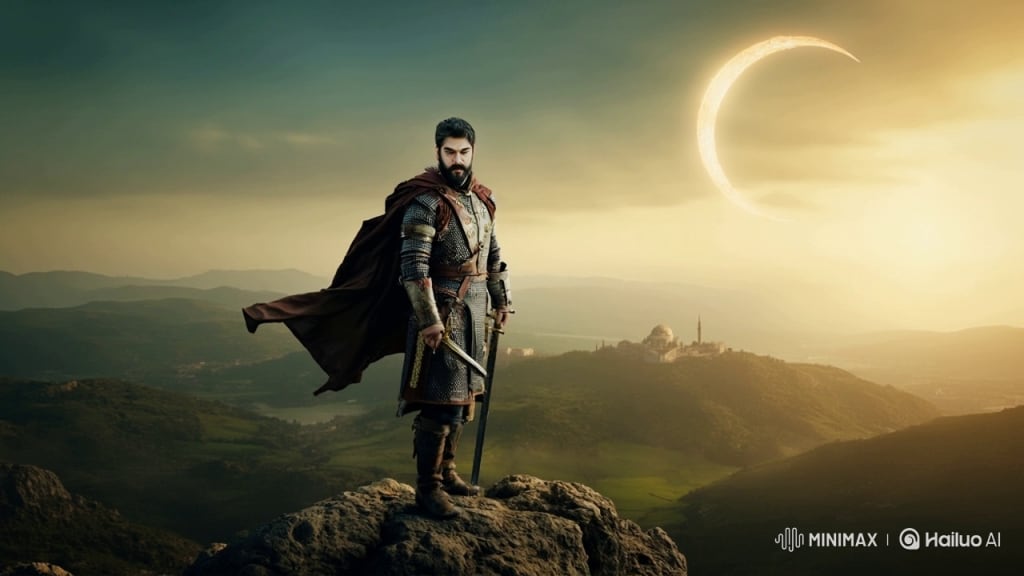
The winds of Anatolia carried the scent of wild grass and the smoke of distant hearths. Along the foothills of the Sakarya River, a young warrior sat atop his horse, gazing at the rolling green hills beyond. His black eyes were steady, calculating—not yet the gaze of an emperor, but of a man who understood what was coming.
His name was Osman.
No one knew then that he would become the father of an empire, that the small principality under his command would grow to dominate three continents, shaping the destiny of Europe, Asia, and the Middle East for over six hundred years. The dynasty he founded would bear his name — the Ottoman Empire — but when Osman’s story began, he was simply the ambitious son of a tribal leader on the edge of collapsing empires.
Born around 1258, Osman was the son of Ertuğrul, leader of the Kayı tribe of Oghuz Turks. These were hard times for the Turkish tribes. The once-mighty Seljuk Sultanate of Rum was disintegrating under Mongol pressure, and the Byzantine Empire to the west was but a shadow of its former glory.
Between these two dying worlds lay opportunity.
Osman inherited leadership from his father around 1280, but he didn’t inherit a kingdom — only a borderland, or uç, near the Byzantine frontier. For many, this was a cursed land, constantly raided, constantly fought over.
For Osman, it was exactly where greatness could be born.
Unlike other Turkish beyliks who fought only for survival, Osman saw further. He had a vision of conquest, not merely for loot, but for building. According to later Ottoman chronicles, Osman once had a dream: a massive tree growing from his chest, shading all lands from the mountains of the Balkans to the rivers of Mesopotamia. Whether true or legend, Osman began acting as if the dream were destiny.
He began launching raids into Byzantine territory—not mere bandit raids, but calculated strikes. Fort after fort fell under his control. Local Christians, weary of Byzantine corruption and neglect, sometimes preferred Osman’s rule, for he was known as a fair leader who respected those who submitted peacefully.
But Osman’s genius wasn’t just military—it was political.
He married Malhun Hatun, the daughter of a powerful neighboring emir, strengthening alliances among rival tribes. He attracted warriors not only with promises of plunder but with the offer of belonging to something greater: a state guided by Islamic justice but welcoming of anyone loyal to his cause.
In 1301, Osman struck a decisive blow against the Byzantines at the Battle of Bapheus, near Nicomedia. It was not a large battle by world standards, but it was a signal to everyone in Anatolia: the old empire was crumbling, and Osman was the one pulling at its foundations.
By 1302, the Byzantines had practically abandoned the countryside of Bithynia. Turkish warriors, or ghazis, flocked to Osman’s banner. His principality expanded, not by formal declarations of empire, but by slow, relentless advance.
Osman established his capital at Söğüt, transforming what had been a tribal camp into an embryonic state. His administration began to formalize—coinage was minted in his name, justice was administered by his appointed judges, and Friday prayers bore his title as ruler.
His leadership was so firm that even in his later years, when illness confined him to his bed, his followers continued to push the borders outward, loyal to his vision.
But Osman would not live to see the jewel of his ambition captured.
Shortly before his death in 1326, he instructed his son, Orhan, to take the city of Bursa—a wealthy Byzantine stronghold that would serve as the true capital of his people. Orhan completed the conquest soon after Osman’s passing, laying the foundation for the empire that would, in time, stretch from the gates of Vienna to the deserts of Arabia.
When Osman died, his domain was still small. But in that small principality lay the disciplined army, the clear vision, and the iron loyalty that would, under his descendants, defeat empires, seize Constantinople, and hold dominion over the crossroads of the world for centuries.
From a rugged borderland chieftain, Osman became the architect of an empire that would outlast kingdoms and emperors alike.
His grave rests in Bursa, still visited today by those who remember how the world can change not by the wealth of kings—but by the dreams of a shepherd’s son with a sword, a vision, and the will to see it done.
---
Thank you for reading.
From a forgotten frontier came a dynasty that shaped the course of history.
If you want Part 2 (Orhan, Murad, or the conquest of Constantinople under Mehmed II), just let me know.
About the Creator
Waqif Khan
i'm creating history from old people
Keep reading
More stories from Waqif Khan and writers in History and other communities.
The Rise of the Eternal Blue Sky
The wind screamed across the Mongolian steppes, wild and cold, carrying with it the scent of winter and blood. The boy stood there alone, his thin frame barely enough to withstand the storm, but his dark eyes were steady. Sharp. Watching.
By Waqif Khan7 months ago in History


Comments
There are no comments for this story
Be the first to respond and start the conversation.