
Forgiveness? To do what?
What if they never told us what it's really for?


Forgiveness? What is the purpose of it? And above all, what does it mean? For years, the word "forgive" was a word that I didn't understand, that I didn't like. It horrified me. For a long time, I associated this word and this concept with a form of cowardice and injustice. I thought that it allowed people who had hurt us to get away with it and even to do it again. And that it represented a gesture of kindness on the part of the victim towards someone who didn't deserve it, and who moreover, often didn't even take the step of asking for forgiveness for the harm he or she had done. I have often thought that this was something useless, and even dangerous for oneself. Because it left us defenseless against potential aggressors and enemies. I heard everywhere and all the time that it was necessary to forgive. So I tried to understand why it was repeated over and over again in many philosophical, spiritual, and religious systems, in books, in the media, in movies. Even the people I met in my life were saying that we should not hold grudges against those who had hurt, betrayed, or humiliated us. So yes, I was told, mechanically it seemed, that God loves those who forgive, that Jesus invited us to turn the other cheek. But I was never told why I should forgive, and also what benefit I would get from it. This lack of a coherent explanation made me even more reluctant. Clearly, to turn the other cheek meant for me to sign one's death warrant and to invite all the unjust of the earth to trample us. It was like carrying a sign that instead of saying "free hugs", would say "free punches". Another striking inconsistency was that very often, not to say almost systematically, those who extolled the virtues of forgiveness did not seem to live by these sacred rules when they found themselves cheated or offended. Had they too been influenced by this doctrine without rational basis or explanation? I even came to consider this morality, although it had noble intentions, but was devoid of pedagogy, as propaganda bordering on the absurd. Instead of calming me down, these words had the opposite effect and increased my anger when I heard them.
In spite of everything, I was still trying to understand. Then one day I saw a video of Olivier Clerc, a writer, and speaker on personal development and spirituality. A large part of his work is about forgiveness. Finally, he was the first human being to speak about forgiveness in an intelligible way. No preaching, no guilt-tripping. He didn't say, "You must forgive". Just letting forgiveness live as a free option changed everything and relieved me of the weight of unjust obligation.
With simple, clear words, he gave a definition of forgiveness that made sense.
"Forgiveness is the method of healing the wounds of the heart". Immediately I saw potential personal benefits to be gained. Finally, I saw forgiveness as an act that could benefit me. Although I was willing to listen to him, I wondered. How could I do this? The next part of the talk continued to convince me when he said, "we don't forgive others because they deserve it but because we deserve to live in peace". It is no longer a gift to the other, but to myself. These ideas were enlightenment that caused a real upheaval in my way of thinking. He added that forgiving does not mean condoning the act, or even being with the person who committed the hurtful act, nor does it mean reconciling with them as if nothing had happened. It is just to stop torturing ourselves for a past act that we cannot change. Not taking this step of forgiveness is like thinking endlessly about a blow that was dealt with us only once. Each time we remember it with a grievance, the wound opens up again and we suffer again and again.
Since I understood this, I feel it physically in a very intense way. Every time I succumb to the temptation of the desire for revenge, I feel my heart tightening. I feel heavy as if plunged into darkness. On the other hand, when I do not wish harm to those I identify as having hurt me in the past, this weight and darkness leave me. I feel fresh and light, at peace, facing a bright future.
Depending on the case and the moment, I oscillate between neutrality and benevolence towards them. Sometimes I wish them nothing, neither happiness nor unhappiness, at other times I send them waves of love through my thoughts, without expecting any reciprocity. I don't feel the need for it. Because I do it all for myself. I cultivate my inner field where fruit trees grow. And this field becomes an orchard full of trees giving delicious fruits, the fruits of my soul. I enjoy it. There is nothing like peace in this world.
Very clearly again, there is no obligation. Nothing is forced. Neutrality is more than enough to satisfy the thirst for peace. The benevolent thoughts emitted are a bonus for me. Because of all these waves of love, I send them only if I feel that it makes me feel good, and it is me who receives them.
One element that had bothered me for a long time with the notion of forgiveness was the sacrificial aspect that I thought it entailed. This was the main obstacle to my willingness to forgive and prevented me from doing so. Today, I no longer feel that way.
I do not turn the other cheek. When a potential conflict arises, I try to remain calm and I say what I think firmly, though in a cool, and collected manner. I may be able to identify through his or her actions and energy that the other person may not be on that personal evolution journey, or that he or she does not have a method for doing so. The interaction can potentially be toxic. I don't enter his field and let him express himself with his energy to avoid it contaminating and affecting me. If someone assaults you, says something means to you, has passive-aggressive behavior towards you, tell yourself that this person is sad. Tell yourself that if that person were happy, they wouldn't do it. Our goal is not to get into a verbal or physical fight, nor to win the most battles. Our goal in life is to be happy, to feel good. That is the victory. People who have not yet made this life choice, or who perhaps do not know how to do so, do not blame you specifically. As Don Miguel Ruiz teaches, it's not personal. They are arguing with you today, with someone else tomorrow, and the next day with someone else.
To each their own energy and behavior. Only what is ours is our responsibility.
Our job is to focus on our energies and behavior. These are the things we can influence. As Rumi said, "I used to be smart, I wanted to change the world, now I am wise, I want to change myself". We can't change anyone in this world but ourselves. I would add that the control of our emotions has the advantage of allowing us to make decisions lucidly. Because anger is a very bad advisor. When we remain calm, we multiply the chances to see situations and behaviors as they are.
Let's avoid judging people and let's base ourselves on the consequences of actions in order to be protected from potentially harmful effects. Let's do it for the love of happiness and peace. Let us accept our imperfection, by definition all humans.
We are mammals subject to our hormones, to the cycles of the seasons, with 90% of our decisions being unconscious and linked to our emotions.
Despite our good intentions and all the methods of self-control put in place, sometimes anger prevails. Knowing how to forgive ourselves proves to be life-saving. Let's forgive ourselves for our past and future mistakes. Because they will happen, for sure. The goal is not to be perfect. The balance of life is governed by a scale. It's up to us to make sure that the pan of the scale that holds fear, anger, and resentment is lighter most of the time than the one that holds love, hope, and peace.
About the Creator
Julian Salvatore
Hello, beloved world.
To those who read these lines, thank you.
Passionate about the arts, travel, and life, I share visions and emotions through stories and articles.
Keep reading
More stories from Julian Salvatore and writers in Humans and other communities.
BAY OF VENGEANCE
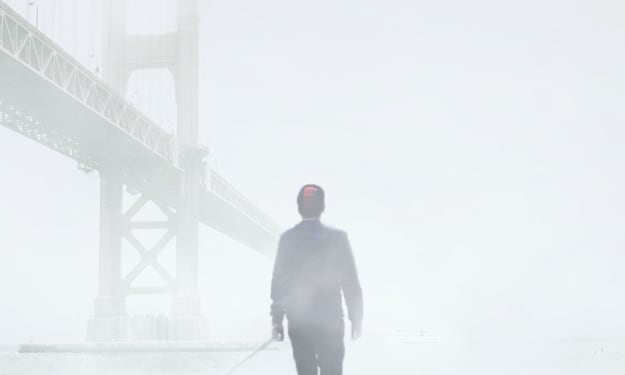
The rays of the rising sun reflected on the dazzling tiles of the large elevated terrace that was facing the bay of San Francisco. Passing through the half-opened glazed door, they irradiated the white walls and designer pieces of furniture of the sleeping room with a delicate spring warmth, giving them in places yellow and cream shades. From the terrace, you could see the harbor with all these berthed yachts, the lighthouse as well. Orienting the glance to the right, you could see the island of Alcatraz barely two miles away. And everywhere the blue, form the sky to the ocean, pure and light, omnipresent. The house was on Marina Boulevard, in the Marina district, one of the wealthiest of the city. It was a modern house. Its architecture was radical. Its cubic shape and its general structure had very sharp angles. It was built a decade ago, during the early eighties. Because yes, we were in 1989, a Saturday of May more precisely. On the first floor, in the bedroom, the landlords, Alan and Claire Anderson were sleeping snuggled together. They were young, handsome, blonde, and tanned. They looked like fitness magazines models. The radio-alarm clock was displaying 5:55 AM. But no need for ringing. Both perfectly coordinated woke up simultaneously. Alan was behind Claire. Keeping the same position, he caressed her long hair and kissed her neck softly. After a few minutes like this without moving, they got up at the very same time. Always as synchronous in their moves, and with saying a single word, they entered the bathroom and faced the double washbasin, perfectly choreographed, they washed their faces and brushed their teeth. This being done, they put on their sportswear, got outside the house, and after a few brief stretches and without forgetting to start their stopwatch, started running.
By Julian Salvatore4 years ago in Fiction
The CEO of Everything
They say "jack of all trades, master of none," but they forgot to mention the part where the jack of all trades is also the camera woman, the makeup artist, and the person currently yelling at a tangled Wii microphone cable in a her own bathroom while recording herself singing and trying to make it look realistic and professional. (As professional as you can make it with nothing but a cell phone camera and a mic that doesn't work)
By Sara Wilson7 days ago in Humans
Two Farmers Unearth a 17th-Century Silver Treasure While Working Their Land: A Remarkable Discovery
In a discovery that feels lifted straight from the pages of a historical novel, two farmers recently unearthed a 17th-century silver treasure while working their land. The find, consisting of coins, jewelry, and small silver artifacts, provides a fascinating glimpse into the region’s past and has ignited interest among historians, archaeologists, and the local community. Beyond the monetary value, this discovery underscores the enduring stories buried beneath the soil, waiting for chance and circumstance to reveal them.
By Salaar Jamali7 days ago in Humans
The Blue Ridge Stalker
Tom had left the Ford down the way, its spark plugs finally exhausted and no mechanics for a dozen miles back through the foothills to Strossburg. No matter, he had worn his boots—almost as if he planned for this to happen. The puzzle he sought to solve emanated from the woods clinging to the slopes above; the valley behind held no mysteries.
By Stephen A. Roddewig3 days ago in Fiction


Comments
There are no comments for this story
Be the first to respond and start the conversation.