
For Whom the Pebble has Value
True riches are contained in the heart
The mansion had gone to Roger’s widowed mother, Dolorous, and the ranch to his uncle Jim. His oldest brother, Robert, was bequeathed the house in the Keys and the cabin cruiser tethered at the dock. And his middle brother Terry got the thoroughbred farm in Kentucky. Old friends, employees and others had also received smaller items from Jules McWorth, who had thoughtfully allocated his possessions to those important in his life. Everyone gathered around the magnificent granite table in the Manhattan conference room smiled with satisfaction having gotten what they felt was their due. Everyone but Jules’ youngest son, Roger.
“There is one more item in the will.” Franklin Minton, the McWorth family lawyer, flipped over the last page. “To my youngest son, Roger, who danced to the beat of a different drummer from the day he was born, I leave my notebook.” Minton pulled a weathered black notebook from his briefcase and held it up for all to see. “As you have challenged me all the days of your life to keep you on the straight and narrow, I now challenge you. On these pages are my most treasured thoughts and ideas and hopefully some wisdom. Everything mentioned in this book is yours. Good luck, son. I wish you beauty, elegance and mirth.”
The room shuttered with a collective gasp. All eyes watched Roger rise, walk to the head of the table and accept the notebook from Minton. He thumbed through it quickly noting his father’s loving spirit captured in the handwritten passages and sketches as a piece of paper dislodged and floated to the plush carpet. He bent, picked it up and waved it in the air.
“A check for $20,000.” Roger’s family and friends applauded. Though they had gotten Jules’ most valuable possessions, they didn’t want Roger left out in the cold despite his checkered past and eschewing the family business and going off on his own.
* * *
While his family members enjoyed their drinks and the sumptuous reception buffet at the Cape Cod mansion, Roger sat in the corner pouring over his father’s words and drawings. The worn black leather cover exuded the decades of experiences it spent in Jules’ coat pockets as he traveled the world and made his fortune. His notes were mostly written between the lines, but sometimes cryptic or scribbled in a passionate rush of imagination.
“Whatcha doing, Rog?” Robert’s wife Janice loomed over him, her lipstick mirrored on the rim of the champagne glass curled in her fingers. Everyone knew she was the resident gold digger, but harmless, and her movie star looks accentuated family gatherings. “Deep dark secrets in that little book?”
Roger slid the worn ribbon to mark the page. “Not really. Dad’s ideas about life. Doodles and drawings.”
“Lemme see.” She leaned forward, the excellent work of a plastic surgeon barely contained by the neckline of her black dress.
Roger reluctantly spread open the notebook where a drawing of a lighthouse on a rocky coastline stood bold among crashing waves.
“I know that place,” Janice pointed a perfectly manicured forefinger with little rhinestones glued into the red paint. “We pass it on the boat.”
“Yep. Channel Harbor Lighthouse. We spent a lot of time there as kids playing on the bayside beach. Dad’s favorite spot to get away.”
“Your dad gave the little island to the state. Tax write-off.”
“Right again. Nothing gets by you, does it, Janice?”
Sensing the outsider tone of her brother-in-law, she stood up, waved her finger at him, and sauntered away unsteadily on her high heels.
Roger re-opened the notebook, flipped the page and read a curious historical note his father had written with a steady hand, as if not wanting to omit an important word…
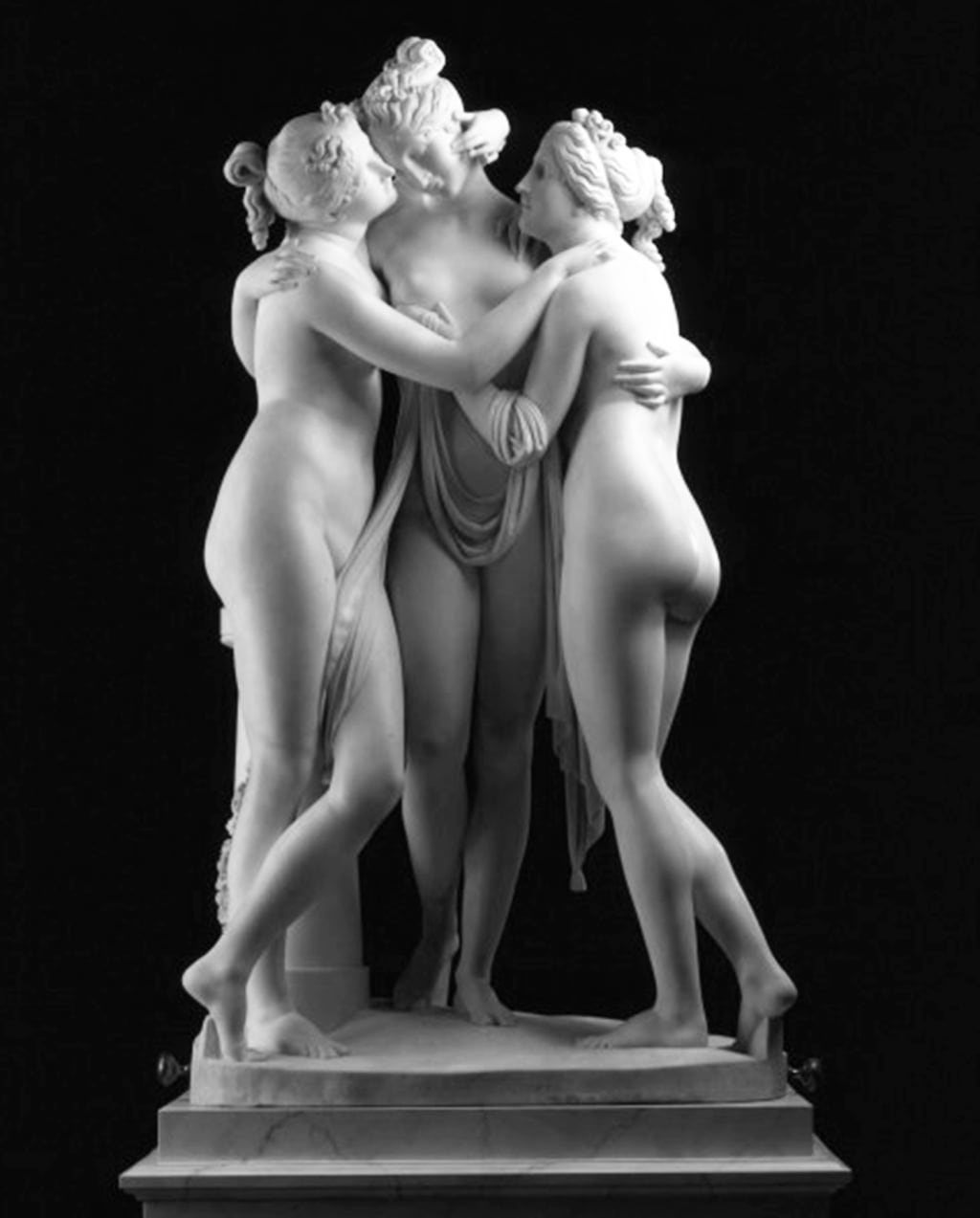
In 1814, the 6th Duke of Bedford, traveled to the art studio Antonio Canova in Rome and was blown away by a neoclassical sculpture done for Napoleon’s Josephine titled “The Three Graces”. It depicted the mythological daughters of Zeus in white Carrara marble. The three nude figures represented Thalia (youth and beauty), Aglaia (elegance) and Euphrosyne (mirth), iconic images of art and literature. The original was sold to the Russians for permanent display at The Hermitage in St. Petersburg and the Duke commissioned a second sculpture for Scotland. Canova also produced a third version, hidden from history for over 200 years, until it appeared for sale on the black market.
Below these notes in blue ink was contact information for an art dealer in Paris. But the page had gotten wet and most of the words were blurred beyond readability.
“Your brothers have only a head for business and making money,” his father had confided that day on the beach, his masculine face illuminated from the sun flashing down off the lighthouse window. “I must have this statue, Roger. It will be our secret.” Jules McWorth had never mentioned The Three Graces again.
“Twenty grand. Not bad little brother.” Terry smiled down at him, his perfect white teeth taunting him as they always did on the basketball court or in the game of life. His chief skill of riding coattails and kissing ass had assured his position in the family business.
“Hadn’t thought much about it,” Roger met his superficial gloating gaze with one steeped in the lessons of hard knocks.
Terry plucked the check from the hand-scripted pages and read the note at the bottom. “For youth, beauty, elegance and mirth… Dad always did have a strange sense of humor.”
“I’m grateful for the notebook,” Roger replied. “Things are transitory. Knowledge is eternal.”
“Philosophy is for the man with full belly and clothes on his back,” Terry mocked his philosophical brother.
“Did you know that Confucius valued human beings over property?” Roger replied.
Terry slipped the check back into its bookmarker position. “Come visit us in Lexington. We have a yearling with Secretariat’s bloodline. It’ll run in the Derby in two years.”
“Only if I can sleep in the stables.”
“Ha-ha,” Terry scoffed. “You remain a hopeless dreamer.”
Roger watched his brother join the others in conviviality and flipped another page in his father’s notebook. As his eyes ran over a detailed hand-drawn schematic he knew exactly what he must do.
* * *
Roger had traveled the world with a backpack, sleeping in hostels or under old stone bridges, working just long enough to earn a stake to get him to his next location. He lumberjacked in Canada and herded mountain goats in Tibet. Sailing through Micronesia as crew on a two-masted schooner he had been kidnapped by pirates, then escaped by jumping into the sea at night and swimming to shore over razor sharp reefs. His intelligence and wit allowed him to sit at eye level with spiritual gurus and won him invitations to dine in castles with robber barons. While his brothers had one years’ experience repeated twenty times, Roger had crammed forty years’ experience into fourteen years.
“An angel rides on your shoulder,” his mother told him when he recounted his adventures. “I love all my sons equally, but you are the special one.”
“I’ve made a lot of mistakes, mother,” Roger confided.
“If you were to eliminate the mistakes you would also lose the knowledge you gained from them,” his mother said with pride. “You understand the richest man is not the one who has the most, but the one who needs the least.”
“‘He for whom the pebble has value must be surrounded with treasures wherever he goes’.”
“Is that your line, Roger?”
“Wish it was. Par Lagerkvist, Swedish author of Sibyl, a modern parable.”
Dolorous McWorth looked deep into his eyes and took her youngest son’s hands in her own. “You can handle anything, Roger. One day you will do something wonderful that will make your father proud.”
* * *
His mother’s words rang in his mind as the bow of his little aluminum boat banged through the breakers, the rotating beacon from the Channel Harbor Lighthouse sweeping over him. Decades of storms had eroded the soft beach Roger knew as a boy and the lighthouse was now surrounded by a collar of rocks. The storm assured none but the foolhardy would venture forth and provided the cover he needed to complete his task.
A rogue wave rose up and crashed down, upturning the skiff and sucking Roger into the dark cold waters of the north Atlantic. His hands fought for purchase. A rough line went around his neck. He grabbed it and hauled himself back to the surface by the float on a lobster trap. Another wave deposited him on the slippery rocks. The twenty-foot climb was treacherous, but he inched up the jagged face toward the unmanned brick spire crowned with the crystal light.
Roger topped the wall and rolled on the grass, lying there a moment to allow his breathing to catch up. He rose and closed the short distance to the heavy wooden door at the base of the lighthouse. It was locked and unmovable. Recalling the drawing he had memorized from his father’s journal, Roger counted ten bricks up from the ground along the right side of the door frame then ten bricks to the right. He tapped on the brick. It moved enough for him to wedge in a finger and find the key.
Inside the lighthouse, Roger made his way up the rusted steel spiral staircase to the top platform. In the center was the great rotating beacon, a xenon lamp encased in a thick lens designed to concentrate the light beam so it could be seen for miles. For 150 years this watchtower had protected ships and given them navigational bearings. It was now maintained under a grant from the McWorth Foundation, a means of giving back to the society that had given Jules McWorth so much success.
The platform was also Jules’ favorite place in the world. He had tended the light as a boy, and it became a place of peace and refuge as he progressed through life. He could sit for hours and watch the beam sweep over the sea and around the bay, illuminating the water and the boats in its care. The lighthouse made Jules feel he was doing something important rather than just making money selling pneumatics. It also satisfied his need for solitude and contemplation where he could fully appreciate youth, beauty, elegance and mirth.
Roger tapped around the wooden base that held the enormous lens until he found the panel indicated in his father’s notebook drawing and pushed the top right corner twice quickly. The panel sprung open, enabling him to spin the turntable and there it was – the white marble statue of “The Three Graces” encased in a silken sheet. Roger carefully pulled the heavy statue from the hidden cavity, unfastened the sheet and unfolded the note tucked within the goddesses.
My dear son. If you are reading this note it means I have passed on and this great art treasure is now in your care. Its provenance has been painstakingly researched and is recorded on the enclosed thumb drive. Below is the name of a collector who is willing to buy “The Three Graces” for whatever you ask. I know you will use the money wisely. Love, Dad.
A tear slid down Roger’s cheek as he folded the note and buttoned it in his pocket. That orphanage in Tibet would now have what it needed to expand its resources and care for the children. All he had to do next was get the statue off the lighthouse island. He peered down through the window as the beacon swept over the sea and land below. The storm had tossed his skiff over the rocks onto the spit of land inside the collar. Roger gently wrapped “The Three Graces” in the sheet and descended the spiral staircase.
About the Creator
Banning Lary
Old Banning has written, edited, published or produced everything imaginable containing words: articles, stories, books, pamphlets, ad copy, documentaries, short films, screenplays and poetry. I love words and read the dictionary for fun.
Keep reading
More stories from Banning Lary and writers in Humans and other communities.
Sam
Had it not snowed that cold November day almost a decade ago, I never would have seen the abandoned puppy some heartless fool had left to God's mercy off Route 55 outside of Lebanon, Kentucky. Nothing is as soothing as whipping past endless miles of land covered with pine and poplar, sun-bleached grays and greens wearing a vast silken bed sheet – evidence of God’s promise worldly things would somehow turn out for the good.
By Banning Lary5 years ago in Humans
Bradley Cooper and the Quiet Weight of a Career Earned Slowly
Bradley Cooper is often described as a movie star, but that label only tells part of the story. What makes him interesting is not just fame or talent, but how long it took for both to fully arrive. His career did not explode overnight. It grew through small roles, awkward risks, public missteps, and quiet persistence. Over time, Bradley Cooper became someone audiences trust to feel deeply on screen. He carries sadness, confusion, love, and regret in ways that feel familiar rather than polished. That honesty is why his work stays with people. To understand Bradley Cooper today, you have to look at the slow road behind him, not just the spotlight he stands in now.
By Muqadas khan3 days ago in Humans


Comments
There are no comments for this story
Be the first to respond and start the conversation.