
Exploring the Unparalleled Discoveries of the James Webb Space Telescope
Unveiling the Unseen
Exploring the Unparalleled Discoveries of the James Webb Space Telescope
The stars have always captivated the human imagination, and our understanding of the vastness of the universe has expanded significantly in recent times. With the advent of the James Webb Space Telescope (JWST), we have been granted an unprecedented glimpse into the cosmos, leading to groundbreaking discoveries that surpass even our wildest expectations. In this article, we will delve into the remarkable findings of the JWST and explore how these revelations reshape our understanding of the universe.
1. Unveiling the Unseen
The JWST, often hailed as a game changer in the field of astronomy, has revolutionized our ability to observe celestial objects. Since its launch in December 2021, this joint project between NASA, the European Space Agency (ESA), and the Canadian Space Agency (CSA) has been pushing the boundaries of space exploration. Its state-of-the-art infrared vision has allowed scientists to penetrate the veils of cosmic mysteries, revealing sights never before seen by human eyes.
2. Peering Through Titan's Veil
One of the JWST's groundbreaking achievements was its penetration of Titan's murky atmosphere using its infrared capabilities. In this endeavor, the telescope unveiled a methane sea, sand dunes, and clouds on Saturn's largest moon. These discoveries shed light on the complex composition and geology of this enigmatic celestial body.
3. Unveiling the Depths of the Universe
The JWST has captured breathtaking photographs of distant galaxies, some of which date back to less than 500 million years after the Big Bang. These vivid and detailed images provide a glimpse into the early stages of galactic evolution and offer valuable insights into the formation and development of the universe itself.
4. Exceeding Expectations
Neil deGrasse Tyson, the renowned American astrophysicist, expressed his awe at the JWST's performance, stating that it has surpassed all expectations. The telescope has successfully met the specifications set by its designers, allowing us to witness the universe in a whole new light. With its ability to detect infrared light, the JWST has unveiled hidden galaxies, revealed previously obscured details, and expanded our understanding of cosmic phenomena.
5. Illuminating the Infrared Universe
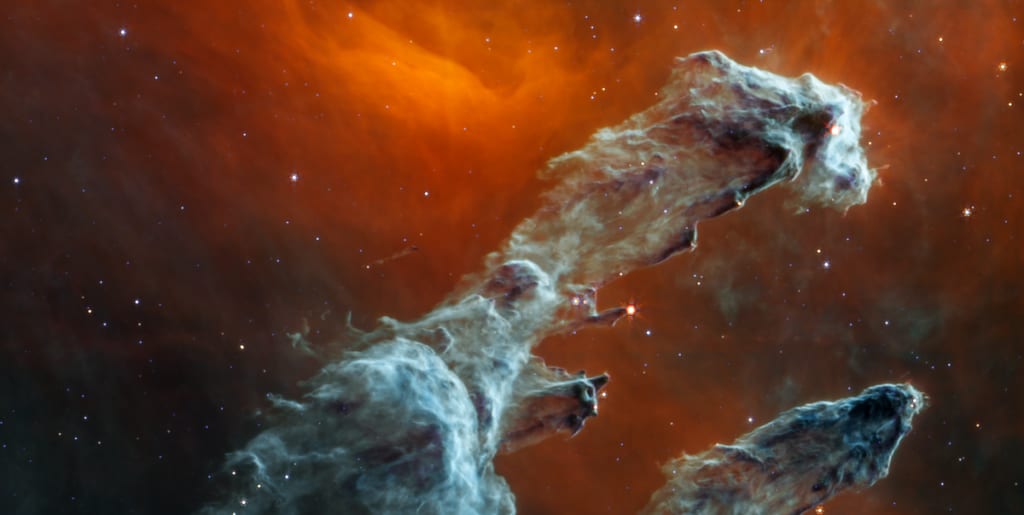
Unlike human vision, which is limited to a narrow range of the electromagnetic spectrum, the JWST's infrared vision opens up a vast realm of celestial wonders. By translating infrared colors into visible light, the telescope enables us to perceive galaxies, stars, and other cosmic objects that were once concealed behind dust clouds or existing in the infrared part of the spectrum.
6. Witnessing the Dawn of Time
One of the most awe-inspiring aspects of the JWST's discoveries is the ability to observe galaxies from the universe's infancy. As light from these ancient galaxies has traveled for billions of years, we are effectively witnessing the birth of stars and the formation of galaxies in their earliest stages. These remarkable observations provide invaluable insights into the origins and evolution of the cosmos.
7. Probing the Mysteries of the Early Cosmos
The JWST's observations challenge our existing theories about the early universe. The detection of ancient red stars in distant galaxies contradicts previous models and raises questions about the mechanisms of galaxy formation. Scientists are now grappling with the task of reevaluating their understanding of cosmic evolution and developing new theories to account for these unprecedented findings.
8. Opening New Avenues of Research
The JWST's powerful imaging capabilities have not only transformed our understanding of distant galaxies but also opened up new avenues of research in various fields of astronomy. By peering into the depths of the universe with its infrared vision, the telescope has enabled scientists to study the formation of stars, planetary systems, and even the potential for habitable environments beyond our solar system. It has provided valuable data for studying exoplanets, their atmospheres, and the possibility of life beyond Earth.
9. Unraveling the Secrets of Exoplanets
Exoplanets, planets that orbit stars outside our solar system, have long intrigued scientists as potential candidates for extraterrestrial life. The JWST has been instrumental in advancing our knowledge of exoplanets by analyzing their atmospheres. By observing the way light passes through the atmosphere of an exoplanet during a transit, scientists can deduce the composition of gases present, including signs of life-supporting elements like oxygen, water vapor, and methane. These observations contribute significantly to the search for habitable worlds beyond our own.
10. Proving the Existence of Water
Water is a crucial ingredient for life as we know it, and the JWST has played a key role in detecting water in distant celestial bodies. By studying the infrared spectrum, the telescope has identified water vapor signatures in the atmospheres of exoplanets and even in regions of star formation within our own galaxy. These findings deepen our understanding of the prevalence of water in the universe and provide insights into the potential for habitability in other planetary systems.
11. Unveiling Stellar Nurseries
Stars are born in dense regions of gas and dust known as stellar nurseries. The JWST's infrared vision allows scientists to peer through these dusty regions, providing a clearer view of the processes involved in star formation. By studying the structure and composition of stellar nurseries, researchers can gain insights into the conditions necessary for the birth of new stars and the evolution of galaxies over time.
12. Paving the Way for Future Missions
The success of the JWST has paved the way for future space missions and telescopes. Its groundbreaking discoveries and technological advancements have inspired scientists and engineers to develop even more advanced instruments for space exploration. The knowledge gained from the JWST's observations will shape the design and objectives of future telescopes, enabling us to delve deeper into the mysteries of the universe.
13. Inspiring the Next Generation
The JWST's discoveries have captured the imagination of people around the world, inspiring a new generation of astronomers and space enthusiasts. Its remarkable achievements serve as a reminder of the vastness and beauty of the cosmos, igniting curiosity and wonder about our place in the universe. The telescope's ability to push the boundaries of our knowledge motivates aspiring scientists to pursue careers in space exploration, ensuring that the quest for understanding continues for years to come.
Conclusion
The James Webb Space Telescope has ushered in a new era of space exploration, unveiling unseen wonders and challenging our understanding of the universe. Its powerful infrared vision has allowed us to witness the birth of stars, explore distant galaxies, and search for signs of life beyond Earth. The discoveries made by the JWST have not only expanded our knowledge but have also inspired future missions and ignited a passion for space exploration. As the telescope continues to unravel the mysteries of the cosmos, we eagerly anticipate the groundbreaking revelations that lie ahead.
About the Creator
Keep reading
More stories from Sajjad Rana Hussain and writers in Humans and other communities.
Sex with Spirits
Sex with Spirits: Exploring the Phenomenon Hey everyone, thanks for popping in! Today, we're going to delve into a hot topic that has been making waves on the internet. I've been asked about it quite a few times, and I've noticed other psychics being asked the same question. We're going to talk about sex with spirits. Yes, you heard that right! It's a fascinating subject, and I'm here to shed some light on it. So, buckle up and let's explore the intriguing world of spiritual encounters.
By Sajjad Rana Hussain3 years ago in Humans
My First Time Skiing and I Got Lost, Alone, in the French Alps
Looking back, I can trace some of my life’s biggest adventures to a simple action from my sister. She’d introduced me to Tommy (a very long time ago), a colleague of hers, who had overshared his penchant for Italian-looking women, and I ticked that box.
By Chantal Christie Weiss2 days ago in Humans
How To Recover Motivation After Disappointing Dating Experiences Recently
The disappointment that comes with dating may make a single person discouraged, frustrated, or even exhausted. In case relationships are not formed as anticipated then one would wonder what it is that he/she chose to do, or to begin losing the desire to know people. The disregard of such emotions can lead to their accumulation and influence confidence.
By Robert Smitha day ago in Humans




Comments
There are no comments for this story
Be the first to respond and start the conversation.