

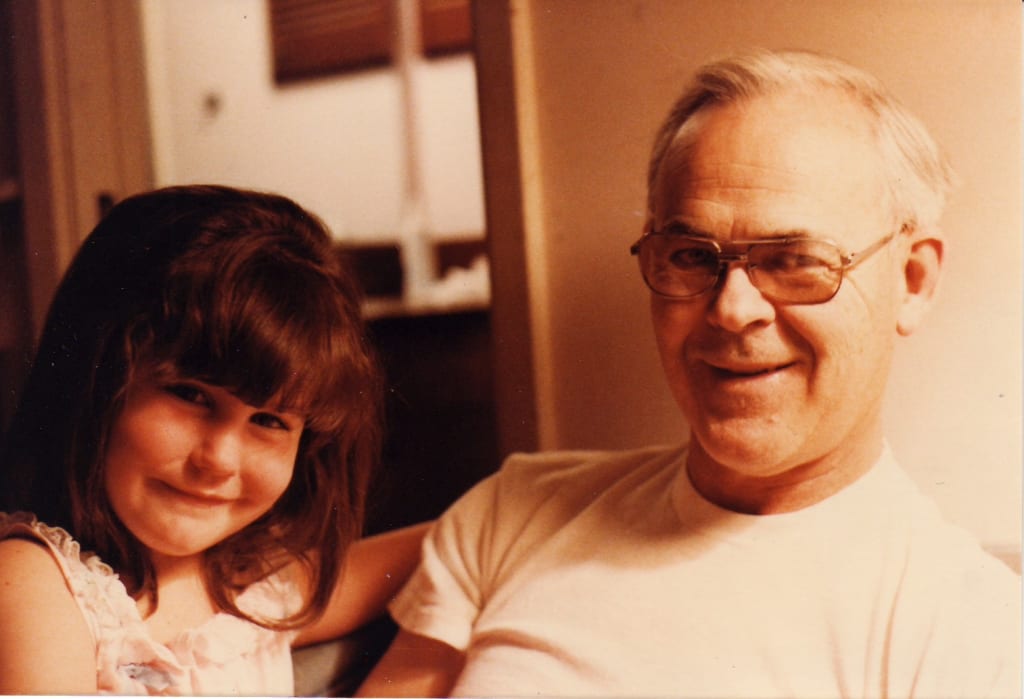
If I stood on the tips of my toes, I was just tall enough to peek through the windows of the double doors that led from the back kennel to the examination room. I could see my father in his green scrubs, firmly holding down a squirming ball of fluffy curls. I heard the dog’s whines from behind the door, but didn’t understand; shouldn’t a veterinarian be making it feel better? My father’s face was set with determination as he plunged a syringe deep into the fur. His firm hold on the dog’s chest gentled as its kicking legs slowly stilled. My father’s hands, so big and powerful, waited until there was absolute silence in the room.
Urine pooled under the dog before spilling over the side of the examination table. Surely this meant that the dog was going to be all right after all. Pushing open one of the doors, I looked hopefully up at my father.
“Daddy?”
My father’s anger took me off guard as he snapped his head around, his hazel eyes flashing behind his glasses.
“I told you to stay in the back. I told you not to come in here.”
His voice was tense and hoarse. When he was angry, his voice sounded constricted more than loud. That’s what scared me: how much he was holding back.
Leaving the dog on the table, he stomped over, grabbed my arm, yanked me back into the kennel room and slammed the door shut. This time, I didn’t open that door. I didn’t move. I cried silently while my father disposed of the dog's body in the crematorium furnace. His footsteps were quick and heavy; I listened to them with fear and shame cascading down my cheeks as I huddled against the kennel cages. I focused on the drain in the adjoining grooming room, counting the holes in the metal. My father rarely showed his anger, usually seeming cheerful, calm, perhaps distant with thought. But his anger was a beast no one wished to wake, and I’d done just that.
His footsteps crunched in the gravel outside when he returned from the crematorium, and he opened the door to the kennel. He stood awkwardly in front of me as I dealt with the mess of tears and snot on my own. Pulling out his well-worn handkerchief, he handed it to me as he crouched down beside me. He still hadn’t said a word since his return.
“Is the doggie ok? Did you make it better?”
Despite his anger, this was still my foremost concern. I was scared I’d done something to interrupt him and made things worse.
Picking me up, my father carried me into the examination room that doubled as his work kitchen. Pulling an underripe pear from the same mint green fridge that housed animal urine and fecal samples, he sliced it up as he grappled with his thoughts. Placing several fruit slices onto a paper towel, he handed them to me as he munched on some as well. I’m not sure if that was when I started hating pears or if I’d always thought they tasted like handfuls of sand.
Swallowing the last of his pear, he finally explained calmly, “That dog was sick. He was going to die, but first he was going to get even worse and be in a lot of pain. Sometimes I have to let them die before they get sicker,” he said. Nodding to emphasize his justification, he added, “It’s the humane thing to do.”
I was too young to understand what “humane” meant, but I nodded as if I did.
Washing his hands and cleaning up the steak knife he kept for cutting fruit, he cleared his throat. “How about we go pick some pecans out front?”
His anger was gone, swallowed with the pear slices. His face now held the familiar, gentle smile I knew. He held out his hand — the big, powerful hand that felt safe. I took it, and we went outside the front of the clinic to pick up pecans that fell from the trees.
*******
Two and a half decades later, I was reading Twelfth Night as my father moaned in misery and despair beside me. I’d always heard the cliché of “the stench of death,” but it was the first time I’d experienced it – it was coming from his mouth. Each awful rattle that seemed it would surely be the last blew a sharp, putrid odor into the room. I’d read the same line for half an hour because I was afraid to look up. He was slipping in and out of consciousness, and the moans got much louder when his awareness strengthened. I forced myself to look at him as I placed my hand over his, patted it awkwardly and whispered, “It’s okay.”
I knew it was absurd, and nothing was okay, but what else was there to say? Our conversations had always been based on silence; this one was no different. Death would not give us more words.
Only his right eye was able to open to a tiny slit; at its corner, a single tear hovered in the deep wrinkle of his eyelid as he looked at me. It was as if he was trying to memorize every detail of my face in the ghastly yellow fluorescent light coming from the single bulb beside the bed. It was 1am, and my mother was due to arrive shortly. I refused to leave him until she got there because I knew it was time. Three weeks of kissing him goodbye every day, thinking that would be the last time.
My mother slipped in and took my place, and we spoke softly as I agreed to go home to walk my dog and take a nap before coming back.
“But I’m going to kiss my Daddy, first.” I tried to smile as I did so, and quickly left, glad there were no windows to look back into. Every night I told him I loved him – except that night. I don’t know why. Perhaps because we’d always said more with silence to each other.
It was 3am when my phone rang and penetrated my brief sleep.
My mother’s voice sounded lost and surprised.
“Amy? He’s gone.”
“I’ll be right there.”
The streets were so familiar and yet everything looked so strange. What was a world without my father in it? He’d been sick for so long, he had suffered so much, and yet I felt so oddly unprepared.
“My father is dead.” I kept repeating the thought in my head, rehearsing saying it out loud for the first time. It sounded so strange.
After being grilled by the security officer and having him be the first to know that my father had just died, I was let back into the hospital a few moments later. Approaching his room, the same room I’d seen him wither away in for three weeks, tied down, yelling, suffering, his mind destroyed by dementia, my mother greeted me with relief. I embraced her and let her sob on my shoulder.
“It was so weird,” she said, “He just… stopped breathing. I had to get the nurse to make sure. But it was peaceful, and I was holding his hand.”
My father’s forehead, which had been burning with fever and sweat, was still cooling but just warm enough that it seemed like he might wake up at any moment. I kissed it, just as I had two hours before. I looked at his beloved face, now serene, his eyebrows knit together slightly. His suffering was now over.
“Praise Jesus,” I whispered. “The lord is merciful.”
My mother looked surprised at my comments, as I’m not known for being religious, but she didn’t say anything.
We stood together in awkward silence for a moment, unsure of what to do. We were both a mess of tears and snot. My mother told me he’d slipped into a coma right after I’d left, and it hadn’t taken long after that. I realized I was the last thing he saw before he died, since his eyes closed after I kissed his forehead.
Gathering our things, we started to leave.
When I looked over at his body, I saw him through the windows in the veterinary clinic door -- the man in green scrubs who was furious that he was powerless to protect his daughter from the painful reality of death.
He waited until I after left to die. Even in the throes of dementia, he was protecting me from witnessing his passing. There was nothing humane about his illness, the treatment he received during his illness, or how our medical system is set up to handle it. He lived out his worst nightmare and I had to watch it, something he never wanted. That was the fear, the anger that raged inside him.
He was able to do for animals what we cannot for humans: give them dignity and peace in their final moments.
About the Creator
Keep reading
More stories from writers in Humans and other communities.
I Don't Need My Phone... Wait, Is That Actually True?
My parents gave me my first cell phone when I was twelve years old. It wasn't a fancy iPhone or anything, not even close. Just a simple black flip phone for when I needed to call or text them after school.
By Madison "Maddy" Newton3 days ago in Humans
How To Avoid Emotional Burnout While Searching For A Genuine Partner
Finding a real partner may be a challenging process that is accompanied by emotions, although dating can be exciting. The lack of fulfilment, incompatibility of intentions, and daily attempts to have contact with each other may result in emotional exhaustion or burnout. Dating may be exhausting, low-self-esteem, and cause cynicism towards relationships due to emotional burnout. One should learn to balance optimism, work, and self-care to be energetic and enthusiastic in the process of finding a meaningful relationship. Single people are able to safeguard their emotional well-being and still find real partners by being deliberate in their dating and setting limits.
By Grace Smith5 days ago in Humans
Bartender
On the heels of grief, pain bears down hard. On the heels of death, pain awakens the quiet place between the end of our own life and now. Feeling anything is like seeing a film and in black and white, slow motion, all sound turned off. Just watching. Gritting teeth, awkward smiles and bloody red eyes move around, scanning the others who are feeling something I don't want to feel, but I do. Escapism is all I have ever known. ~
By ROCK aka Andrea Polla (Simmons)5 days ago in Poets


Comments
There are no comments for this story
Be the first to respond and start the conversation.