
ESCORT OR COURTESAN?
"The more I saw her, the more she enchanted me"
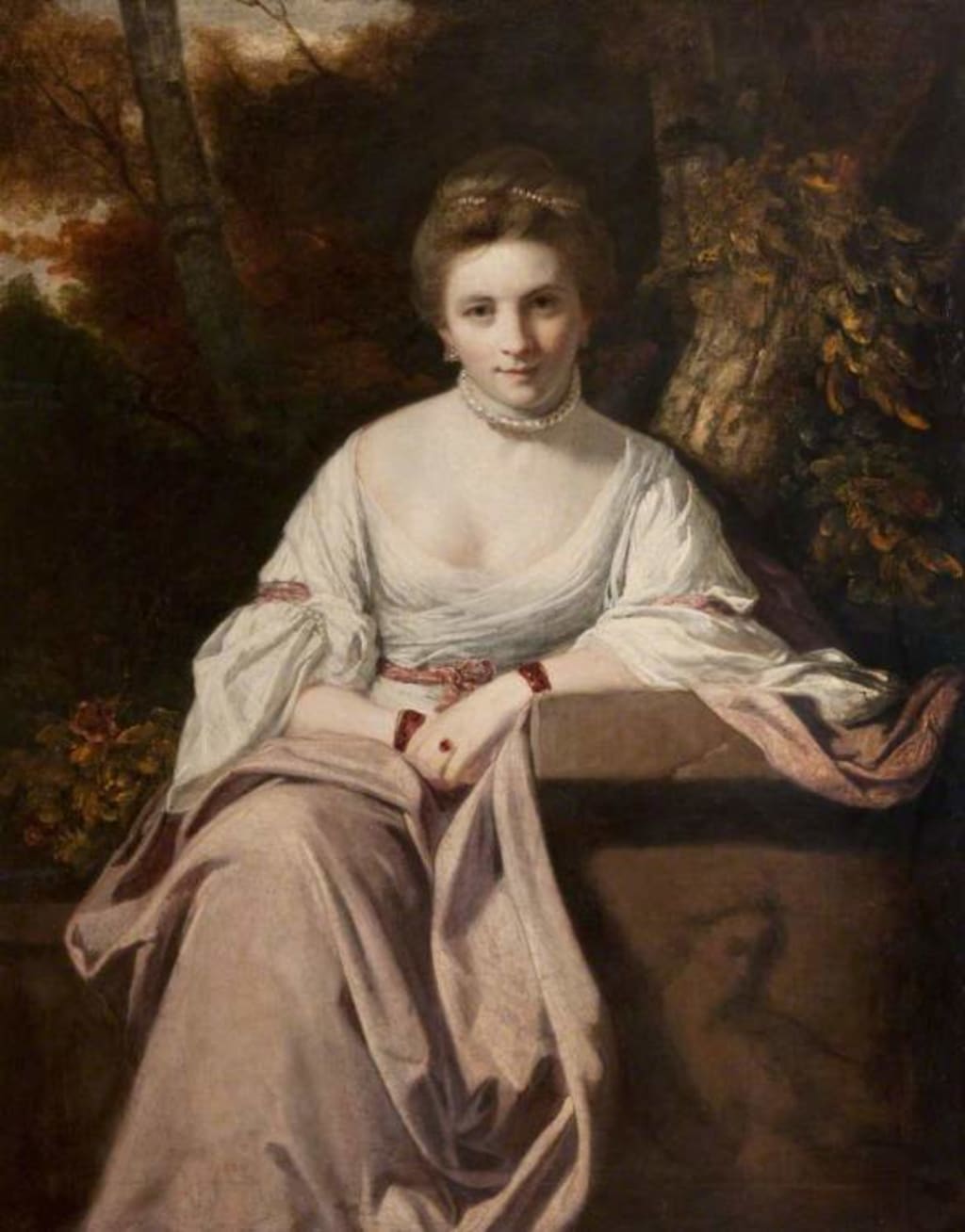
Today we know them as “Escorts”. In the 18th Century they were called “Courtesans”. They held fashion in the palms of their hands, as well as the men, and women copied these leading ladies of fashion. They came from all walks of life, some rising to great wealth, some dying in poverty. Whichever Era we live in, they are ‘classed’ as the same thing — “Prostitutes”.
Even in the Georgian Era, those who could afford it followed the fashionable ladies of the day and some came from a very unusual place. They were never out of the newspapers and were the most famous “celebrities” of the time. Some were ‘labeled’ as Courtesans, others as Mistresses, still others as Harlots and lastly as Whores. The difference between a courtesan and a whore is that a courtesan got paid for her company (as well as for having sex).
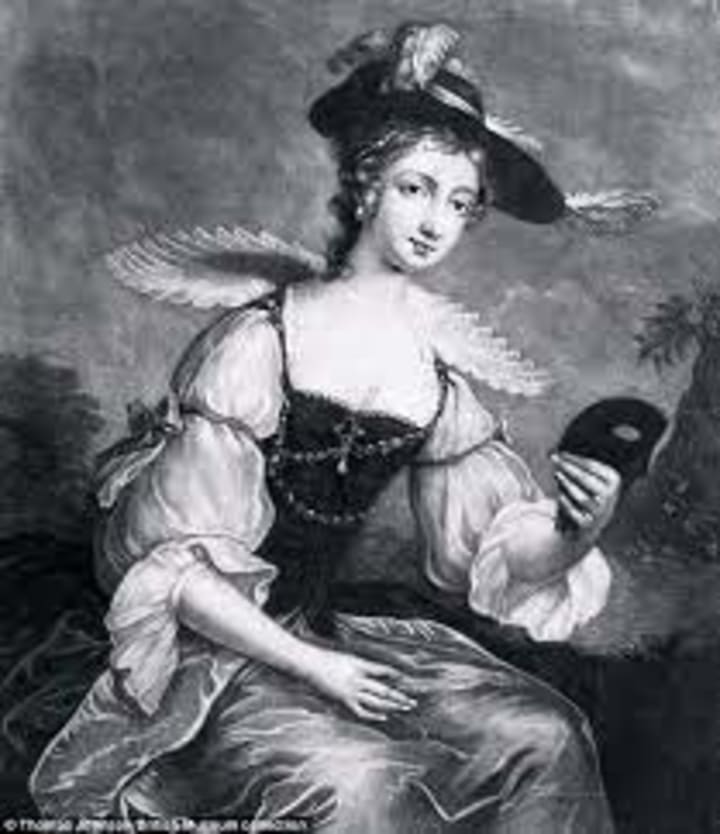
Fanny Murray (yes, this was her real name) was one such “leading lady”. Fanny was born around 1729 in Bath, and her father was a traveling musician called Rudman. When both of Fanny’s parents died, she was only twelve years of age and she had to live as a flower-seller, selling flowers on the streets (in Bath), near the Abbey and outside the Assembly Rooms. Being so young, attractive and on her own, Fanny was bound to attract unwanted attention. Jack Spencer was the grandson of the Duchess of Marlborough, known philanderer, and he thought the seduction of such a young girl to be a bit of fun. Once he had deflowered Fanny though, he left her to defend for herself. A Captain in the Army quickly took his place but again, left Fanny alone.
At fourteen years of age, Fanny became the mistress of the sixty-six year old Beau Nash, who ‘taught’ her about the finer things of life. Moving to London, however, Fanny became a “dress-lodger” — an apprenticed prostitute who had to work to pay for the very expensive dresses that she wore to solicit the male customers. Once she had paid off her ‘debt’, Fanny worked for herself, as a prostitute, but she remained poor. A famous pimp from Covent Gardens, Jack Harris, noticed Fanny, had here examined by a surgeon to see if she was clear of venereal disease (which Fanny had to pay a £20 deposit for), and put her name down in a book “Harris’s List of Covent Garden Ladies”, a book which told ‘clients’ that these ladies/women were clean from disease. Fanny appeared in this book as a new face, “fit for high keeping with a Jewish merchant”.
This shot Fanny to fame and she was known as the “Toast of the Town” by the end of her teenage years. The central character in “Memoirs of a Woman of Pleasure” by John Cleland, was called Fanny Hill and it was said that she was based on Fanny. Now Fanny Murray was constantly in the news. Prints of Fanny, which were done by Mezzotint, were bought by thousands of men and Fanny became one of the original ‘pin-up’ girls. She became available only to the very rich and was now one of the leading ‘ladies’ of fashion.
Becoming the mistress of John Montagu, the Fourth Earl of Sandwich, Fanny was involved in all sorts of debauched parties and orgies. However, at the age of twenty-seven Fanny had run up immense debts and she was sent to a “sponging house” (a temporary place for debtors, similar to prison). All of her ‘gallant’ customers had deserted Fanny and she faced poverty. Hearing that the son of the man who had first seduced her, John Spencer, was getting married, Fanny wrote a begging letter, explaining to the son what his father had done. Managing to manipulate the son, Fanny received £200 a year and was introduced to the actor David Ross.
The couple fell in love and married in 1757. The marriage appeared to be a happy one, with Fanny ‘turning over a new leaf’ and leading a blameless life as a wife. The couple were married for twenty years before Fanny died at forty-nine years of age. A happy outcome, perhaps it was what Fanny wanted from the beginning of her life, to be an ordinary wife.
Mary Darby was born in 1757, in Bristol, and her father was a naval captain, Nicholas Darby. He deserted Hester (Mary’s mother) for a mistress, and Hester started a school for young girls in order to support her five children. However, Darby (Mary’s father) had the school closed down but he died in the Russian naval service in 1785.
Hester encouraged her daughter to marry an articled clerk, Thomas Robinson, because he claimed to have an inheritance. Mary was against the idea, but seeing how he cared for her and her younger brother, Mary followed her mother’s advice and married him. After marrying Thomas, Mary found out that her new husband did not have any inheritance and that he liked to live ‘an elaborate lifestyle’, not even bothering to hide his multiple affairs. Mary gave birth to their only daughter, Mary Elizabeth, and even took the six month old baby with her when the couple were imprisoned in the Fleet Prison. Thomas had been arrested for debt. It was here that Mary started her ‘career’ in poetry, publishing her first book “Poems by Mrs.Robinson” in 1775. The money from the books supported her family because her husband refused to work. Mary found a patron in Georgiana Cavendish, Duchess of Devonshire, who sponsored her second volume of poems titled “Captivity”.
When Thomas was released from prison, Mary decided to go into the theater, performing in many of Shakespeare’s plays. Mary quickly became a popular actress and caught the ‘eye’ of the Prince of Wales (the future King George IV). The very young Emma, Lady Hamilton, sometimes worked as Mary’s maid and dresser, at the theater, at this time.
Mary was now becoming a leading ‘lady’ of fashion and introduced a loose, flowing muslin style of gown which was baked on the Grecian style which became known as the “Perdita”. The Prince of Wales ‘offered’ Mary £20,000 to become his mistress. It took her a long time to make the decision to leave her husband because Mary did not want to be perceived as “that type of woman”. Thinking that the Prince would treat her in a better way, Mary left her husband.
However, the Prince ended the affair and refused to pay the sum he had offered Mary. Mary ended up settling with £5000, with the promise of an annuity, in exchange for the Prince’s love letters. Mary was now becoming famous for her ‘smart’ carriage rides. She became involved in politics, becoming an ardent Whig supporter, and Mary was soon propositioned by several ‘gentlemen’, including George Fitzgerald. Mary’s poetry became influenced by the Whigs.
Mary met the love of her life, Colonel Banastre Tarleton, in 1782, and their affair lasted until 1797. It was a passionate affair but stormy, and when Mary became pregnant she feared that Tarleton would desert her and the baby. Chasing him through the night, Mary lost the baby and became so ill with rheumatic fever that she was lame for the rest of her life. Tarleton left Mary for an heiress of £20,000, Susan Bertie.
Mary’s illness forced her to live a new way of life and so she soon dedicated her life to writing. Mary wrote several books and poems which were published: “The World”, “The Oracle” and “The Morning Post” being just three. Living with her daughter at Englefield Cottage, in Old Windsor, Mary had a small circle of intimate and loyal friends.
Mary died on 26th December, 1800, with only two people attending the funeral, John Wolcot and William Godwin. A sad and lonely end for such a talented woman. Did Mary also just want a ‘normal’ life?

Kitty Fisher was a Georgian “A-list Star” who died before she was thirty. Kitty was famous, ostentatious and she packed a lot into a few young years. Being born in Soho, London, in 1741, it is almost impossible to separate the myth from the truth. Her image was famous but as a woman, Kitty was almost unknown. Being originally a milliner (according to some sources) Kitty was introduced to London’s high life (either by commodore Augustus Keppel or lieutenant-general Anthony George Martin).
Kitty quickly realized that she had a flair for publicity and became known for her affairs with wealthy men. Her fashion was soon ‘scrutinized’ and Kitty became one of the leading ‘ladies’ of fashion. She was one of the first ‘pin-up’ girls and her fame spread throughout Europe. The famous Italian Giacomo Casanova, while visiting London, commented: “the illustrious Kitty Fisher, who was just beginning to be fashionable. She was magnificently dressed, and it is no exaggeration to say that she had on diamonds worth five hundred thousand francs. Goudar told me that if I liked I might have her then and there for ten guineas”. Like so many stories, we don’t actually know if this is true but it does give an insight into the world in which Kitty was now living and moving.
Her famous rivalry was with Maria Gunning, who had raised her status by marrying Lord Coventry, thus becoming Lady Coventry and Kitty’s social superior. It came out later that Lord Coventry had had an affair with Kitty and thus continued the rivalry (on a whole different level!). “The other day they ran into each other in the park and Lady Coventry asked Kitty the name of the dressmaker who had made her dress. Kitty Fisher answered she had better ask Lord Coventry as he had given her the dress as a gift”. (Wynne) A lovely piece of gossip!
Kitty married John Norris, who was the son of the MP for Rye, and settled into married life, becoming a generous mistress to the poor. However, after only four months of being married, Kitty died of smallpox or consumption in 1767. Kitty was buried in her best ball gown. It seemed sad that when Kitty had just settled down, death took her.

These are only three of the famous Courtesans of the Georgian Era. One can see why they lived that “kind” of life as it was better than working every hour and remaining in poverty. The glamor of the high lifestyle and the beautiful dresses and jewels maybe made it all worthwhile to these women? All they seemed to actually want was to settle down in marriage and have a ‘normal’ life. An interesting thought!
If you enjoyed reading this article, please feel free to like / subscribe or leave a tip or even go over to my website where my other articles on the Georgian Era are: https://sarah-s-story-book.webnode.co.uk/
About the Creator
Ruth Elizabeth Stiff
I love all things Earthy and Self-Help
History is one of my favourite subjects and I love to write short fiction
Research is so interesting for me too
Keep reading
More stories from Ruth Elizabeth Stiff and writers in Humans and other communities.
"Coming Out"
When a young lady “came out” in the Victorian and Edwardian Eras, it meant something quite different to how the generation understands those words today. For a young lady, who was born into a wealthy family, it was one of the most important events in her life. It represented her change in ‘status’ from a child to an adult and it ‘introduced’ her to society. This occurred (usually) between her 15 and 18th birthday and ‘showed’ that the young lady was ready to marry. Before this, she was always in the school room, rarely going out to parties.
By Ruth Elizabeth Stiff4 years ago in Humans
The River That Ate the City: How a Calculated Decision Poisoned Flint, and the Outsiders Who Forced the World to See It
The definitive true story of the Flint Water Crisis, the failure of corrosion control, and the engineers and doctors like Dr. Marc Edwards and Dr. Mona Hanna-Attisha who exposed the poisoning of an American city.
By Frank Massey 4 days ago in Humans
The Ritual of Winter Challenge Winners
Welcome to the Winners Announcement for The Ritual of Winter challenge. This prompt focused on winter rituals and the meaning that settles into them over time. The top pieces stay grounded in ordinary acts and repeated routines, letting winter shape the work through pace, attention, and restraint.
By Vocal Curation Team4 days ago in Resources


Comments
There are no comments for this story
Be the first to respond and start the conversation.