
End Notes
A short story of a little black notebook
We first meet Pat as he emerges from the Wall Street stop of the Number 2 train, making a right turn and entering the shadowed canyon of Wall Street. He deftly dodges early morning tourists standing still in front of the Stock Exchange, armed with cameras and phones on the ends of selfie sticks and oblivious to the dirty looks being thrown their way. He pauses in front of his usual breakfast spot, a small deli on the ground floor of the building opposite his office. The enticing smell of butter, and toasting bread wafts out from the open glass doors. The queue to the counter is surprisingly short and, on a regular day, this would have been more than enough incentive to enter and order his usual fried egg and cheese on white toast. But today Pat—full name Patricio N. Go—hesitates, unsure whether to spend three dollars and seventy-five cents on a breakfast sandwich. He hesitates because today he woke up a full hour early to dress and leave the house to avoid speaking to his girlfriend, who is moving out. While he’s determined to start saving more money—rent on his own could be doable if he’s careful, and he’d rather live out in Jersey than have to share an apartment with strangers—he knows that staying away from home until Gemma leaves for good means spending some time and money at a café or bar after work. In the end, the scent overpowers him. He gives in.
Hot sandwich in hand, he rides the thirteen floors up to his office, a large architectural firm that specializes in designing other offices. He nods at the girl behind the reception desk and wordlessly makes his way to the break room. He snags a cup of coffee (mediocre but free) before settling down at his desk for another day of drawing bathroom plans. This was part of the reason why Gemma was leaving. She accused him of having little to no ambition. But, unlike her job at her father’s best friend’s PR firm, he couldn’t simply bluster his way up. Gemma didn’t understand that in order to even apply for an architectural license he had to have so many hours of experience under his belt, and that experience often began with that least exciting of all architectural drawing tasks: toilet partitions.
He was in the middle of measuring the correct width of an accessible restroom stall when his boss arrived. Theo looked like the quintessential architect: softly graying hair, thickly framed round Corbusier glasses and black turtleneck over gray wool slacks, and had watched too many reruns of Mad Men. Theo gave the younger man an approving pat on the shoulder.
“Up and at ‘em early, Pat?” he said in his loud basso profundo. “Good man.”
Growing up in the Philippines, our hero had gone solely by the family nickname “Trick”, a name he had been especially proud of in his high school years because it seemed to intrigue all the Catholic school girls. Coming to the U.S. for college, he’d chosen to go by Pat, rather than Patricio or Patrick. None of these still felt like his name, but it was something he learned to live with.
“Listen,” Theo says, sitting on the edge of the next desk, tossing his black leather man purse carelessly next to him. Its gleaming gold logo winks mockingly at Pat. “I have a pair of tickets to that special exhibition at the Guggenheim—the one with that weird woman who just sits there and looks at you. My wife had a work thing come up at the last minute and she’d kill me if I went without her. Something about needing experiences like this to be shared… anyway, would you like to take them off my hands? You could take that lovely girlfriend of yours.”
Pat tries to keep a neutral expression, despite the twin feelings of shame and worry swimming dangerously close to the surface. “Well—“ he starts, knowing the coveted tickets command a hefty price.
“Please just take them—they came with our memberships and I’d hate to see them go to waste,” Theo leans in and grins, “or to someone less dedicated to his job.”
Pat now has to keep excitement from his face and voice. “Then I’d love to. Thank you.”
“Splendid! I’m sure you’ll have a wonderful time,” Theo says, folding back the supple leather flap of his bag to retrieve a white envelope. He drops the envelope onto Pat’s desktop and, with another forceful slap on Pat’s back, Theo lopes off towards his corner office, designer sneakers squeaking loudly on the polished concrete.
Pat nearly crosses himself, amazed at his good fortune. He felt better, having something to look forward to rather than sitting forlornly at a bar and drinking alone. And not just any old something: Rania Gilenova’s performance piece “The Gaze”. Gilenova had first performed this piece in Paris. The performance consisted of her sitting at a table for two, hands folded neatly in front of a small black notebook. One by one, guests came to sit at the chair opposite her. Silently, the artist would reach out, palms upturned. The guest would place their hands in hers, and the artist would simply hold their gaze for however long she deemed necessary. Guests’ reactions to this part of the performance ran the emotional gamut from embarrassment to sudden bursts of tears and sobbing. After releasing them from her stare, Gilenova would leaf through the black notebook and, finding the appropriate page, rip it out and hand it to her guest. No one ever revealed what message they received from Gilenova; it felt like some sacred secret pact both parties entered into when they touched hands. Even Paris’s most jaded critics heaped praises.
New York tickets had sold out in the same day they were released, and are being sold for over $200 on Craigslist. Pat momentarily thinks about selling the other ticket, but decided against it. It seems poor manners to sell something that had been given so freely. If he called Gemma and told her about them, she would probably go, but that would end messily. He puts the tickets in his backpack instead, willing himself to forget about them until after work.
At five-thirty on the dot, Pat saves his impeccably laid out restroom stalls and turns off his computer. He rarely leaves on time, the optics of staying late always went in your favor when yearly reviews came around. As he looks up he sees Theo watching him from his office and pauses. The older man smiles and gives him a thumbs up before waving him off.
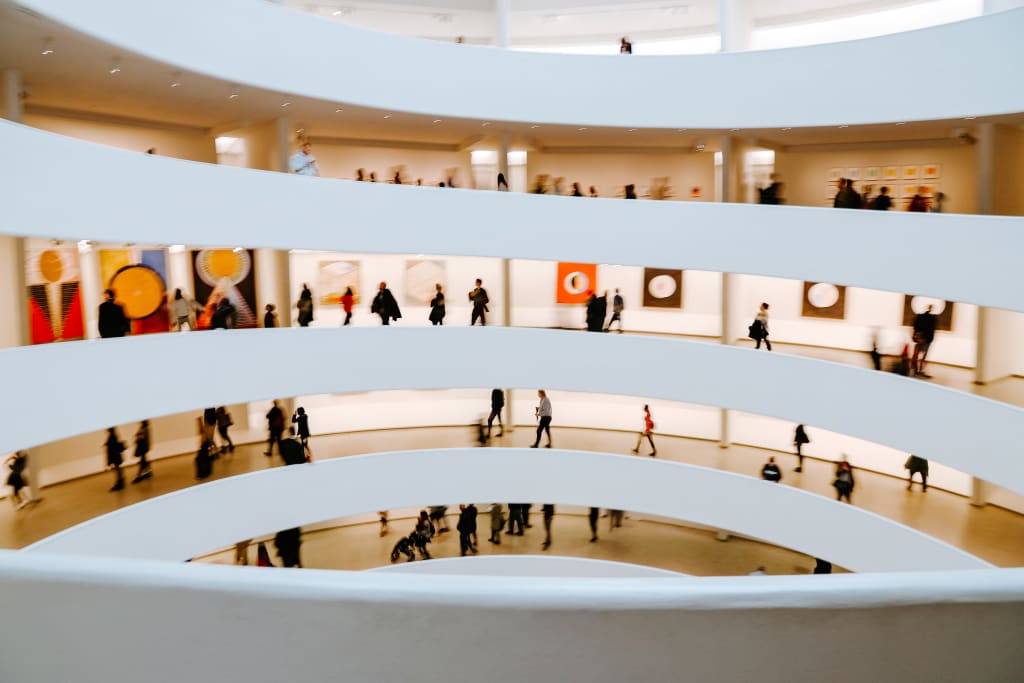
The line outside the museum stretches halfway around the block, even for ticket holders. Pat supposes he should be grateful that it is early October, when the air is comfortable enough with just a light jacket on. He makes sure the tickets are still in his backpack and places them in his jacket pocket along with his phone. The line shuffles forward at a slow but regular pace, and a little under an hour later Pat finds himself inside the circular foyer. He leans over to catch a small glimpse of Gilenova, unmistakable in a diaphanous bright yellow gown that grazes the floor. He shows his ticket to the jacketed docent and surrenders his backpack to a guard, who exchanges it for a hard plastic chip with a number. At this point in the line, warnings in several languages are posted showing phones and cameras with a sinister red bar through them, letting guests know photos and video recordings are prohibited.
As the line before him grows shorter, Pat feels a nagging sense of unease seep from his belly. He can’t quite figure out why he suddenly wants to turn on his heels and leave. The soft sobs coming from the center of the foyer are not encouraging. Maybe this was a bad idea, he tells himself. No, it’s just an emotional day, get over it, he counters. It’s a free way to kill time and, if this whole performance thing is a bust, you can still wander around the museum for an hour. With only one person in front of him, Pat gets a better look at Gilenova, whose long dark hair hangs loose over her shoulders. The man across from her removes his wool cap, his face round and friendly, his suit a little tight around his middle. Pat watches her take the man’s hands and hold them aloft. The man sits up straighter in his chair, as if steeling himself for something. After a minute or so of excruciating silence, she releases his hands and opens the notebook. She finds a page, pauses, then returns to her leafing before finding another and tearing it out. She slides it across the table, her expression unchanging. The man, now quite red-faced, quickly stuffs it into his pocket, grunts a thank you, and scurries out.
The man in front of Pat turns to him and gives him a little smile, fingers reaching up to his forehead in mock salute before entering the cordoned off area. Pat watches the uncomfortable exchange between artist and willing participant again, the nagging feeling now causing him to repeatedly tap his left foot on the floor. The man receives his folded piece of paper and opens it, eyes hungry. He glances up, face stricken. He crumples the paper in his fist, looking as if he would reach across the table to strike Gilenova. With a scornful sniff, the man storms out, throwing the ball of paper into the nearest trash bin.
It’s finally Pat’s turn, but he can’t seem to make his feet move forward. The docent gives him a look and nods his head towards the table where Gilenova sits, waiting patiently. Pat only moves forward once the docent takes a step forward, afraid he’ll cause a scene and have to be escorted from the museum.
As he approaches Gilenova, Pat’s attention is fixed on her head, which seems large in comparison to her delicate frame and is dominated by a long, curved beak of a nose. He is about ten steps away when her eyes flick towards him, hazel eyes so bright they remind him of an eagle he saw once in an aviary. The delicate layers of her gown extend the metaphor, rippling like feathers with her slightest move. He sits across from her, dropping down quickly into the seat as if on her silent command. Gilenova draws herself up and reaches out her hands. Pat tries to think of anything other than how many hands have held hers today. He gives her a shy smile and places his hands, palms facedown above hers, hovering slightly. She blinks, with amusement he thinks, and hooks her thumbs around his, squeezing gently so their hands touch.
The first three seconds seem interminable. Pat’s nervousness travels up from his toes to his knee, which bounces up and down with alarming speed. The two seconds after that are less awkward. Gilenova’s eyes and face seem to have softened, the lines around her forehead and eyes less pronounced. Pat tries to decipher what he sees in them. Laughter? Annoyance? Pity? He can’t quite place it, but it is not hurtful. Perhaps it is understanding. And through understanding, empathy. Could she see the sleepless nights, the tossing and turning he had done on the couch for the last month? The endless budget spreadsheets and calculations in an effort to keep the apartment he loved? The helplessness as Gemma slowly collected empty boxes from nearby bodegas and grocery stores?
When Gilenova finally lets him go, glancing down at the notebook between them, Pat bows his head with a deep sigh. In the few minutes or mere seconds since she first touched him, he seemed to have traveled a long way and back, with no more answers than when he left, but with a soul less heavy. He watches her pause over the closed notebook, then reaching decidedly in and ripping off a page with a thick sound. Like the other man before him, he doesn’t read the note right away, merely palming it, giving her a brief nod of thanks before walking away. He looks back to see if he can catch her eye, but Gilenova’s eyes stare straight ahead.
Pat finds a quiet corner of the museum and sits on the cushioned bench. The piece of paper in his hand is thick, he notices, thicker than the ones the others seem to have received. Maybe she had mistakenly ripped out more than one. But Gilenova did not seem like the kind of woman who made mistakes with her art.
He opens it reverently, half-afraid of what he might find. The contents of the page were half pre-printed and half written in Gilenova’s looping scrawl.
In case of loss, please return to: Raina Gilenova
As a reward: $20,000
The revelation surprises Pat so much he lets out a loud “Ha!” Confusion, then disappointment oozes over him. She had given him the end paper of her notebook. But why? What kind of strange joke was this?
Pat now feels the anger the other man felt. He is ready to crumple the paper into the tightest, most indignant ball before throwing it over the balcony and at the artist’s outsized head. Sadly, the thickness of the paper prevents him from doing so, or from satisfyingly tearing it to pieces.
He glances at his watch to see the museum will be closing in half an hour. In half an hour, the artist will get up from her table and leave, resuming whatever life she has outside these circular walls and forgetting all about the unremarkable boy she’d played a merry trick on. Maybe that was it, Pat tells himself, she gave it to you as a joke, something to break the monotony of her day. She’ll have a good laugh about it later, how earnest you were, how gullible. But something else in him said that Gilenova would never take her art so lightly.
Pat decides to spend the last half hour of the museum’s day aimlessly walking up the sloping floors, not quite paying attention to any of the art. When the last call for visitors to leave is given, he takes the elevator down to the first floor. Gilenova’s table is empty. A cold chill washes over him and he scrambles to retrieve his backpack and leave through the heavy glass doors.
Out on the street he sees a shiny black town car stop for a petite woman with an overly large updo. Pat calls out her name and runs clumsily towards her, backpack slapping against his thigh.
“Ms. Gilenova,” he says when he reaches her, his breath catching. Without knowing exactly why, he reaches into his pocket and gives her the piece of paper back.
She smiles at him, red lipstick flecks in her teeth. She unfolds the paper and nods, looking at him with what seems like affection.
“Oh my dear,” she says. “I’m glad you didn’t leave.”
“I don’t understand,” he says.
Gilenova nods at the smartly dressed chauffeur, who hands Pat a thick manila envelope. Pat holds it in one hand, unsure of what to do.
“Go ahead,” Gilenova says.
Pat opens the envelope and sees piles of crisp bills. He looks up, forcing his jaws closed.
“But—why?” he asks.
Gilenova shrugs. “You returned my page. The last hundred people didn’t.”
“Yes, but why...me?” Pat asks. You could have given it to anyone.”
Gilenova reaches up and pats him on the cheek. “Dear one, everyone needs a little bit of good luck in their life.”
She withdraws her hand and is helped into the car. The door slams shut and Pat can only see himself reflected in the dark tint.
The car drives away and Pat turns towards downtown. He could take a cab, he knows, all the way to his apartment in Brooklyn which will be wonderfully peaceful and empty. He stuffs the envelope in his backpack and holds it in front of him, hugging it tightly with one hand. He heads towards the nearest subway stop. As he nears the end of the block his pace quickens, lightens, buoyed by the inherent unpredictability of the universe.
About the Creator
Keep reading
More stories from Melissa Dy-Liacco and writers in Humans and other communities.
There's No Crying Over Spilled Dragon Blood
“There weren’t always dragons in the Valley.” We rolled our eyes as the van came to an abrupt stop, jolting everyone halfway out of our seats. Duffy always said the same thing when we arrived on the scene for cleanup duty. Lately, that was practically every other day, so everyone was heartily sick of it, anticipating what came next. I glanced at the rearview mirror and saw Stephen from his place at the front passenger seat, a small, sardonic smile lifting one side of his mouth.
By Melissa Dy-Liacco4 years ago in Fiction
The CEO of Everything
They say "jack of all trades, master of none," but they forgot to mention the part where the jack of all trades is also the camera woman, the makeup artist, and the person currently yelling at a tangled Wii microphone cable in a her own bathroom while recording herself singing and trying to make it look realistic and professional. (As professional as you can make it with nothing but a cell phone camera and a mic that doesn't work)
By Sara Wilson6 days ago in Humans
Pondering as I Wander
Our mind is the place that tells the truth about who we are. It’s the time capsule that we as individuals hold the key to. Some waiting to unlock it, while some throw the key away. In hopes of keeping ourselves locked away, as if it makes us untouchable.
By Deana Cabisona day ago in Humans




Comments
There are no comments for this story
Be the first to respond and start the conversation.