
Echoes of Gaza: Voices That Refuse to Fade
“A land of broken walls, unbroken hearts.”

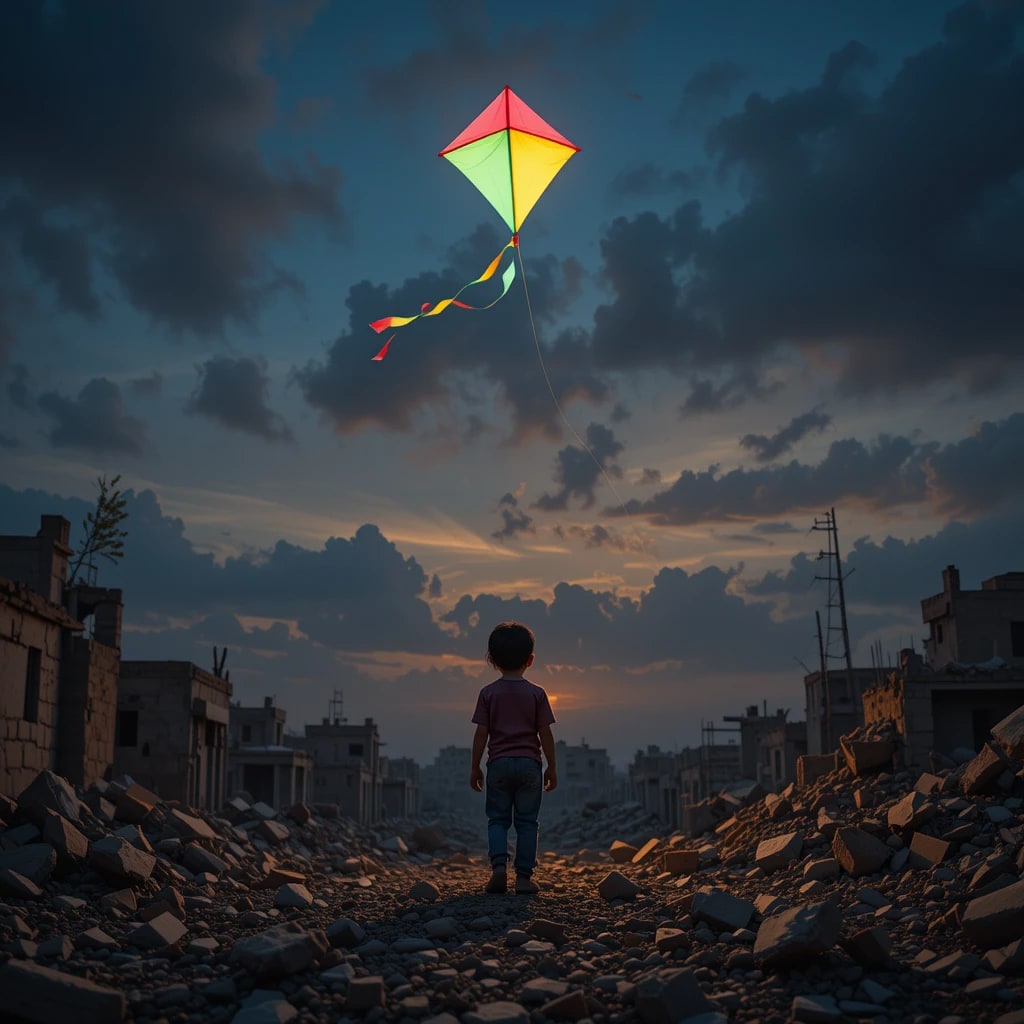
The first sound every child in Gaza learns to recognize is not a lullaby, but the hum of drones. It is a constant in the sky, like a second sun that never sets. To the world outside, Gaza is a headline, a conflict, a political talking point. But to those who live inside its narrow borders, it is home—a home that aches, bleeds, and yet somehow still sings.
I met Amal, a young teacher, in a classroom with shattered windows and peeling paint. The walls bore scars of shelling, but Amal’s voice carried warmth. Her students, bright-eyed despite their surroundings, clutched worn notebooks as if they were treasures. “We write because it reminds us we exist,” she told me, her smile both proud and tired. Each time her students formed letters on a page, they were building something no bomb could erase.
Envy might fill another land—envy of wealth, of status, of luxury. But in Gaza, what exists instead is yearning. Yearning for ordinary things: electricity that lasts the night, borders that open for travel, skies that carry only clouds. These longings shape the daily rhythm of life. Every candle lit during a blackout is not just to fight the dark, but to say, “We are still here.”
The Weight of Memory
In a small home near the sea, an old man named Youssef keeps photographs in a tin box. They are faded, edges curled, the kind of pictures you would expect to see in any grandfather’s collection. Only here, many of the faces in those photographs are gone, swallowed by war. Youssef touches them gently, as if by brushing away the dust he can summon back the laughter, the meals, the songs that once filled his home.
“Memory,” he says softly, “is our most dangerous weapon. Because memory refuses to disappear.”
His words carry a truth I could not forget. Bombs can erase buildings, but they cannot erase the echo of a child’s voice calling “Baba,” or the scent of bread baking in the morning. Memory lingers in Gaza like a stubborn flame, one the winds of violence cannot fully extinguish.
Children of Resilience
On the beach, children fly kites patched together from plastic bags and scraps of cloth. Their laughter rings louder than the waves, a sound so pure it seems almost defiant. To watch them is to witness resilience in its simplest form: the decision to find joy in a place where joy is scarce.
One boy, Khaled, told me his kite was meant to “touch freedom.” When I asked him what freedom meant, he thought for a moment. “It means my mother doesn’t cry at night.” His words cut deeper than any political analysis ever could.
The Hidden Strength of Women
If Gaza has a heartbeat, it is carried by its women. Mothers, sisters, wives—they hold families together with quiet strength. I saw women baking bread in clay ovens, sharing what little they had with neighbors. I saw a widow stitching clothes late into the night, her hands raw, so her children could go to school with dignity.
“Men may fight wars,” one woman told me, “but women survive them.” Her resilience was not loud, but it was unshakable, and it kept hope alive in her household.
Beyond the Walls
From outside, Gaza is often seen only through the lens of suffering. And yes, there is suffering—raw, unrelenting, and unjust. But inside, there is also poetry. There are musicians who strum broken instruments and fill courtyards with song. There are poets who carve beauty out of grief, painting words across the darkness like lanterns.
To live in Gaza is to live with contradictions. It is to mourn and celebrate in the same breath. It is to feel imprisoned and yet profoundly free in spirit. It is to walk on streets cracked with violence while carrying dreams too wide to be contained.
Echoes That Refuse to Fade
What struck me most was not despair but endurance. Gaza’s people refuse to vanish into silence. They write, they teach, they create, they dream. Their voices may be muffled by walls, but they echo far beyond them—echoes of grief, yes, but also of courage.
The world often asks, “When will Gaza heal?” But perhaps the better question is, “When will we learn from Gaza?” For in this strip of land, surrounded by barbed wire and borders, lives a lesson the world needs: that the human spirit, though fragile, is also indestructible.
As I left, I passed a mural painted on a wall still standing amidst ruins. In bold colors, it read: “We were not born to die. We were born to live.”
And in that moment, I understood. Gaza is not just a place of loss. It is a place of insistence—an insistence that life, no matter how battered, is still worth living, and that voices, no matter how silenced, will always find a way to be heard.
About the Creator
Keep reading
More stories from Saqib Ullah and writers in Humans and other communities.
Why Envy Can Be a Teacher, Not an Enemy
Nobody likes to admit they feel envy. It has a bitter reputation, the kind of emotion we hide behind polite smiles and carefully chosen words. We call it ugly, toxic, destructive. We try to push it away like an uninvited guest at a dinner party. Yet, the truth is, envy comes to visit us all, no matter how wise, successful, or content we think we are.
By Saqib Ullah5 months ago in Humans
An Open Letter to the Productivity Guru Industry You Are Making Us All Sick.
This is an open letter to the productivity guru industry. You promise focus clarity and success. You sell morning routines rigid systems and endless metrics. You frame rest as weakness. You frame slowness as failure. You frame worth through output.
By Wilson Igbasi5 days ago in Humans



Comments
There are no comments for this story
Be the first to respond and start the conversation.